Manuel Velázquez is
an intense and intellectually serious painter and sculptor. His baroque language
is infused with minimalist and conceptual elements. This conjunction is clear
in the exhibition Umbra at the
Galería de Arte Contemporáneo of the Unidad de Servicios Bibliotecarios y de
Información (USBI)—the library of the Universidad de Veracruz—in Mexico. Ten
large paintings—measuring 2 x 2 meters each—and sculptures of irregular formats
but similar dimensions inhabit the giant exhibition area with its air duct
pipes exposed like the Pompidou in Paris and Metz.
Velázquez initially delved into figuration but gradually began to favor pictorial, material, and sculptural situations that offered a field of aesthetic and social reflection and that synthesized the predominant instability. One could say that each piece is a two- or three-dimensional excuse to exercise Velásquez’s work, while at the same time arriving at contemporary primitivism, a feature that the artist has been developing since the beginning of his career. The paintings reveal and conceal the gesture of the process and the objects or instruments that loom on their surfaces. They cannot be called gestural paintings but “action encounters” with the various materials used by the author. Here observing is equivalent to guessing. Instead of depictions or definitions, we are presented with glimpses. That which is shown is hidden and shown again. Although historical periods are not forgotten, they are not the central subject of his work.
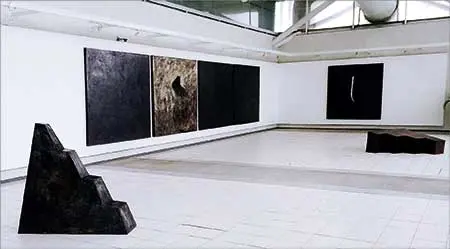
The works on wood are rendered with acrylic paint, graphite, and encaustic and treated with painting processes, sanded and coated with patinas. Some paintings and sculptures display provocative and velvety darkness. In the lighter paintings, the luminosity is used to maintain in its own way the aura of mystery. Both the high option and the low one—-white and greys against blackened tones and burnt reds—destroy any traditional references. Likewise, the mystery deepens in the large format objects, as the gaze travels through the shapes and edges it tries to discover the contents of the air inside. It is debatable whether or not the three-dimensional works are sculptures or objects, in the same way, that one can wonder about prehistoric formations like dolmens and menhirs in France and Scotland.
Velázquez installed in the same room the two- and three-dimensional works. He alternated the vertical and horizontal three-dimensional pieces, thus increasing the instability, from the point of view of the viewer’s perception. The title, Umbra, means both shadow and reflection, a definition that is verifiable in the exhibition: some of the sculptural forms emerge in the paintings; certainly painted presences are constructed volumetrically. This free correspondence indicates that Manuel Velázquez is a complete and complex artist who does not repeat his series. The exhibition space at the USB presents students and scholars with a variety of expressions in the visual arts. It is important that this space permit the interaction between intellectual, sensitive, and exploratory aspects.
GRACIELA KARTOFEL