Experimentation has
been a constant in the work of Marco Lamoyi (Mexico, 1957), both at the
materials and spatial-disciplinary levels. Lamoyi has traveled from
hyper-realism to photography, from abstraction to glass sculpture, from hand
drawing to the use of image-editing programs.
After a somewhat longer than twenty-year career and many local and international exhibitions in galleries and museums, Lamoyi’s art is now on view at the Guijarro de Pablo gallery in Mexico (the gallery has a Miami subsidiary). Guijarro de Pablo has the good vision of exhibiting work both by emerging and well established mid-career artists, and its activity is not limited to presenting exhibitions: the gallery also fosters art projects. At Guijarro de Pablo, Lamoyi presents Treize, a selection of sixteen recent works, which can be grouped into four distinct bodies of work.
The first group of works comprises works with phonetic titles carrying no real meaning, such as Bloop Bloot or Bweek’dZrtood, which leaves them open to personal and subjective interpretation rather than forcing a given concept or narrative. This kind of work is a contraposition of elements and ideas and presents a meticulous, artisanal, aseptic finish. The ground is prepared with chalk, a traditional method that speaks of Lamoyi’s deep recognition of art history and its more classical media. On the other hand, these works also have a geometric and abstract intention, perfectly proportioned lines, blocks of color, all with great harmony and pulchritude. However, they also include another element, a series of plasticities based on oil paint, laid in many cases in up to 15 cm-thick layers. A mixture of colors and elements from the harmonic side but manipulated so that the folds, accumulations, and shapes are worked like sculptures, a three-dimensionality that makes it, however, affirmed clearly as painting by its being on a two-dimensional canvas.
Lamoyi catalogs these works as inscribed in the school of Expansive Painting, where the material that comprises the artwork expands on the canvas itself to create a dimension that prompts new reading and new approaches. Part of the same contraposition is the use of classical materials such as wood, fabric, chalk treatments, and oil, the latter a malleable, slow-drying material which requires the passage of time to achieve the texture and solidity of the final product we see in the exhibitions. Such a loaded layering of oil paint is rather disconcerting when we see an impeccably white background. In these works, Lamoyi is able to push painting’s traditional boundaries, explore an expanded field on the basis of the material, and produce volumetric artworks that need to be observed from different angles in order to recognize all the shapes, all the textures, all the possibilities that matter and light generated in the high relief of the layered pigment.
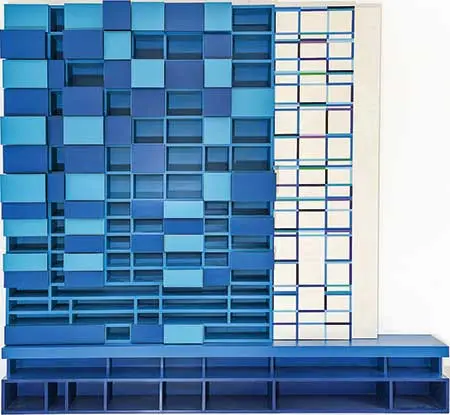
A second group of works also play with space and volume, but have more of an assemblage-like than a sculptural expression. Heavily connected to minimalism, I felt like a box and Labirynthian also come close to applied arts; the artist explains that his intention was to begin with the idea of a chest of drawers, use its functionality, and fuse it to the aesthetic element. The end result is highly dynamic and playful, since the small “drawers” can be rearranged as the viewer pleases and the entire works continues changing. In the second case, the work is doubled as if reflected on a mirror, extending onto the wall. In that sense, Lamoyi is able to push the boundaries of painting and to handle a single concept’s two- and three-dimensional perception at the same time.
A third group of works comprises Lamoyi’s Archival Printings, works painstakingly created using image-creation and editing software, with brushstrokes replaced by pixels and the long process of preparing the canvas, mounting it on wood frames, drying the oil paint equaled by the process of shaping and building, inch by inch and on the basis of vectors, large-format works that will later be digitally printed.
A final line of work is represented here by Dresden, part of a series Lamoyi has been working on since 2009, comprised of abstract drawings of cities in moments of historical conflict.
Treize presents us with the conceptual and technical explorations of a multidisciplinary artist whose main creative tool is curiosity and the need to expand conventional painting.
ISAURA RUIZ