
The refined
conceptual practice of Marie Orensanz is based on the deconstruction of related
structures such as language, botany, physics, and architecture, in order to
develop a solid conceptual corpus around the fragment through minimal and
delicate procedures.
In 1978, Orensanz wrote a manifesto on Fragmentism that was presented during the summer at the Alejandra Von Hartz Gallery, in Miami, as part of the compelling exhibition titled Marie Orensanz: Works from the ‘70s.
Followed by Le Petite Larousse definition of the word fragment as a “small part of a broken thing,” Fragmentism appears in the body of the manifesto—in Spanish, French, and English—defined as follows: “Fragmentism searches for the integration of the part into a whole, transformed by its multiple readings, into an unfinished and unlimited object through time and space.”
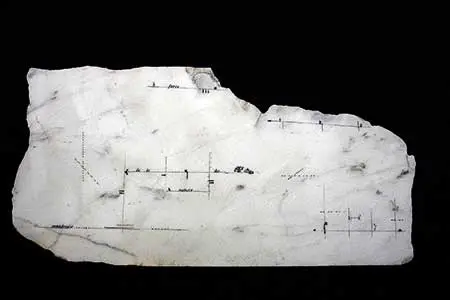
Located on the central wall of the gallery, the piece is used as the backbone of the concise exhibition composed of drawings on paper and Carrara marble fragments that serve as support of highly fragile and delicate graphite drawings.
Marie Orensanz was born in Buenos Aires, Argentina, in 1936. Her professional trajectory as an artist developed on both sides of the Atlantic, between her native country and France, the nation that welcomed her during the bloody years of the dictatorship. An active protagonist of the vibrant and committed creative atmosphere in Argentina during the sixties and seventies, in her works minimalism and conceptualism, coexist in an organic manner.
Marie Orensanz: Works from the ‘70s, consists of drawings on paper and marble, photographs, and video. The fragmentary is not only the unifying element of the show but it also acts as an identitary sign. Amid the continuity that is existence, the here and now becomes just one point, the minimum fragment amid an infinite chain of exchanges and reconnections. It is just in this niche where the incomplete makes sense and the fragmentary then becomes an evocative quality, an extension of self in the other, an infinite possibility.
Rendered in graphite, colored pencils, and pastels, the delicate drawings are more reminiscent of technical drawings or botanical records than of artistic works. Seconded by the careful cursive calligraphy, the physical, scientific or mechanical codes answer to a vital ontological necessity. Poetically-charged titles like Transmitir la Energía del Pensamiento (To Transmit the Energy of Thought), La Acción es la Consecuencia del Pensamiento (Action is the Result of Thought), and Pensar es un Acto Revolucionario (Thinking is a Revolutionary Act), support the brief text and detailed drawings that coexist in a careful composition in which balance and spatiality become an active part of the meaning of Orensanz’s work.
During her multiple travels to Carrara, Italy, the artist collected fragments of broken marble scattered on the floor. These would eventually become the enabling support for sculptural drawings in which the original hardness of marble is transformed into fragility. Then, Orensanz leaves on the surface small graphite notes and pastel—diagrams, algorithms, hidden signals—that are integrated into the veining of the material.
For Maria Orensanz the notion of the unfinished, the incomplete—and therefore the fragmentary—has been a constant throughout her artistic trajectory. Hence, her proposals are not closed systems that give clear answers but, quite the opposite; they are dominated by polysemy and suggestion.
Eros, 1974/2007/2008, is an announcement that lists three exhibitions that occurred in different cities and different years. Composed of twelve statements that match the titles of the works, the publication was originally conceived as participatory art. Viewers begin their participation by reading the printed material where each of the incomplete sentences has the potential to encourage discussion and therefore change.
To Orensanz fragmentism should be approached as a strategy, an incentive that arouses interest through the evocation, as it incites viewers to reflect, given that thinking, as Orensanz well says, means freedom.
JANET BATET