Following its recent
opening, Beatriz Gil Galería presents its second project titled Milton Becerra. Heads and Tails. The new
exhibition spaces house forty-one works from the late eighties to the first
decade of the third millennium. A sixty-four-page catalog with color illustrations
and a central text by Maria Elena Ramos that explores in-depth Becerra’s
proposals throughout his long career complements the exhibition. The entire
body of work by Milton Becerra combines several factors on which the “one and
many” are revealed as the thread of discourse full of meanings. The author
conceives his proposal from a conglomeration of elements that multiply in
reiterative sequences that juxtapose, coalesce and organize—or
disorganize—either symmetrically or asymmetrically, organically or
constructively, in two-dimensional and three-dimensional formats.
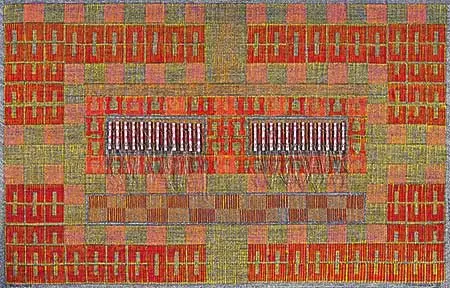
From the beginning of his career in the seventies, his interventions in the rural landscape show an increasing interest in the ecological realm as the natural environment of mankind. Based on impressions that he paints on rocks, logs tied to trees, and other installations executed in situ, Becerra triggers a process linked to the primitive actions of human beings as cultural entities that leave traces, trails, and marks that speak of their existence and their pass-through eras and places. These traces of time, sediments of memory, and vestiges of cults or past evocations are actions that involve a return to an origin associated with mother earth and to the same territorial attachment of aboriginal peoples. In this manner, Becerra develops a theme that encompasses aspects of ancestral roots that lead him to develop a sort of “weave” achieved through the application of techniques—intertwining and recycling objects—and the conceptualization of the material and allegories expressed through signs, identities, and belongings, both from the distant past and the immediate present. He relies on memories, hints, and allusions to recreate a comprehensive vision that includes primordial forms of a cosmogenic nature.
Since the eighties, Becerra uses extracts like flax and stones. He gradually incorporates, multiplies, and brings together diversified components—like wood, textiles, minerals, metals, quartz, feathers, and metal coins and paper —that enrich his visual vocabulary. His works contain a universe of fragments, of scattered links that simultaneously refer to ancient and contemporary civilizations. According to Becerra “we cannot have memory unless we find the legacy that our ancestors left us...” Thus, he researches the Olmecs, Mayas, Aztecs, Ye’kuana, and Yanomamis and studies their clothing, utilitarian pieces, ritual objects, and sacred geometries. This is suggested in Arma tribal IV (Tribal Weapon IV, 1989-1990) and also in the Portables that are reminiscent of majestic and highly beautiful cloaks or pectoral Warriors. An example of this is the work Portable un Colón (Portable One Colon, 1995-1996), made of cotton fibers and Costa Rican coins. The Raspadores de monedas (Coin Shredder, 2004) consists of segments of wood, abstract designs and encrusted coins refer to boars for shredding tubers used by the indigenous peoples. Some of the shredders have been provided by the Piaroas and Curripaco tribes.
In the compositions De la serie Héroes patrios: Sucre y Páez, (From the National Heroes Series: Sucre and Páez, 1998), $ 1 II (2005) and 1$ (2006), the author distributes bills and coins with fiber moorings and combinations of lines, circles, triangles, squares and rectangles that he alternates with a dynamic chromaticism in which matter and space, planes and volumes, establish a dense and eloquent story. Another group of works focuses on pro-independence figures, like in the intervened book Bolivar (1998), as well as in the intervened bills that Becerra baptizes with the name of Doble Identidad (Double Identity, 2010). “Like in the work by avant-garde artists,” explains Maria Elena Ramos, curator of the exhibition, “in Becerra’s language the objectual is charged with symbolism, and the materiality—money—also in them carries within an immaterial component. In addition to the visual and tactile values of the materials, the essential matter of values and value types were also gradually integrated. But in Becerra’s contemporary works, the current (including the current powers of the economy) submerge his roots in the ancient drives and atavistic impulses and desires of humanity: having and accumulating power, achieving, overcoming, being capable, possessing, and controlling. In order to mobilize these forces (or to renew them here, through art) fetish, ritual and myth play a role....”
Milton Becerra. Heads and Tails will remain open from September 26 until mid-November of this year. It is a timely opportunity to admire the works of this Venezuelan artist represented in Spain, Germany, France, Costa Rica, Brazil, and Venezuela, among other countries.
GLADYS YUNES