
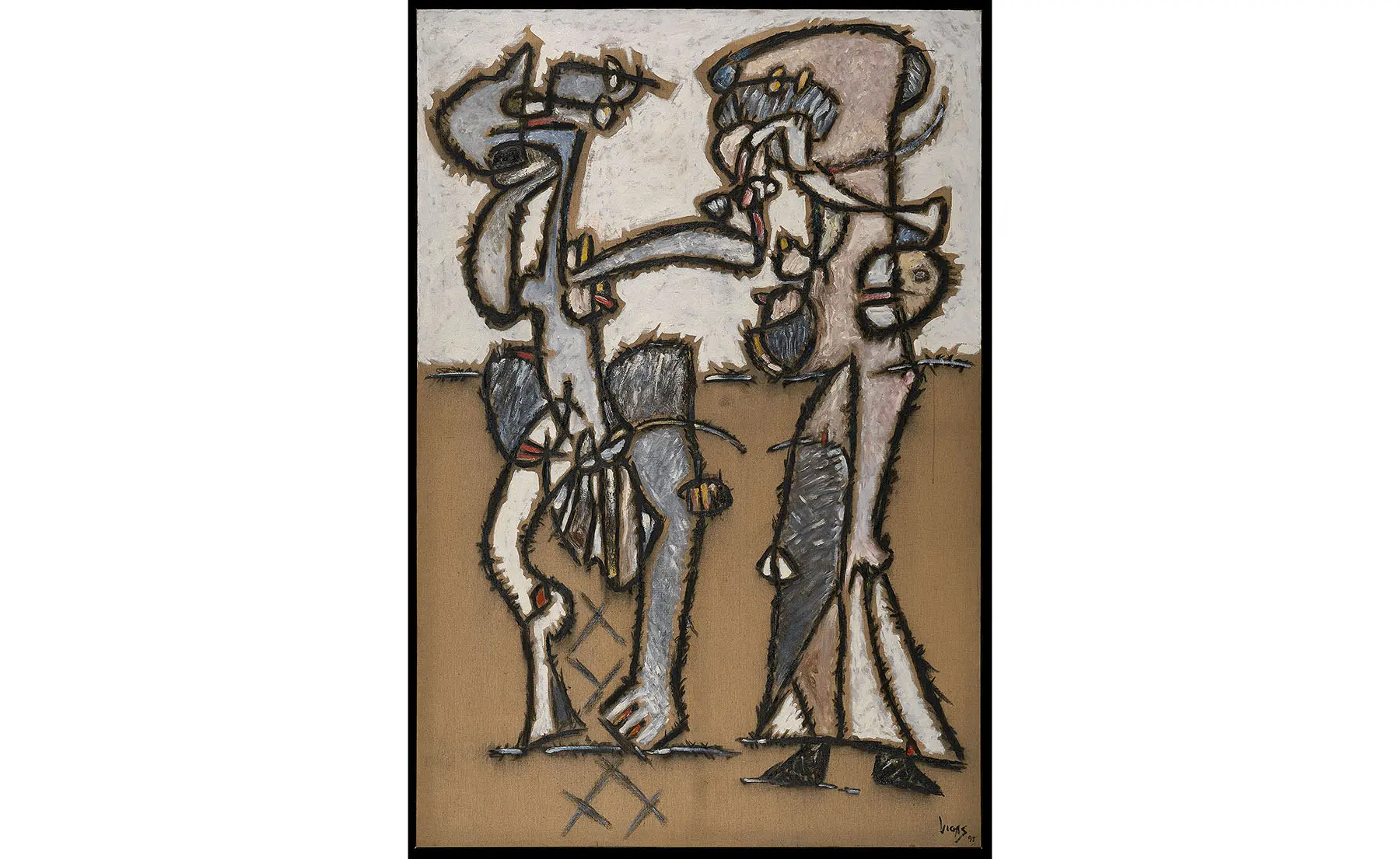
Oswaldo Vigas (Venezuela, 1926-2014) belongs to the generation of artists whose proposals gave Latin American art, during the second half of the Twentieth Century, a distinctive identity. After his recent death, the Foundation named after him has organized a traveling exhibition titled Oswaldo Vigas. Antológica 1943-2013, which opened on October 9 at the Museo de Arte Contemporáneo (MAC) in Lima, where it will remain through December 7. After Lima, the show will visit the capitals of several countries, among them Chile, Colombia, Argentina, Brazil (São Paulo and Rio de Janeiro), Panama, Mexico, and a number of cities in the United States.
Featuring 70 paintings and 6 sculptures, the show presents a panoramic view encompassing the different periods of his work, from his schematics of the 1940s through his deconstruction of the figure during the last decades of his life. The curatorship, by Bélgica Rodríguez, offers an illuminating analysis of Vigas’ formal and aesthetic contributions over a prolific career. The prologue, written by Fernando de Szyszlo as a posthumous tribute, is a valuable testimonial of the close friendship between the two painters.
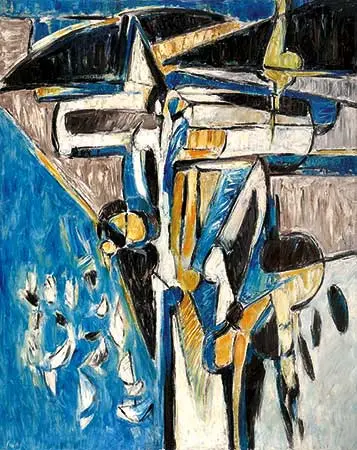
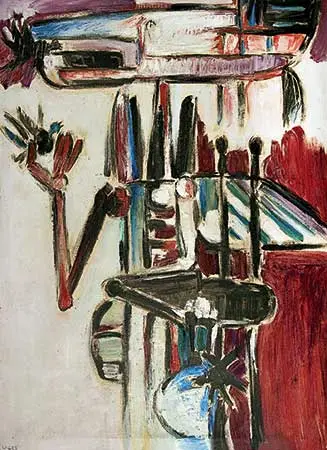
The selection of works brings together examples that, seen globally, reveal the essential stages of his development as a visual artist. “Throughout his career,” Rodríguez points out, “Oswaldo Vigas has sustained the representational independence of deformed images, internally decentered and presented in fragments that are reconstituted thanks to certain invisible ‘inscriptions’ and formal ‘signals’ suggested to render the figurative comprehensible…” From this standpoint, it is possible to appreciate the shifts undergone by Vigas’ work, from his earliest compositions dated 1943, such as Telegramista II and Ciudadano elector, where the figure is subjected to a process of continuous stylizations. In the 1950s, Vigas’ interest in indigenous art drove him to explore the defining features of ancestral cultures, and there emerged the theme of his Brujas, developed with dedication and depth. Bruja infante, 1951, is an example of this Latin-Americanist series that, over time, became the dominant matrix of his oeuvre thanks to a treatment that synthesized the binomial “form-figure” and orientates his conceptual and stylistic concerns. Around those years, the abstract-geometric concept also finds space in Vigas’ language through an expression that, for its use of colors and organic character, comes close to the constructions of the sensible geometry that characterizes a portion of the abstract-geometric manifestations in the region, as can be noted in Personajes I (Estudio para mural de la UCV), 1953-1954. With the advent of informalism in the 1960s, a movement around which many artists of the period rallied, Vigas’ vigorous and decisive brushstrokes do not see their strength diminished by the gestural freedom proposed by that style, as we see in Personagreste II, 1961, and Bestiario, 1963. The telluric connotation resulting from these experiences is reinforced by the resizing of the figure, predominantly female, that is the central object of Vigas’ proposal, as can be observed in the creations where the artist systematically disarticulates it and reformulates as the substance and content of his painting. An example of that is Floreciente, 1967, as well as other geometric and expressionist compositions of the 1970s and 1980s, such as Comedora de pájaros, 1976, Ancestro rojo guerrero, 1977, and Agorero, 1986. Vigas delves at greater depth into the theme that has occupied his career: the “female figure-form” that—according to Rodríguez—is an “image transformed into an icon subjected to aesthetic considerations for its ambiguous beauty…”
In the 1990s and 2000s, the creation of segmented, disarticulated, and restructured characters generate a corporeal succession that appears to trigger atavistic and primordial forces that hark back to archaic expressions of graphic communication: Comadres de Ipacarai, 1995, Presencia animal, 1999, Tres figuras, 2007, and Crucifixión, 2013 signal the logical outcome of these explorations based on intuition, discursiveness, and the pictorial element.
In Vigas’ production in sculpture, a discipline he first engaged in the mid-1980s, gives continuity to those initial searches; in some cases, Vigas’ compositions acquire totemic features, as is the case with Gran divinidad lunar, 1995 (240 x 122 x 100 cm). An imposing bronze work whose asymmetrical monumentality irradiates directional volumes with multiple meanings due to its jumbled and disjointed structure, its modulations of filled and empty spaces, and the visual and tactile games that Vigas was able to play with hard metal. Matadora, 1997 and Guardián, 1994 are works that reveal the peculiarities Vigas imprinted on his three-dimensional work.
Oswaldo Vigas. Antológica 1943-2013 is, undoubtedly, a unique opportunity to encounter and contemplate the works that made such a renowned and recognized artist, with awards such as the Premio Nacional de Artes Plásticas in Venezuela, 1952; the S.A.S. Prince Rainier III Contemporary Art Grand Prix in Monaco, 1993; the Médaille Vermeil de la Ville de Paris, 1993; his naming as Commandeur de l’Ordre des Arts et des Lettres in France, 2008; and and his Membresía de Mérito de la Fundación Carlos III in Spain, 2012, among others.
GLADYS YUNES