
Developing
interrelations between economy, society, and the arts and examining the idea of
art as a socio-economic element is the central proposal of Paulo Climachauska.
Once again, the artist shows this approach in his Naturaleza Económica (Economic Nature) series recently presented in
a homonymous exhibition at LURIXS: Arte Contemporânea, in Rio de Janeiro.
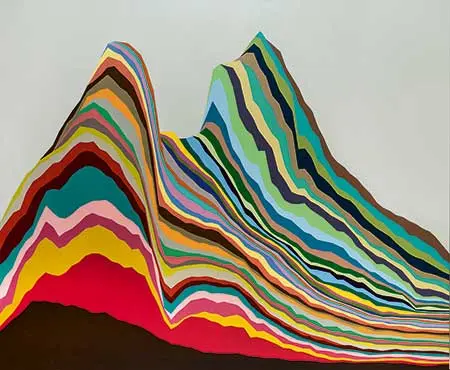
Consisting of 10 works, the exhibition presents paintings in acrylic with abstract images in geometric patterns that are reminiscent of mathematical graphs. The series, as its paradoxical title reveals, points to a play between beauty and reality designed to confuse viewers. The titles of works like Duna, Archipiélago y Cascada (Dune, Archipelago, and Cascade), lead to the following question: are they economic graphs or figurative representations, or both?
Behind his apparent aesthetic operations, Climachauska proposes a strong critique of the capitalist system. As the economic model favors the notion of addition and accumulation—which is also reflected in the art world—the artist emphasizes subtraction processes through an art that is both constructive and thorough and invites viewers to complete detailed graphic schemes with their own gaze in operations of optical illusion.
Climachauska was born in São Paulo in 1962 and graduated in History and Archaeology at the University of São Paulo. He participated in several biennials, solo and group exhibitions at the national and international levels. Opting for the study of social sciences was a well-meditated choice. As a young and gifted drawer, he found that the generalizing and technical nature of academic education in the visual arts did not provide much philosophically speaking. He needed something deeper and more conceptual that could nourish his artistic projects; thus his choice for the social sciences. They exposed him to great thinkers like Ulpian Toledo Bezerra de Meneses and Walter Zanini.
Climachauska made the systematic action of mathematic operations the leitmotif of his work. By using mainly subtraction, he began to compose with the number of sequences lines that outlined detailed drawings.
Among his figurative proposals are geometrized indoor environments and architectural facades. In the series titled Forest-All (2007-2008) images of plants in rigorously constructed interior environments emerge to reveal the paradox between organicity and geometry. In the series Catedral (Cathedral, 2011), Indian ink compositions transform the interior spaces of the supposed churches into geometrized constructions, game cubes, and architectural skeletons.
Subtractions paintings became emblematic in Climachauska’s career. He used that resource to portray landmark modern buildings that he transformed into fill-the-dots games to be completed by the imagination of the viewer whose gaze organizes the sequences. When they become monumental scale works, on panels or through direct interventions on the walls that interact with the real and the surrounding architecture, the compositions become even more present forces that propose a phenomenological relationship of enjoyment and perception.
Recently, the artist worked around the idea of randomness, based on the observation of the movements in the children’s game “pick-up sticks.” This research resulted in drawings, paintings, and the installation Modelo para Armar (Model Kit, 2011), in which the pieces were large scale. The sticks, made of aluminum and industrial colors, gather and disperse, falling on the floor and composing random organizations. Another reference to the world of children was the use of the playground structure known as the jungle Gym, most recently in an installation that consisted of ten white structures scattered across the garden of the Fundação Eva Klabin. The aim was to highlight the constructive quality of art with a unique geometric twist.
Climachauska also worked with predominantly figurative images, like in the series Vende-Se (2009), which consists of paintings inspired by famous photographs of street vendors in Rio de Janeiro in the 19th century, taken by Marc Ferrez (1843-1923). The first time that he worked with human figures was in the mid-2000s when he created drawing versions of paintings by French painter Jean Baptiste Debret (1768-1848)—who was part of the French Artistic Mission in Brazil—by relying on the subtraction technique. In both series, Climachauska makes a significant critique of the social inequality in Brazil.
This is the paradox that gives meaning to his work: the more that the artist subtracts, the more that he constructs the work. His is a constructive and rigorous art based on measurement and scale; it is both physical and phenomenological, minimalist and political. Not surprisingly, the world of children served him as nourishment for several works. Now in Naturaleza Económica, the artist once again turns ambiguity into the subject of his work, showing that simple graphs can be transformed into mountains or ocean waves. Many of his paintings—whose drawings are created through subtractions—result in ludic creations to the extent that surprise is part of their nature. The images—which seem computer generated because of the precision of the figures’ contours—reveal, when observed closely, their artisanal nature; with thousands of small numbers (the artist even relies on a team to help him). As art critic Aracy Amaral once said, there is something ritualistic about Climachauska’s work. Behind all his planning and attention to detail, Paulo Climachauska erases the borders between art and life, weaving a subtle invasion of languages between each sphere.
ALESSANDRA SIMÕES