
Giving form to words
has been the main characteristic of the work by the artist from Rio de Janeiro,
Rosana Ricalde, since the beginning of her career after graduating from the
Escuela de Bellas Artes (EBA/RJ) in 1994. In her most recent solo exhibition titled Lapizlazuli at the Sergio Gonçalves
Galeria in Rio de Janeiro, Ricalde demonstrated once again her drive to create unprecedented
works, including paintings, drawings, and objects. The pieces are the result of
an exploration of eastern culture, especially the classics of Persian
literature like The Arabian Nights, The Garden of Roses, and Layla and Majnun.
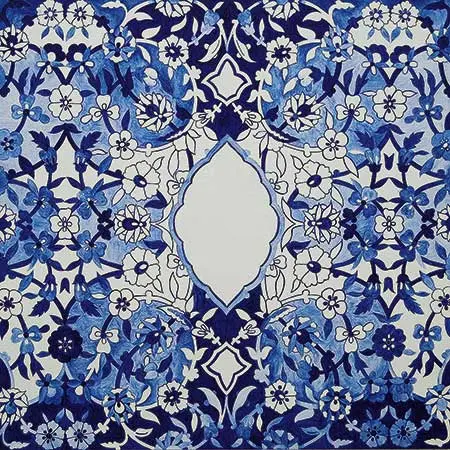
The paintings were based on drawings of blinds (wooden screens placed on windows to allow women to see the street without being seen) and patterns of Persian rugs with their various symbolic elements. Ricalde also presented drawings based on Mehndis (temporary tattoos made from a dye extracted from Henna) designs. Without explicitly using the texts in the works, she shows a clear aspect of her work when she uses text as inspiration and not directly in the works.
However, she uses text as the raw material in many of her works, like in Alfabeto de los Verbos (Alphabet of Verbs, 2002), in which she typed 14,000 verbs in Portuguese on tags and pasted them on 42 panels; or also in 2011 when she projected an installation on a current world map. There, the continents were constructed with pages from Italo Calvino’s book Invisible Cities to recreate several cities from around the world.
Many of Ricalde’s works are like concrete poetry—a common language among the vanguards of the twentieth century—in that the written text is reorganized into a format that is in itself an image, creating a sort of pictogram and representing a symbol, a real object or figure that serves as a key image of the work. The artist depicted images of oceans, where language and drawing are combined forming a whole that is a poem. The wave-shaped lowercase letters list—organically and poetically—the names of the oceans around the world.
Regarding the use of words, this is an aspect punctuated at various times throughout the entire course of the history of art. It is a “symbolic characteristic of the word,” as researcher Simon Morley affirmed in the book Writing on the Wall: Word and Image in Modern Art. This symbolism appeared as far back as the Renaissance, in the posters of Henri de Toulouse-Lautrec, during the avant-garde (cubist collages, paintings by René Magritte and Fernand Léger), in the art of the post-war—like in the 1959 work Trophy I by Robert Rauschenberg, or the 1970 conceptual piece Earth to Earth Ashes to Ashes Dust to Dust by Lawrence Weiner, among others. By saying that we read images in the same manner that we read words, Morley suggests that this operation is an offensive against all forms of fundamentalist thinking, since the relationship between image and word promotes ambiguity and indeterminacy against codes, causing a semiotic whirlwind that upsets the placid surface of language.
Ricalde also makes use of poetic cartographies. Marítimo (Maritime, 2008), Globo (Balloon, 2005), Viajes de Marco Polo (Travels of Marco Polo, 2009), Mar del Japón (Sea of Japan, 2009), Mar del Mundo (Sea of the World, 2005), Mareas (Tides, 2008) are works in which you can observe a rather expressive geographic field, where physical worlds are formed through words (besides the Bible and the dictionaries, the atlas was also a bibliographic resource that always fascinated Ricalde). Ciudades y Memoria (Cities and Memory, 2006), reminiscences of the city gain volume in the name of its streets and inhabitants. In contrast to politicized maps, a common resource in contemporary art, Ricalde creates a cartographic of affections.
It is perhaps a result of her interest in cartographies that Ricalde also chose to create urban interventions, although in a more explicitly-politicized manner. The Jabón Rio (Soap Rio) installation—created in collaboration with Felipe Barbosa and Andrea Di Bernardi—held in the Santa Teresa (RJ), consisted of a wall made with “Rio” brand soap bars that eventually dissolved with the rain and washed the streets. In this work, the letter is also present on the soap bars as an advertising sign charged with semiotic connotations.
Several books, such as Michel Foucault’s The Order of Things, and The Search for the Perfect Language by Umberto Eco, have inspired Ricalde’s work since the beginning of her career. Her proposals have always been about giving visibility to the text and allowing it to eventually lead to the image. She once said that writing leads her to the image almost like a mantra. In the exhibition Lapizlazuli, drawing inspiration from Persian literature led her once again to a world of peculiar forms. The extremely delicate drawings make the images reminiscent of the unique and characteristic outline of Arabic calligraphy. Softly shaped Arabesques lie in a universe in which beauty may be the most plausible result of the confluence of image and word.
ALESSANDRA SIMÕES