Through several
disciplines such as anthropology, urbanism, and politics, Sandra Calvo (Mexico,
1977) is an artist who deals with themes associated with the public space and
makes critical analyses on informality, labor organization, acts of resistance, and temporality. She primarily relies on video, installation, photography, and
writing to perform spatial and conceptual reflections on the themes that are
recurrent in her work.
Her most recent work, Arquitectura sin Arquitectos (Architecture without Architects), exhibited in the South Gallery of the Museo Universitario del Chopo, is an installation that documents through space and video the stages of construction of housing in irregular settlements and areas that surround large Latin American cities, where the inhabitants take on the role of architects and build their dwellings according to their needs. In this particular case, this installation is a full-scale reproduction of the house that the artist chose in order to investigate the construction process in an area known as Ciudad Bolivar in Bogota, Colombia, during a residency in South America.
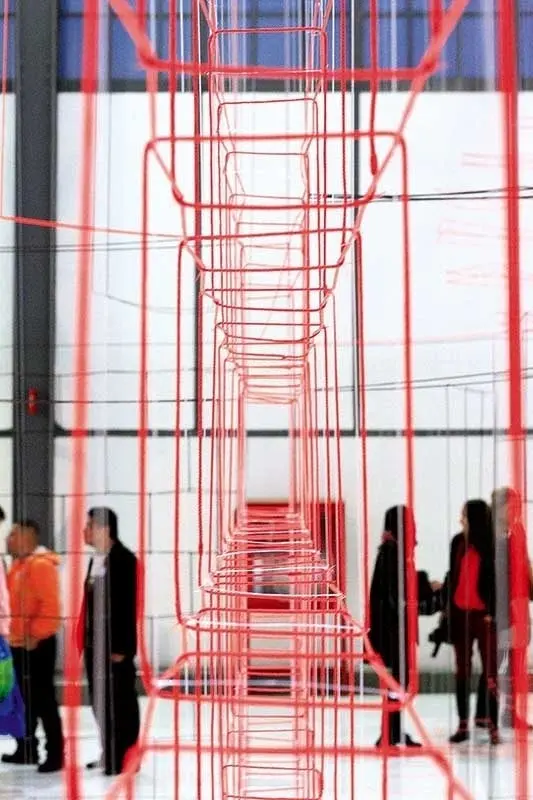
Through a web of threads, Calvo presents environments and elements of the rooms that are part of the house, as she transits between the real space, the space yet to be constructed, and the space in conflict.
She established a collaborative exercise with the participation of the family that owned the home for the life-size projection of the expansion of the house. This exercise suggests the location and recreates a space that can be accessible.
In these types of irregular settlements, there is no planning in the development or in the remodeling. The homes are built and inhabited while they are being projected or expanded.
The piece looks like a dynamic, highly simple, and flexible sculpture, but it also conveys a complexity achieved through the intersecting threads, a symbolic and spatial pattern that aims at recreating an already existing space and another one that has yet to materialize. The black thread describes the construction already built while the red thread symbolizes the imaginary space that is often a source of disagreement among the inhabitants of the house.
The work was complemented by a video with conversations with the inhabitants of the house that ran until October 31.
The project Arquitectura sin Arquitectos was developed between 2012 and 2014. It was based on the homonymous book by Bernard Rudofsky written in 1964, in which the US architect writes about vernacular architecture and its intrinsic aesthetic and functional values.
In Latin American countries, especially in the suburbs, as well as in marginal and rural areas, this conception of vernacular architecture still makes sense and remains in force in everyday family self-constructions.
In Sandra Calvo’s work, it is evident that public spaces are under continuous construction and molded according to the needs, circumstances, geography, politics, and economics, according to the social dynamics that, although often problematic, nevertheless do achieve functionality.
ISAURA RUIZ