
Víctor Maldonado’s
work is a paradox of assimilation and identity, power and repose, normalcy and
absurdity. In the exhibition Lucha, featuring
photographs, monoprints, and a video, Maldonado dons the mass-produced masks of
the most famous Mexican lucha libre wrestlers,
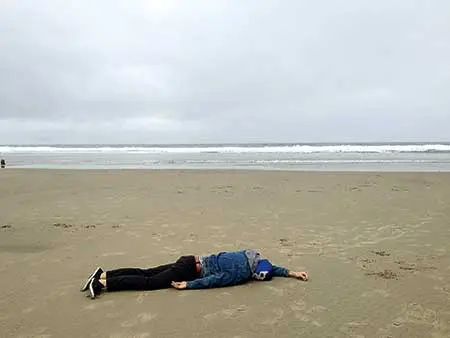
yet he portrays himself in passive, relaxed positions at home in Oregon, often
stretched out on the ground, down for the count.
Born in Changuitiro, Michoacán, Mexico, Maldonado recently became a US citizen after living in the United States for 38 years. This experience caused him to confront and embrace latent fears and to contemplate what is freedom. His latest series of interdisciplinary, conceptually driven work involves a stereotypical icon of Mexican popular culture, play and humor, and sublime nature. In the past, Maldonado touched everything he made. For the first time, the artist is giving up control of his work and relying on trust and chance.
Lucha, the exhibition, started as a social media project. Maldonado asked the question: What if I put on the mask of El Santo (1917-1984) or El Demonio Azul (1922-2000) and I become Macho Libre or Mad Mex, two alter egos? He did exactly that at dozens of places in Oregon including the coast, the mountains, at home in Portland, and at his favorite family restaurant. Then Maldonado asked family, friends, or a bystander to take a picture, which he posted on social media platforms. Lucha features digital pigment prints of various images from this social media project.
This is the first exhibition Maldonado has titled in Spanish, and lucha, has as many meanings as the shades of green in a Northwest forest. What is remarkable is how the artist probes the boundaries of assimilation and identity by wearing a Mexican wrestling mask in Portland, Oregon, a city that seems to be inclusive, but is also plagued by racism. There is no struggle between Maldonado and his alter egos, nor do there seem to be any uneasy feelings on the part of Maldonado’s children who appear in two photographs. There is a comfortable acceptance of these simple, humorous and poignant scenes like the happy ending of the story he reads to his daughters in the photograph Frog and Toad. While lucha libre masks are symbols of strength and empowerment in Mexican and Chicano culture, Macho Libre and Mad Mex are superheroes because they expose themselves--to nature, to intimate domestic moments, and to the viewer. Maldonado is putting himself in his work in a more vulnerable way, and this makes him feel alive.
As the son of migrant farmworkers, the artist subtly suggests borders in his work by placing himself in transitionary spaces in nature. In Washed Up, he is lying down on the sand like a log that has rolled ashore with the tide. In Beaver and Gorge, his back is to the viewer and he is on the threshold of a vast woodland. The silver El Santo mask he wears in Gorge is like the shimmering scales of steelhead trout that inhabit the majestic landscape in the distance and migrate from rivers and streams to the ocean.
The wrestler’s mask is also a thin membrane that probes liminal spaces and the experience of inner and outer worlds. It is an object Maldonado uses to flatten, distort, and expand space. His various depictions of the wrestler mask when he is not wearing it heightens the ambiguous and abstract nature of negotiating identities. Mask, an 11 by 8.5-inch photograph, is a dark, sepia-toned, image. The sewn outlines of the openings for eyes, nose, and mouth are barely discernible in a black abyss, and this mystery draws the viewer closer to the haunting visage. In Maldonado’s Maskcam series, the artist places a camera in a lucha libre mask and records the inside of the mask and oblique views of the outside world at various stops during a walk through downtown Portland. These images give the viewer a slight claustrophobic sensation and their four apertures filled with color, line, form, and light suggests abstract painting or collage.
Lucha touches on such contemporary issues as the intersection of social media and identity, and surveillance. In Maldonado’s video Luchadrone, a cameraman and his camera, mounted on a remote drone, stalk Mad Mex, a zombie flaneur, who moves through the rich variety of Portland’s city landscape at dawn. Mad Mex walks in a straight line through downtown park blocks, effortlessly traversing over, under, and through whatever is in his path. From time to time, Mad Mex falls to the ground and lays on grass or asphalt like an offering to the Northwest environment that has shaped him.
In lucha libre matches, sometimes wrestlers bet their disguises, and the loser must reveal his true identity. My bet is that Maldonado will defend his mask for a long time and maintain his status in the ring, expanding the complexities and approaches to self-representation, self-articulation, and self-definition.
CHERYL HARTUP