
Vida Yovanovich is
known for creating compelling and poetic photo essays centered on subjects and
spaces that her gaze accompanies for extended periods of time to successfully
capture a substantial sensitivity and empathy, whether she focused on social
realities or intimate situations; situations that she approaches with a clear
gaze fueled by a deep sensitivity.
Her photo essays are always radical. They are on the threshold of “something” that is not obvious but that makes palpable the imminent present and future of subjects/contexts portrayed in quiet places inhabited by death, disaster, neglect, and loneliness—among other conditions and consequences of the destiny given to the depicted existence.
Whether she uses analog or digital media, Yovanovich’s white and black photographs have always been technically flawless. But obviously, it is not her neatness or technical perfection that has placed her among the best contemporary photographers in Mexico, but rather the consolidation of a tremendously powerful visual aesthetic in her visual compositions.
Analyzing the evolution of her work, it can be said that that strength and dignity in the face of devastation, always present in her pictures, is the result of supportive and silent respect for the themes/subjects that she focuses on; as she distills the negotiations—conscious or unconscious—that is based on memory, history, witnesses, absences, pain, and hopelessness.
Scream the Silence, her most recent solo exhibition at the Laboratorio Arte Alameda, is a project born and nourished for three months in Austria and then developed for four years. These are works that stalk the atrocity of one of the historic genocides that destroyed the existence and sense of the humanity of mankind: the Holocaust. Yovanovich confronts it through her own insistent presence in one of the deadliest camps in WWII: Mauthausen.
This is the first time that Yovanovich presents a project in which she exclusively relies on video-sound installations. Leaving behind the stillness of analog photography—the narrative vehicle she had been using until now—the aesthetic/ethical inquiries in this exhibition masterfully make use of the temporality of video; durations of shared events filled with death that confront us like a silent scream.
Through the unflinching dialogue between the eight works presented, Yovanovich successfully confronts us with visual temporalities whose cadences impress upon viewers' densities of unspeakable things. Among the (in)visible horror that surrounds and inhabits Mauthausen, the artist seeks traces, answers, ‘something’ that may still exist among the emptiness that emanates from the memory of the site.
Paul Celan said that there was nothing left to write after that brutal effort to extinguish the other. How is it then possible to narrate the events to make such atrocities present?
I find that the only possible answer to put in words can be found in Jacques Derrida’s statement (even if it did not refer to the subject at hand) that a narrative (récit) implies not merely to recall the past, but also to know that the recovery of past events involves a promise and a commitment to the future. Scream the Silence reiterates this sense of the (in)expressible as she also rescues that promise and awakens that commitment by responding—as it can only be done when facing that which belongs to the abyss of the unspeakable—with the intelligent use of the experience-in-time that video allows.
Yovanovich gives form and place to stories previously buried in a land that walks on corpses by creating videos—almost dead because of their immobility—that resist the passing of time in contained-duration in Memoria que se borra (Memory that is Erased); or the 65 small trees planted and tended by the artist during four years in Grita el silencio (Scream the Silence) awaiting in a side chapel as if to remind us of the strength of life; very much like listening to the testimonies in as many languages as those spoken in the camp. They are whispers that emanate from the darkness of an interior cloister by a curved fabric wall under the panoptic projection of one of the surveillance points of the camp (Control Tower).
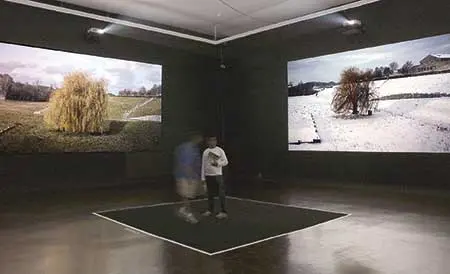
Noteworthy among the visual-sound events of the exhibition is the compelling video installation titled Salix Babilónica (Babylonian Salix).
Four takes in a loop of a lonely willow are projected on the entire surface of four walls. They are static films of the same tree but each in a different season of the year. They are captivating even as one knows the context and heritage contained in the image, the tree, the place and its history. In a hypnotic manner, this four-times-tree pulls viewers into the center of the exhibition space. We cohabit in the overwhelming silence that Yovanovich experienced hundreds of times as she tried to penetrate the material memory of Mauthausen. We are witnesses to a stagnant temporality, shameful, yes, but still alive. The willow survives with integrity and determination.
After an unquantifiable period of time immersed in the evidence of time and the rebirth of branches, we notice under our feet the outline of a square indicating the dimensions of one of the gas chambers that exterminated at least 200,000 lives. Suddenly, something moves in one of the projections of the tree: a bird leaves the tree and flies away with a speed that makes it almost invisible. There is life in Mauthausen, despite Mauthausen.
MARCELA QUIROZ