Information is
malleable. It can be printed in newspapers or broadcast via television, or it
can be the raw material for works of art. A datum finds its tone when it is
inserted in discourse and intertwines with other data to generate meaning,
which often presents itself as objective. In the majority of cases, what we
have is a message directed by intent that, conscious or otherwise, binds its
possibilities, giving news and events no other reason for being than their
reduction to a moment of enunciation. Thus the way in which the dismayed
expression of newscasters become almost immediately a smile as they go to
lighter items; they forget.
Wilson Díaz engages information in a different tone than that of a news report, transcending “late-breaking news” but retaining “the site of the events”: he consolidates territoriality, sustaining (collective) memory and refusing to create a polarity between the good and the bad. Díaz reiterates his own presence as a direct witness that does not escape a historical moment, trapped like the rest of the country in a territory deemed “post-conflict” and an extensive zone of distension.
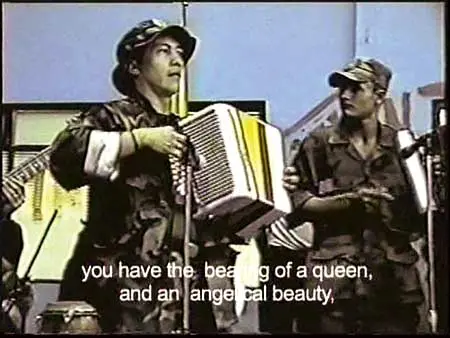
La flor caduca de la hermosura y de su Gloria (y su raíz) harks back to the artist’s experience in San Vicente del Caguán; specifically, it is an exhibition that unfolds and loops back, spiral-like, around a video titled Los rebeldes del Sur, “a video recorder in the zone of distension, where we see guerrillas playing Vallenato music, in a kind of armed choreography…” (Semana magazine, 2007), which by the way was censored at Displaced: Contemporary Art from Colombia, an exhibition held in the UK in 2007. Without exploring that debate, which has been already glossed at length, it is worth noting the handling of information that allows Díaz to keep an archive afloat, transforming it into memory as he returns to it time and again.
These paintings, drawings, and recordings make reference to a nonexistent center because all the information is liquefied, the data is centrifuged from different angles to form a new enunciation, one that is devoid of the undertones of a sociological investigation, one that has no thesis, but works of art. The documentary and referential nature of these works bear witness to the persistence of essential problems over time, expressed in historical archives from a variety of contexts, ranging from record-industry productions, through public-policy plans and documents, to an exhaustive follow-up of characters like Guillermo Torres, who changed his identity to Dr. Julián Conrado when he began to write songs for the guerrillas. Wilson Díaz moves from one datum to another and uses them as excuses for unstoppable artistic energy, the fundamental value for an understanding of his work beyond its themes and the meanings he builds with what he does.
Amarillismo, a compilation of recordings produced by mass-media companies, and the Julián Conrado series, connect popular music with ideological circulation, bringing to the fore everything that moved through the corner of our eyes in the 1980s and 90s. The radical relationship of one thing with the other demonstrates that the connection is not entirely misbegotten. The recordings and their covers imply political positions, states of the collective unconscious that are only made evident when the information or the cultural object are displayed as art or under a critical gaze, freed from the inertia or the everyday. Corporations, media, banks, and the (instituted) guerrilla circulated their own musical productions. Politics and everyday life had a soundtrack, which, with its vallenatos, cumbias, and boleros, hid the sound of bullets flying in the background; all this implied a power struggle, a struggle for people’s ears.
The music that “enters us” through the ears, our hearing being a sense that doesn’t blink, is also part of an institutional program, the sometimes camouflaged propaganda of a specific paradigm. The paintings, exaggerated amplification of the record covers, evince what for many has been long invisible, power relations in the context of a paradoxical, highly corrupt, violent historical development. In the South, they are all rebels; the polarization of information congeals all statements into a Manichaeism that impedes its malleability. The news reiterates a range of pre-defined conflicts, with narrow areas for entertainment (zones of distention). This makes it necessary for data that appears as objective and is invested with the value of truth, to be sieved by an artist who reveals his own subjectivity and plays with them. This is exactly what Wilson Díaz has done throughout his career: playing. (And there is nothing more serious than immersing oneself in play).
BREYNER HUERTAS