
The latest
installation by Angela Valella titled Objects,
Spoonful and Buildings at the Art @ WORK project, an alternative exhibition
space located in the waiting room of Mosquera Orthodontics in Miami, clearly
and intelligently summarizes what has been Valella’s artistic practice in
recent years: spatial intervention composed of images, collected and carefully
selected elements, sculptural objects and volumetric arrangements that offer
the possibility of reconsidering the use of a particular space and confer it
new readings.
Besides being an artist, Angela Valella (Havana, Cuba) is also a curator and educator. Her work easily transits from two-dimensional to three-dimensional space on a continuous review of dogmatic schemes. In recent years, Valella has progressively increased her presence in the cultural life of Miami with different projects of a collaborative nature like The Nightclub—ongoing since 2012—a sort of nomadic platform that tries to build content and establish a dialog between several artistic practices, through exhibitions curated at different locations and displayed for a single night. Last year, Valella received the Cintas Fellowship Award, the highest honor ever awarded to a Cuban artist in exile. Her work is primarily concerned with the use of objects and spaces to try to create new models of dialogue and find ways to associate them.
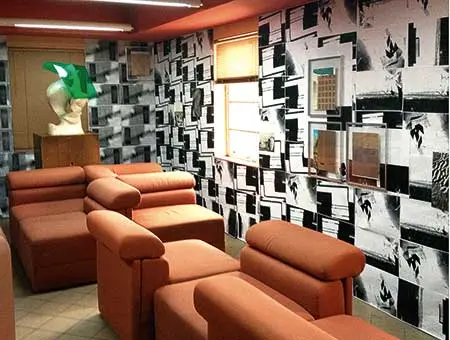
For Objects, Spoonful and Buildings, Valella invaded the entire space devoted to the waiting room along with the reception desk area ordinarily used for receiving patients. She temporarily changed the nature of the place, making it a dynamic and daring space that broadly challenges the issue of perception and the dynamics of education in contemporary art. In Objects, Spoonful and Buildings visitors, mostly regular patients of Dr. Mosquera, enter the waiting room to find a complete transformation of the space: Although they do not choose to intervene in the work, they nonetheless do so in a natural and flexible manner with their mere presence. The walls have been completely lined with enlarged photocopies of buildings and repeated abstract geometric patterns attached like wallpaper. The images used to cover the walls were taken from a book about Merzbau by Dadaist Kurt Schwitters, a conceptual milestone in the history of art that greatly influenced the concept and the origins of modernity. To Valella, Merzbau symbolizes the same thing that it does for Schwitters: the polyvalent and vitally continuous space that can be contemporary art, regardless of medium, form, or place. Collages on expired photographic paper and torn pages from a book by Henry Moore mounted on glass rest over the installation of photocopies alongside other clippings directly superimposed on the “wallpaper.”
In Objects... the furniture in the waiting room is placed at the center of the receiving area with a clear sculptural vision that changes the usual place for the waiting patients. Like they usually do, they remain seated facing each other—like if they were in a loveseat—for the duration of the installation, as the new dynamic of the space modifies the behavior that traditionally occurs in waiting rooms. Thus, Valella successfully blurs the boundaries between life and art by manipulating the space in which people interact.
At the back of the room, a didactic sculpture by Henry Moore, partially covered with a green acetate, breaks the homogeneous volume created by the seats arranged in rows. One of the keys to understanding Valella’s work is, undoubtedly, through the observation of the relationships that she establishes by reflecting on the history of art and its teaching. In this case, musing about Moore’s work is set in contrast against the enlarged images of the Merzbau in order to recreate a dialog of the geometric space—achieved through the veiled tones of the photographic paper used in the collages and visual recharging of the physical space in which the boundaries of each element blend and become one.
The installation by Valella works great with the idea of an assembly made not solely of the interaction between objects, but also between the place that these inhabit, the people that use it and the new potential uses for each of the elements in it. The elements that characterize Valella’s work are interested in geometry at different planes, the issues that emerge in art history and its teaching, as well as the architecture and use of the space. Likewise, the re-use of printed material, photographs, photocopies, and offsets, found objects, and preserved ones, speak about the preservation of memory, the recycling that allows for superimpositions, thoughts, and movement of ideas in palimpsest.
AMALIA CAPUTO