
There is nothing more
contradictory in essence than a garden of weeds, since a garden is, in
principle, supposed to be full of good plants and fragrant flowers; from
English gardens to French ones, to the very famous Japanese gardens where
everything is controlled. At the same time, there is nothing more compelling,
poetically speaking, than to imagine, see and smell a garden of weeds.
According to Monet—an excellent gardener—a good gardener knows how to “order”
his garden and which flowers to put next to each other. So, is no coincidence
that the French impressionist painter gave so much importance to his garden.
But in this respect, he was not inspired by the English and much less by the
French—whose gardens he regarded as decadent—but rather, by the Japanese and
their peculiar approach to gardening: respect the space and do not alter it. It
was so in the 19th century, where evil has an important place in the
collective imagination, that Charles Baudelaire wrote his famous book of poems Flowers of Evil. Those sickly flowers,
dedicated to a “hypocrite reader” that would not understand anything about this
evil flora that grows in the heyday
of capitalism where debris and progress go hand in hand; these, among others,
could be the perfect background for the visual intervention Jardín de Malezas (Garden of Weeds) by
Camilo Bojacá.
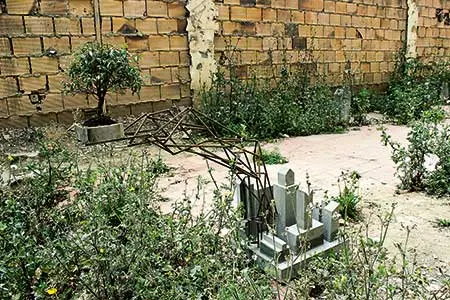
This intervention is performed in a vacant lot that is the future site of the exhibition space El Dorado of the Fundación Bachué in Bogotá. In this space, located just across from Torres del Parque, Bojacá successfully installed a garden in which he created a favorable environment in which plants emerge from the interstices and constructions that the artist himself has set in concrete and brick. On some small scaffolding created by the artist, rest a few concrete and brick “constructions;” mockups of impossible spaces that support bonsais. Besides these small buildings grow, unchecked between the interstices of ruins, a few weed plants that gradually invade and fill the space.
So for example we see a mockup with concrete buildings that reference a large city that could be Tokyo, New York, or Bogota. From these mockups emerges an iron construction that looks like a tower: It is not the Eiffel Tower nor the famous Tatlin’s Tower; it is a building that looks like an oil well that is leaning on one of its sides to support a bonsai created in concrete: at the foot of the construction, the weeds powerfully emerge like dandelions, which grows freely in any corner where there is a little dirt or dust and some moisture.
About this project, Bojacá had this to say: “The vacant lot as the manifestation of the neglect or failure of a project or structure, the total consumption of a building. It can be a fenced area that has been confined in a sort of uncertainty about its use or purpose or, conversely, the result of a more complex strategy associated with to do with harassment and dispossession (...) Perhaps these small weeds represent a return to that field where growing takes time and effort, wherein the passing of time unfolds slowly and the limits of nature and architecture have a mutually beneficial relationship. Thus, the vacant space becomes an opportunity to question the manner in which we establish a relationship with the surrounding space and with nature.”
Territory, place, building, city, and nature are constant elements in the work of Camilo Bojacá. Beginning with drawings his work gradually delved into sculptural interventions. As his constructions begin to be invaded by weeds and a dialog between the two elements is established, an unavoidable question emerges: why are these plants considered bad? Evil seems to grow out of control in a vacant lot. Unhealthy herbs flood the place like a new vortex that grows increasingly uncontrollable. Indeed, in these new territories, the vegetation is unmanageable; It creates a new landscape where ruins are literally a part of a natural world that will soon give ground to progress embodied by construction.
There are plenty of architectural and urban historic precedents that inspire the artist: In Saruhanbey-Turquía an immense tree appears to perforate a construction. But the construction was actually built around it as a sign of respect for a tree that has been there for many years. The same seems to happen at some bus stops in Bogotá, where the ceilings are real gardens. And one last important reference for Bojacá is a building in Beijing that has a mountain on its terrace. With Jardín de Malezas the artists appear to be insisting that buildings can coexist with nature and, in the process, he generates new political cartography of plants; one that José Roca had explored in Colombian Art.
NOTE
1. Camilo Bojacá. Jardín de Malezas, Bachué Notebook No. 1. 2014.
RICARDO ARCOS PALMA