
Carlos Ginzburg’s
exhibition at Henrique Faria in New York is dual-vector confirmation:
Ginzburg’s work deserves attention, and Henrique Faria’s gallery, since it
established itself more formally on 67th Street, has been fulfilling
its mission of presenting and revaluing notable conceptual artists from Latin
America, especially Argentina and Venezuela. It is not the only commercial
gallery devoted to an artistic movement; atypically, it also plays a
historiographic role in bringing to light forgotten practitioners of a kind of
art that is not immediately appealing but profound, theoretical, and
reflective. Chronologically speaking, these artists were important in their
countries of origin in the 1970s, and they remained faithful to their line even
after being swept aside by the vertiginous process of speculation that began in
the 1980s.
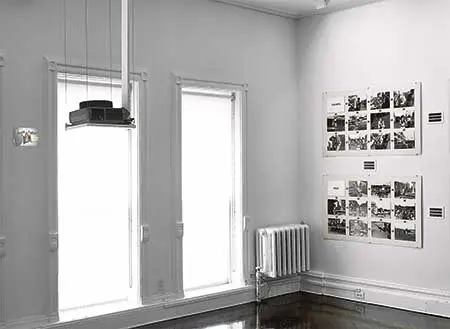
Carlos Ginzburg was born in Argentina in 1946; specifically, he hauls from La Plata, hometown to many other notable artists who, coincidentally, followed a more theoretical than visual path. His works reveals him as a tireless traveler, artist and photographer, photographer and artist. Besides his many travels, Ginzburg has lived and studied in France, working with Pierre Restany and Severo Sarduy, among others. The areas in which he has been an important figure connect to “political ecology” and fractals, and he has even been seen as close to arte povera. The museography in this exhibition ratifies the artist’s and the gallery’s conceptual attachments. The images are presented as a great visible archive, and organized in series on panels, alternating with collages and video. The gallery was covered in works, yet it didn’t feel oversaturated; it looked like a giant newspaper, with predominance of black and white images and a limited presence of color due to certain offsets and a minimal presence of everyday objects. Also, texts are an essential element in Ginzburg aesthetics. In his texts, the artist uses mostly cursive typefaces, with the exception of his titles, which are set in capital print. Le Dentier Occidental—presented in articulated acrylics—is notable for its use of stamps, another conceptualist resource, that function as image, appropriation, and declaration. The stamp, rectangular in format and rose-hued, reads in its upper half: “Gauguin: Painter and traveling artist”; the lower half reads: “Ginzburg: traveling artist exclusively”.
Ginzburg’s prints are in silver gelatin. The most common size he works in is 18 x 24 cm. Texts by the artist are mounted on cardboard panels next to the photographs, in several series; under each photograph, the technical card is handwritten on the support. Other images—in the same kind of printing technique—are individually framed. Works like Untitled, along with the photograph and the inscription on the cardboard, feature a collage of cigarettes and matchboxes, among other objects. In 10 ideas e Arte Pobre (1968-1971), Ginzburg accumulates an orderly series of offset prints, manila-folder paper, and a rope. Other works are untitled but have an identifying undertitle, such as Artes y vide (1980-82) or Untitled (Yo nací en Brahmin), circa 1982, both including collages of offset images and ink-on-paper manuscripts, sometimes including photographs taken by the author and/or found objects. The various series are dominated by manuscripts in French and/or Spanish, although there are exceptions: some texts are not hand-written but typed and alternate French and English, as in the Mexico series.
Since the 1970s Ginzburg has kept journals (what are also known as travel notes). Some reach 200 pages, have cardboard covers, and their height oscillates between 28 and 32 cm. In them, the artist includes his photographs and ephemeral elements connected to the topic, as is the case of Chiang Mai 2. The title The Forgotten Vintage responds to the fact that these are all originals (photographs, collages, and notes). At the same time, it describes a typical New York situation: collectors who are especially interested in vintage works, which is not a common requirement in other cities. So, between initial and/or author-made prints and prints made later—always within the set or numbered originals indicated/authorized by the artist—there are those who tend to be especially interested in prints made earlier, while there are collectors for whom this is of no relevance.
GRACIELA KARTOFEL