
A beautiful and
unsettling video installation by Charly Nijensohn reopened the Espacio
Fundación Telefónica in Buenos Aires, along with two other exhibitions that set
the tone and accompany the fast-paced technological transformations that have
led to the current prominence of digital culture. Hernan Marina’s intervention
of the façade of the foundation: Hermes, the messenger, with 300 linear meters
of turquoise neon tubing, hints at the changes taken by the institution beyond
its architectural adaptation. The bright herald, a rapid transmitter that
predicts the possibility of understanding and the art of interpreting, perhaps,
the hidden meanings of the third and semi-permanent exhibition titled The Ecosystem of Communications.
The amazing images of the moving video installation, Estado de Emergencia (State of Emergency) by Charly Nijensohn (Buenos Aires, 1966) reveal unexplored territories of great visual and emotional impact. This contemporary art proposal of the Espacio Fundación Telefónica—which belong to the company of the same name—invites to a contemplative journey of magnificent solitary geographies and even confirms the multiple possibilities of current technology.
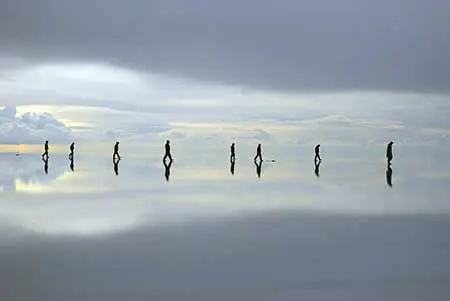
The Estado de Emergencia piece appears to condense Nijensohn’s 30-year artistic trajectory. It consists of three works created in recent years: El Naufragio de los Hombres (The Wreck of Men), Dead Forest Storm and El Éxodo de los Olvidados (The Exodus of the Forgotten). The video installation is presented for the first time in Buenos Aires as expanded cinema consisting of 12 synchronized projections, and in loop and on large screens. They are accompanied by an immersive sound created by composer and artist Edgardo Rudnitzky (Buenos Aires, 1956). Surrounded by compelling images, visitors enter into an unpredictable perceptual journey. And even as the images create the narrative, the meanings viewers give them do not necessarily coincide with the artist’s intentions. In fact, the differences in meaning and understanding that a work can generate are a privilege of contemporary viewers. Is Nijensohn’s proposal a metaphysical exploration or an environmental denunciation? Is he pointing at the confrontation between man and nature? Is he exploring terrestrial boundaries and existential adventures?
The videos center on mankind and nature, with the contingencies of climate and the presence of water in all its states. The artist and his team—John Paul Ferlat, Teresa Pereda, Edu Abad, among others—built their “work camp” in the areas where they film. They lived in salt huts in Bolivia, in shops in the Amazon jungle and made mountains in the ice territory of that neighbor El Chaitén, in Patagonia. The works are required by necessity with the participation of the locals; they are the main protagonists of these unexpected and/or provoked tensions with nature.
By watching El Naufragio de los Hombres (2008, 7.28 min), and because it is a hallucination, viewers are transported to a white vastness where the only thing that moves, if anything, is the terrestrial sphere. It was filmed in the Salar de Uyuni, in Bolivia, during the heavy rain season in January and February. The flooding of the salterns creates a magical natural mirror that melts heaven and earth and an unearthly light that expands throughout the horizon. The project involved the participation of the Aymara community that live in the village of Colchan located at 3,000 m. above sea level.
The journey continues in Dead Forest Storm (2009, 3.43 min), which appears as a ghostly and sad reverie filmed in the Amazon region with members of the Waimiri Atroari community. Nijensohn discovered the site by chance. In an interview that he gave to ArtNexus, the artist said the following: “In the mid ‘70s, the Brazilian government authorized the construction of the Balbina hydroelectric dam to supply power to the city of Manaus. As a result of this project, the largest artificial lake in South America was created, flooding a substantial part of the Amazon forest and forcing the displacement of the Waimiri Atroari and tribes from their ancestral territories.” These villages were merged and their descendants are now floating amidst the devastation created by our predatory “civilization.”
Meanwhile, the video El Éxodo de los Olvidados (2011, 5:30 min) transports viewers to the magnificent, and barely explored, landscape of the vast and unspoiled Patagonian Ice Fields. The immense, undulated and steep icy mass is just one of the challenges facing a group of climbers, some of which are part of rescue team in those inaccessible regions of the mythical “end of the world.”
Nijensohn, who represented Argentina at the 50th Venice Biennale (2003), lives and works in Berlin. It was one of the founders of the Ar Detroy Group in the late 1980s; remembered for the video performance Un Acto de Intensidad (An Act of Intensity, 1999, 3.40 minutes) shot in Salinas Grandes (Jujuy, Argentina). Here, in State of Emergency, Nijensohn captures three “intense” moments that are full of splendor and uncertainty, courage and danger; across roads that are as beautiful as they are thrilling.
VICTORIA VERLICHAK