
Danilo
Dueñas is one of Colombia’s most important artists. His work, sustained over
time, has not given in to fashion. Dueñas’ oeuvre is inscribed in materialism
that turns space into an aesthetic site filled with formal references, where
objects and things, mostly found by the artist, generate a singular narrative:
tightly connecting individual and collective memory. In his most recent
installation Como es, texts,
books, shelves, rods, and pieces of wood, among other materials, are set to
dialog.
As we move around the space, we encounter a few English words written on the wall using black vinyl typographic lettering: Scripture, Holy Ghost, Psalm, and Covenant. These words immediately submerge us in a mystical, Christian space; for those of us educated in religious schools, as was my case with the Jesuits, these works are not unfamiliar. Yet they remain mysterious: their large size (the words practically go from floor to ceiling) emphasizes the mystery and makes them difficult to read; one would need to move apart from them, but this is impeded by the cloth pieces and other objects arranged in the gallery. A table, broken in two and turned upside down; two large blood-colored cuts of fabric set like blankets on two white supports; on the wall, the word Covenant. The body is forcefully referred in this sector of the installation, but by its absence. In a space of transit between word and word and objects, there is a space of silence: images hung on the wall. A shelf connecting two walls and some subtle perforations on the curved wall: rope, metal, wood, it doesn’t matter: this line generates tension in that space where the dust left after the perforation remains on the floor as a testimony of the intervention.
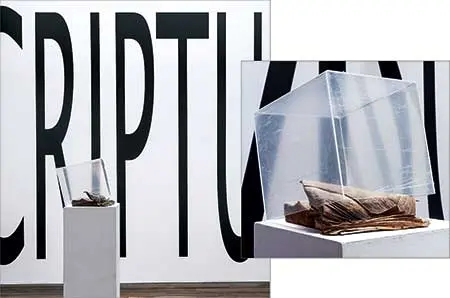
In the contiguous space, the words Psalm and Scripture form an angle: here, a series of books carefully kept inside an urn placed on white supports, and another book, with yellowing, crumpled pages, insisting on the passage of time. The idea of the psalms as sacred writing begins to give us further clues about the place in which we are immersed. We can imagine a reader who has read these books and continues writing in an almost mystical intimacy.
Finally, the words Holy Ghost takes us to a place that seems to be at an initial stage of construction: this Holy Trinity character materializes here in an unfinished state. Such is its immateriality that the artist is able to represent it, or better yet, to present it with the back side of a wood plank on which traces of glue have outlined the figure of a cross, or two white supports one on top of the other, the floor covered by a canvas as tough to protect it during the setup process. But that is the work. And here I remember, unavoidably, the installation Salón de actos (2008), presented at the Colegio de la Sagrada Familia school during the “Urgente” National Artists Salon in Cali. When we entered that installation, we had the sensation of entering a space in which time intended to remain through its vestiges: stairs leading to a window, balconies that enclose the floor, disarticulated shelves and bookcases, all in disarray. Here, where the Holy Ghost is suggested, everything is on the verge of being installed, but never does.
In truth, it is as if every word arranged in the gallery and referred to the sacred scripture of Christianity had an objective translation. The name of St. Augustine of Hippo appears as well, a key figure in Christian asceticism. Indeed, for Augustine materiality was of great importance and in tension with spirituality, as it encompasses all that ties us to the world; in his Confessions, the saint tells us that “It is not the images of things, but the things themselves.”1 This is what he learned from the liberal arts, and it finds in Danilo Dueñas a special resonance, as the artist insists on the issue of poverty as the central axis of his oeuvre:
“Above all, a defense of the poor: how to do and say this without feeling guilty? I think that the main interest of an art exhibition is to make clear one’s affiliations, and this is, for me, the only one of any worth, an awareness of the travails of the poor, always and forever.”2
Como es is able to show us, in the simplest way, the reality of a world where comfort comes mediated by wealth and its tension with poverty.
NOTES
1. Augustine of Hippo. Confessions, Book X, Chapters 9, 10, and 11.
2. Conversation with Danilo Dueñas, electronic media. October 12, 2014.
RICARDO ARCOS PALMA