
The exhibition Immaterial Origin by artist Juan Mejía
(Medellin, 1965) presents a series of sculptures created with polyvinyl,
stainless steel, and Plexiglas structures and rendered in white with color in
their indentations and windows. Whether hung on the wall or placed on the
space, they quietly begin to take over the gallery. Mejía’s formal training as
an architect became the starting point for creating sculptures that have an
architectural quality to them and architectures that boast sculptural
attributes. Without us realizing it, the white shapes camouflaged on the walls
gradually give way to hints of orange, red, green, and yellow. The totems are in
constant dialogue with the wall pieces and even with themselves, a dialogue
facilitated by mirrors placed next to them that help underscores how much they
need one another. The mirrors extend the works in the space, multiply our
presence, our gazes, becoming key elements of the exhibition. With them, the
event is no longer a mere exhibition of sculptures but becomes a unitary whole,
a game of perception. For example, as we contemplate the piece Signos 2 Blanco-Limón (Signs 2
White-Lemon), on display on the top floor, we are also able to observe the
reflection of another two works behind us, Signos
2 Blanco-Naranja (Signs 2 White-Orange) and Totem 8 Blanco-Naranja (Totem 8 White-Orange); so that when we look
at the mirror we actually never lose space as a point of reference and cannot
forget the gaze that commands everything: our own.
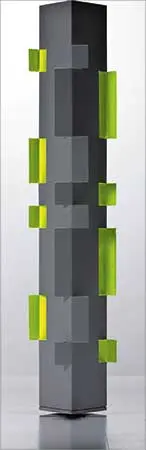
The work by Mejía completely embraces the Zero Movement, an art current founded by Heinz Mack in 1957. Zero expresses “a zone of silence and of pure possibilities for a new beginning,” and it is in this new beginning where the immateriality of the origin of Mejía’s pieces resides. The artist does not solely reference minimalism, the zero point, the void, the nothingness that precedes the first hint of something, but also the tradition of abstract conceptualism developed by Édgar Negret and Eduardo Ramírez-Villamizar. Far from simply following the doctrines of the past and being content with the use of industrial materials to hide his individual expression, Mejía lets his voice be heard through the colors that peek from behind the indentations, cuts, and windows meticulously incised in the material. These and the colors used represent the artist’s personal language, a signature that runs through the walls and floors that we glimpse into when we look through the mirrors. The colors on Plexiglas bring to mind the Memphis group: intense, flat, uniform, and strident, they timidly peek from behind the slotted surfaces; want to look, lift the material covering them. Mejía deconstructs the plane based on these cuts. We could say that he decomposes it to eventually provide a visual composition similar to music from a minimal and abstract language. Especially beautiful are: Signos No. 2 Blanco-Rojo (Signs No. 2 White-Red), in which a diagonal line reveals a deep red that glides over the surface giving rise to different planes and forcing light and shadows to be part of the work Signos No. 6 Blanco-Naranja (Signs No. 6 White-Orange). Here Mejía deviates from the straight line in favor of an undulated form that with every wavy line discretely reveals its content. While these pieces greedily trap color, his Totems—like Totem No. 8—open their steel walls to reveal internal colors that unfold and spread so they can be appreciated from different angles. The color openings and windows of the Totems become the artist’s visual system, through which he decides what he wants us to see. As spectators we are left in Mejía’s hands, we are at the mercy of what he decides to let us see. We are forced to contemplate and surrender to what is presented to us along the way.
By wandering between the Totems and numerical wall pieces, the gaze leads us to abstract and sacred compositions. Color is added to the straight and sober forms to channel our contemplative spirits. There are Totems that also work as sacred objects and that are emblematic in the group of works. With forms inherited from Constructivism, some of the totems stand in the room to remind the rest of their historical and artistic legacy. The white, the vivid colors, and clean forms arise from the zero point of creation as each fold, each indentation shapes the immaterial origin from which these forms emerge.
NOTE
1. Karen Rosenberg (august 21, 2014), “Hail, the Postwar Avant-Garde: ‘The Art of Zero,’ at Purchase College”, New York Times.
CARIDAD BOTELLA