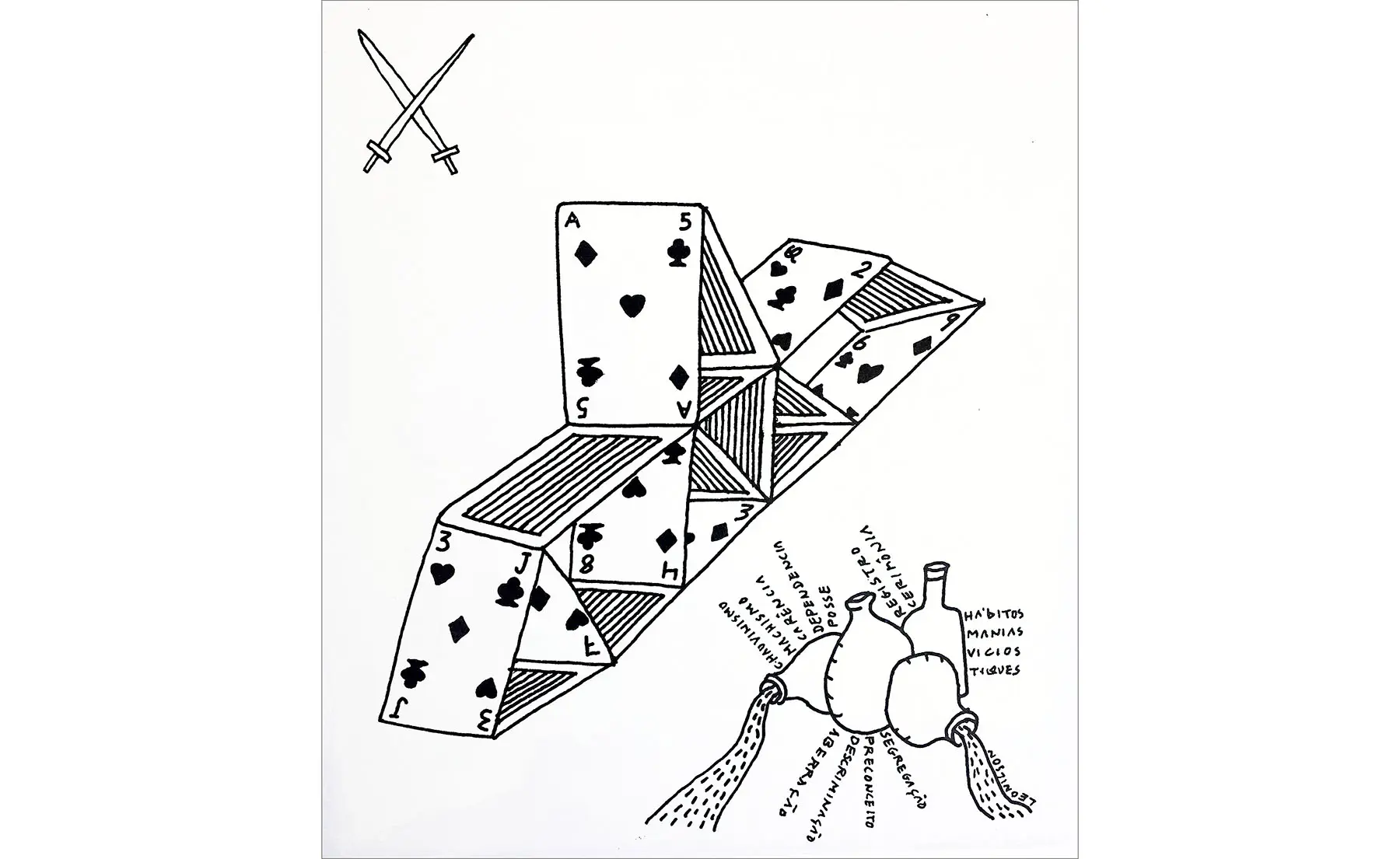
The exhibition Truth, Fiction, a selection of works by Brazilian artist Leonilson curated by Adriano Pedrosa, was on view at the Pinacoteca do São Paulo for three months. Born in Fortaleza in 1957, Leonilson lived in São Paulo since the age of four. He studied visual arts and his work began to stand out in the 1980s when he was invited to participate in the famous How are you doing, generation 80s exhibition at the Parque Lage School of Visual Arts, in Rio de Janeiro (1984) and the 1985 São Paulo Biennial.
Leonilson’s work tends to be seen as close to the formal and thematic characteristics of the “1980s generation”: a supposed primacy of painting, the will to experiment with large dimensions, and the centrality of themes that focus on the banal (or the use of precarious materials) both in the sense of mass culture and that of the biographic and fictive force of some poetics that can be found in his images and others from the same period. However, as with any classification and any art style, these works escape from the boundary-setting desires of historians and critics.
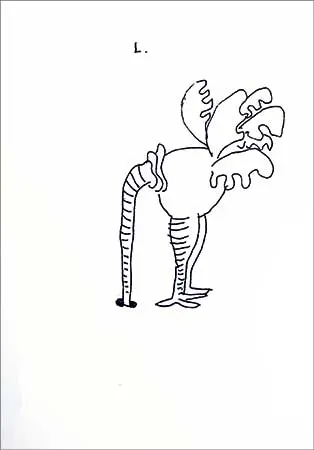
After Leonilson died of AIDS complications in 1993, a number of researchers published books and organized exhibitions intended to revisit his work. Among the traveling exhibitions, special notes should be made of those by Lisette Lagnado (1995), Ricardo Resende, Renata Sant’Anna, and Valquíria Prates (2007), and more recently the exhibition organized by Bitú Cassundé (2011). This show at the Pinacoteca follows the line of providing audiences with an entrance into Leonilson’s oeuvre via the concise gathering of works that, although having points in common with prior exhibitions are never a repetition. It gives us an opportunity to continue making the corpus of Leonilson’s work more and more complex.
Truth, Fiction, takes its title from a 1990 drawing: Favorite Game. It featured the outline of a solitary human figure on a paper page, slightly unaligned to the page’s center, with the words of the show’s title around its legs. On the one hand, truth and all the possible readings of a journal based on Leonilson’s production; on the other, the other side of the coin, the fiction inherent to any datum positioning itself as true. From this perspective, Leonilson’s production can be seen in a pendulum-like motion between document and invention, in the same way, that any autobiography can be seen, and why not, as historiography.
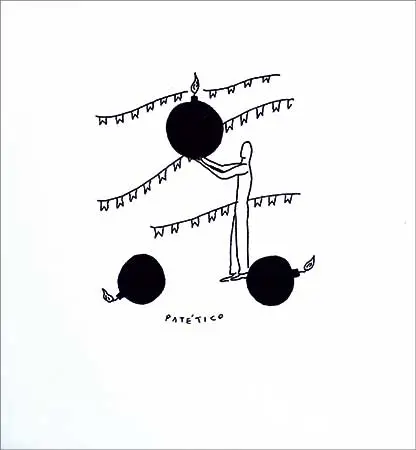
If the words are presented frontally and can be read, the face of the human figure is empty: we see the figure’s male genitalia (might it be a self-portrait?), but the empty face makes it possible for us to take its place and take Leonilson’s stories like ours. In that sense, the relationship between image and text, an important element in his career since the early 1980s, becomes important as a point of contact between the audience and the art. Leonilson’s complex works present us with an apparent simplicity of trace, composition, and even of written texts, but I believe that a trained observer will be aware of the difficulties in deciphering images so concise that they bring to mind, for example, the “noble simplicity and silent greatness” that German historian Johann Winckelmann found in classical Greek art.
Focused only on the temporary arc of Leonilson’s “mature period”, between 1987 and 1993, the curatorship’s decision to think in terms of conceptual segments seems to be a smart one. From this perspective, there is no need to accompany his production year after year, as if one were anxiously consulting a catalog, but an appreciation based on clouds of works that repeat thematically and formally, in the same way, that some events happen more than once in our own lives. Maps, Mathematics and Geometry, and Whites are some of the thematic axes that circumscribe Leonilson’s work on the basis of perspectives that transcend the commonplace; what if, for instance, instead of insistently reading Leonilson through the bias of journal-keeping, sexuality, and his early death, we were to start thinking of his work on the basis of the latest ideas about expression and geometry that characterize the “1980s generation”? And what if emptiness left the background of his drawings and came to the fore?
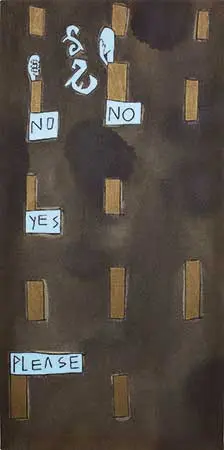
Of particular note is a series of paintings made in 1991 and about which Adriano Pedrosa talked with the artist in a conversation to be published soon. Just as it is possible to easily distance Leonilson from the commonplace, from the historiographic deconstruction of the work of the 1980s via his drawings, collages, or small appropriations of objects, his paintings from the 1990s are again capable of creating a new point of contact. Finally, presenting the public with the artist’s extensive series of illustrations for the Folha de São Paulo newspaper made between 1991 and 1993 confirms the importance and the need to have art historians begin to clarify and untangle the art of the 1980s.
To what degree is the use of the term “1980s generation” the late-coming result of a style-centered and often formalist approach to art history? What is the relationship between those works and the mass media, as signaled for instance by Leonilson’s own production? What was produced in other regions of Brazil, away from the Rio-São Paulo axis? It is for its images and for its ability to raise these and other questions (both artistic and historiographic), that Leonilson’s oeuvre has been the subject of so many monographic exhibitions. It is certainly still capable of sparking new debates.
RAPHAEL FONSECA