In 2009 artist Luis
Poleo surprised many when he exhibited a peculiar exhibition titled Municipal Theatre at the Galería La
Cuadra. Back then, just like in the exhibition that is the subject of this
review, he created his works with a material that evokes the most ephemeral and
poor conditions that exist: cardboard boxes. Poleo opened new significant
possibilities for the use of this material and, both in that exhibition as well
as the current one, his projects are highly political and critical.
In Municipal Theatre Poleo reinterpreted the geopolitical distribution of Caracas through city maps and three-dimensional land surveys made with cardboard (which incidentally gave an impression of great chaos). With them, he questioned imposed territorial divisions and hinted at the political objectives that are part of this fragmentation of power since Caracas is divided into four municipalities, each headed by a mayor. With the exhibition Programmed Obsolescence recently shown at Carmen Araújo Arte, Poleo strikes again with his ingenuity, his intelligent humor, and a sharp critical sense that he uses to question delicate realities that profoundly disrupt the essence of the Venezuelan identity.
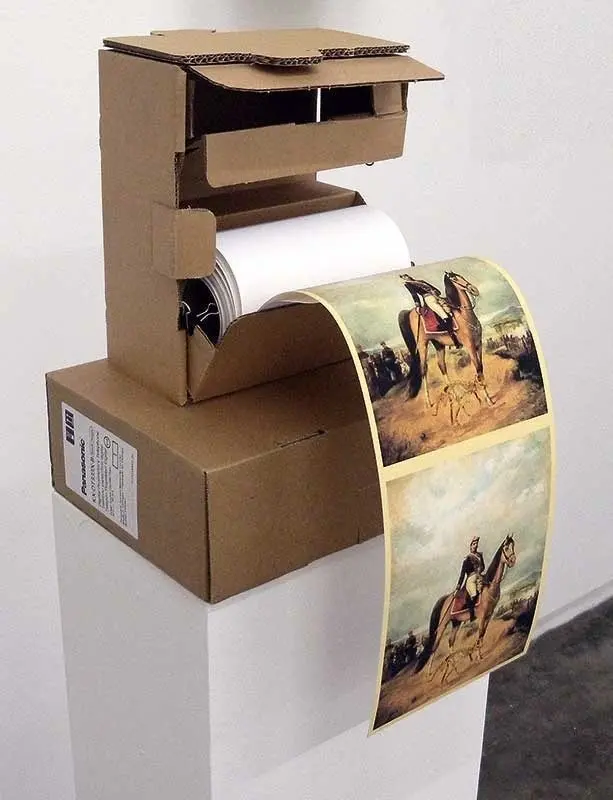
Among the various aspects that Poleo challenges, there is one that encompasses all: the (false) concept that is currently being pushed on nationalism. He does so by parodying two or three central themes: through iconic images from the history of 19th-century painting that represent important moments of the independence process in Venezuela; by questioning specific themes of Venezuelan cultural history such as the arbitrary construction of the Concha Acústica (Bandshell) in Monte Bello urban development in Caracas— abandoned following the fall of the dictatorship of Pérez-Jiménez—and by questioning the kinetic art, a movement that is part of the Venezuelan imaginary and that has been questioned by its detractors as a current that represents the corporate culture and the upper class in Venezuela.
However, the oil industry and culture in Venezuela, a symbol of wealth on this side of the continent, is a victim of its own wealth. Venezuela’s democratic history—which began with the fall of Pérez-Jiménez’s dictatorship in 1958 and continues to this day—is nothing more than the infamous history of dispossession and of a depreciation that goes beyond currency: it is also cultural and affects values and identity. Thus, the rationale for this exhibition by Luis Poleo focuses on facing the little value of the identity processes, questioning the populist political systems like the one implemented by the current Venezuelan government, which has plunged the country into economic ruin and stagnation.
Hence the—devalued—independent figures printed on paper running down the precarious cardboard dispensers; an image of extreme poverty, both because of the material that these devices are made of, and the condition of disposable paper to which Poleo adds the glorious paintings of 19th-century masters. On the other hand, there is the figure of Simon Bolivar no longer riding his horse like in the equestrian sculpture located in Plaza Bolivar, in Caracas: here, he rides a Tyrannosaurus Rex, in an image of the outmost backwardness. Sandra Pinardi, the curator of the exhibition, points out that Poleo centers his attention on temporality, on a supposed future when, by contrast, Venezuela is a backward, poverty-stricken country immersed in obsolescence. According to Pinardi, Poleo performs a “critical examination” like a paleontological exercise with which he reconstructs the future and the use of historical and artistic symbols that, according to him, are “the base on which our nationality, political scene and social body that makes Venezuela is built. “
Programmed Obsolescence is an exhibition that pushes viewers to visualize their own condition: as Venezuelans and citizens of a rich country that was once a model of modernity and now is devastated and devalued. The dispensers and devices that he presents—some obsolete technology in precarious condition—act as metaphors alluding to this context; one that had a heroic history and emblematic modernity of self-improvement and progress. A heroic history because of the struggle for independence in Venezuela during the 19th century that sparked the self-governing sentiment of another four countries in the continent; and modernity reflected in the exemplary architectural and urban development during the 1950s in the country. However, the mockup Concha sin acústica (Acoustical Shell without Acoustics) by Poleo alludes, in a way, to the state of disrepair and obsolescence in which this unique building—a milestone of the engineering of the time—end up when the democratic period began after the overthrow of the military regime in 1958.
In this sense, Poleo confronts the progressive state of obsolescence of the nation by visualizing the consequences of these historical errors. Obsolescence is also a mental state that is unfortunately programmed.
SUSANA BENKO