
The artworks Maria
Raquel Cochez produces are acts of confession and catharsis. Starting with her
first solo show in Panama in 2004 and over the past ten years, she has used art
as a vehicle for self-analysis and a revealing autobiographical process. Over time,
her works have become ever more real, direct, and challenging, showing intimate
aspects of her personal life and admitting the kind of deep truths that most
people would keep secret. The confessional nature of Cochez’s work connects her
to the trends explored by artists such as Louise Bourgeois and Tracey Emin,
among others.
Most of Cochez’s oeuvre revolves around the idealized and distorted concept of the female body, eating disorders, the shame women feel when their bodies don’t conform to social standards and the way these feelings are exacerbated through the constant bombardment from advertising. Art is a reflection of life for this artist who has documented personal experiences such as crash dieting and over-eating, a childhood burdened by feeling obese, a gastric bypass operation, surgical placement, and removal of defective silicone implants. She has created performances, video art, objects, and installations, as well as drawings on paper and acrylic paintings on canvas.
The exhibition’s title, Wet ‘n Wild makes references to the name of a water park María Raquel visited as an adolescent during a family vacation. The day of fun became one of trauma because the pool and slides could only be accessed by people in bathing suits, and Maria Raquel refused to take off the t-shirt she was wearing as a cover-up. The experience of being left alone and forfeiting the fun left a psychological wound until in 2010 when—as an adult and a mother—she carried out a performance for which she returned to the same water park. In the video titled Wet ‘n Wild, we see the artist alone, content and floating in the light blue water of one of the park’s pools, wearing a black bikini that shows her body just as it is.
The artist also appears in the water in a photograph that documents intervention in a public space, with a giant photograph of Cochez on a commercial billboard on a busy avenue, recreating an image from a summer fashion campaign put together by a luxury store in Panama. In an ironic statement, the artist appears in a dark bikini, with a costume jewelry necklace and sunglasses, reclining like a model in a children’s paddling pool. In another piece, a photographic diptych, we see two frontal poses that show only her naked chest covered by a wet t-shirt, displaying how she looked “before” and “after” the removal of her faulty breast implants.
Cochez’s body is the focal point of most of her artworks. In 2006, for the video titled Excess Skin, she filmed herself naked with a paper bag over her head while she moved around in a sort of ritual dance, wiggling her body and the skin that hung from her torso as a consequence of drastic weight loss. In the video duo, she called Belly, a child’s little hands play with the artist’s pale and pliable tummy skin, molding it like putty. In other works, digits that record her fluctuating weight on different dates over long periods of time provide the ‘content’ for Cochez’s objects, including chalkboards and quilts embroidered with numbers.
In her paintings on canvas, Cochez depicts herself eating, in postures that deny any possibility of idealizing the model.1 She makes highly realistic self-portraits where she appears stuffing her mouth with food, or with her cheeks swollen and her face distorted while chewing. She does not usually face the viewer, but rather has her eyes or looks up as if in a state of pleasure. The colorful compositions usually have backgrounds with cheerful patterns of flowers or fruits, like those on the vinyl tablecloths in popular eateries.
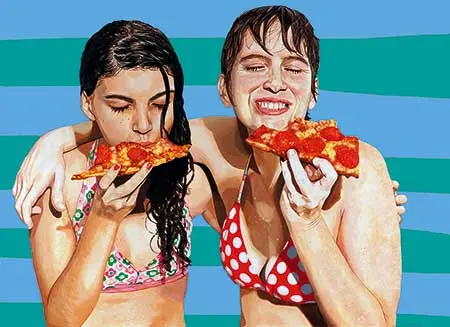
The Wet ‘n Wild exhibition included several portraits of duos or groups of women—the artist’s friends and daughters—who following the exhibition’s theme, appear wet, in swimsuits, and, above all, eat. In compositions with lively blue and green striped backgrounds and a ‘pop’-like air, they stand looking, biting, enjoying, and swallowing junk food such as nachos with cheese or pepperoni pizza. The faces of these girls project a feeling of pleasure and gluttony that might suggest the emergence of a new generation of women at risk. Or maybe, in a more positive light, they reveal a healthy sense of humor and protective self-awareness.
NOTE
1. M. Kupfer, Perceptive Strokes: Women Artists of Panama (Washington, D.C.: Inter American Development Bank, 2013).
MÓNICA KUPFER