
Quickly and
successfully immersed in the international art circuit, Martín Sastre (1976)
operates like a cluster bomb that detonates at the precise height to attack an
entire system. To dismantle his target, the Uruguayan artist relies on humor
and the absurd. In his proposals, video art, the use of objects and
installations, are infused with a 1980s nostalgia for pop and kitsch, as he
often refers to icons that he most likely worshipped as a child: Lady D,
Michael Jackson, Madonna, and Hello Kitty, the movies of the era and the
colorful plastic clothing shown on them, are part of his imaginary along with
political leaders from the region like José Mujica, Barack Obama, and Cristina
Kirchner, among others. Generally, he also places himself in these operations to
bring art, politics, and entertainment to the same stage. With the countenance
of a model or Hollywood actor, Sastre bases the mockery on himself as an artist
immersed in the mainstream. He satirizes the figure of the (Latin American)
artist when he or she is co-opted by the market and the mass media.
In the context of the serious, self-absorbed, and academic Chilean art world, these concerns and strategies may seem unrelated. Thus, the exhibition at the Museo de las Artes Visuales marked an unnecessary milestone for some. The connections with what occurs outside are not very strong and the local exhibition venues seldom present works by artists of international projection, even from neighboring countries. Sastre’s work is eminently playful, fanciful, and falls within postproduction art, given his inclination toward quotations and the use of copies, so incorporated already in the culture of entertainment that more than one viewer could leave with an empty feeling. But all this is also part of a maneuver that—like irony—is present in all of Sastre’s work: fiction.
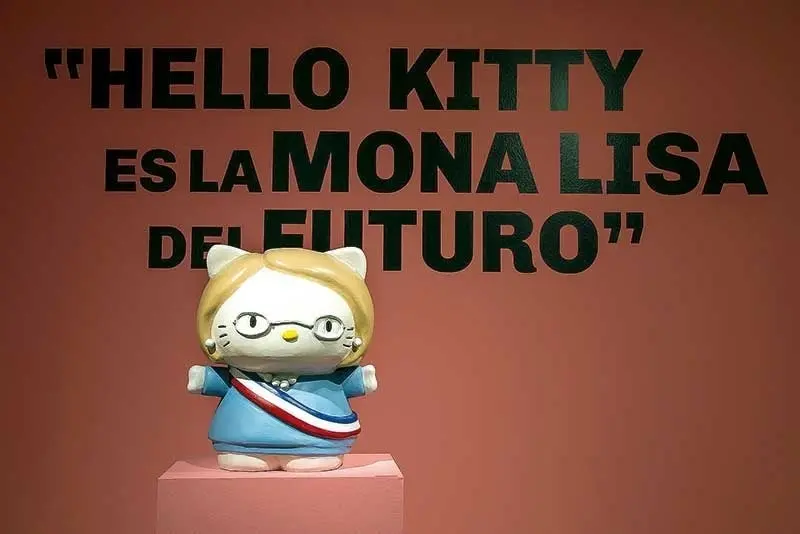
The exhibition Video Store consisted of works created between 2000 and today. The proposal is crowned by the most publicized piece, a sculpture of Hello Kitty that personifies President Michelle Bachelet. Here Sastre appeals to the historical vintage quality of current art by inscribing on the back wall: “Hello Kitty is the Mona Lisa of the future.”
As if wanting to confuse the researchers of tomorrow, his operations respond to the system as fantasies that work in the field of art, in advertising, and in life itself: the perfume made with flowers from the garden of Uruguayan President José Mujica, a work that was auctioned for an exorbitant amount of money at the 55th Venice Biennale; the Fundación Martín Sastre de Arte Latinoamericano Súper Pobre—which has raised funds via the Internet—or his films, which viewers can rent in the museum and watch at home.
The show was literally a video store that exhibited pieces of merchandising like posters, clothes, and objects used in his productions. There were also some pieces for watching in the museum, like the trilogy Video Art: the Ibero-American Legend, Montevideo: The Dark Side of the Pop, and Bolivia 3: Confederation Next, which fictionalizes a future in which Latin America is the epicenter of the world power, with post-apocalyptic overtones and quotes from movies from the 1980s.
Then there was also the work titled Miss Tacuarembó, his first feature film starring the Uruguayan actress Natalia Oneiro, where the artist’s triggering intentions successfully intrude fine in a world that for him has represented a prominent tool of ideological propagation: the film industry. The film tells the story of a girl who dreams of someday becoming a famous artist. While she is confronted with the rigidity and narrow-mindedness of the local scene, the pervasiveness of the Catholic Church, and—most importantly—the castrating censorship of a diabolical catechist, little Natalia feeds her illusions with Venezuelan soap opera Cristal, the choreographies of Flashdance and her miraculous connection with a figure of Christ. However, in repeated flash-forwards, Natalia, already an adult, faces a reality that is far from successful, working on the staff of Cristo Park, a decaying amusement park. Two moments are her ticket to stardom: at age 18, when she competes to be crowned Miss Tacuarembó and, at 30, when she appears in the reality TV show Todo por un Sueño (Everything for a Dream). In both opportunities, failure appears like an abyss that confronts her with the farce that she must assume—or not—to fulfill her dream.
Based in Spain, Martín Sastre has won awards at film festivals for this work already regarded as a “timeless classic.” His strategies leave and return to the world of cinema with the references to the homonymous novel by Uruguayan cult author Dani Umpi, as well as to the 1980s films by Pedro Almodóvar. The selection of the child actress was the result of a casting in which one thousand girls competed for the role, excited about the prospect of working alongside Natalia Oneiro. The artist himself appears as a character in the film. The work seamlessly fits in the context of a museum of visual arts. Truth, art, or fiction.
CAROLINA LARA B.