
Chile 3014. The Museo
Histórico Nacional. A young boy walks holding hands with his parents as they
watch the windows where the most important events in the history of their
country are shown. He stops to observe a scene that shows two men shaking
hands. “Daddy, why do these two men shake hands? Are they friends?” His father
shrugs and grimaces.
The Chilean artist Nicolás Grum presents its Future Museum: the staging of diverse and controversial chapters of recent Chilean history. Grum has chosen controversial events because of their ambiguous interpretation—or frankly, for having been tampered with—and has turned them into dioramas that envision the “future museum,” the manner in which to present the “truth” in the years ahead. Problematic is an understatement. As Lyotard understood it, postmodernism is identified for the end of the “metanarrative,” the elimination of History in favor of stories. There are no reliable sources any longer, so reality must be doubted, contrasted, and interrelated. Continuing (or parodying) the aesthetics of the diorama (popularized in the late nineteenth century by the American Museum of Natural History, in its ambition to present US history didactically—and authoritatively), Nicolás Grum models events like El Gran Pacto por Chile (The Grand Pact for Chile), the time when Augusto Pinochet shook hands with Patricio Aylwin, the then newly elected president, thus sealing with a handshake the transfer of power; the so-called Chilean transition to democracy, as facts have demonstrated, was nothing but an alliance to perpetuate several elements of the dictatorship in democracy—without going any further, the Chilean Constitution, in place since the days of the dictator). Other events less tragic but “popular” are depicted in the exhibition The Pietá Maracaná, a confusing event that occurred in 1989 when the goalkeeper of the Chilean football team was hit by a flare thrown by fans from the opposing Brazilian team and had to be taken off the field in the arms of his teammates. Months later, however, the goalkeeper confessed that he himself had caused the injury and that everything had been a hoax. Another more recent case is The Balserita Puerto Gala (The Little Raft Girl of Puerto Gala). It depicts the adventures of Carolina Tiare-Pate, a girl who had to cross a river on a Styrofoam raft to get to school. After the story of her daily feat was published in the press, the girl admitted that she invented the story to get attention. In all, the artist presented nine events. Although some other pieces and ideas were not used for this exhibition, they may be included in future shows.
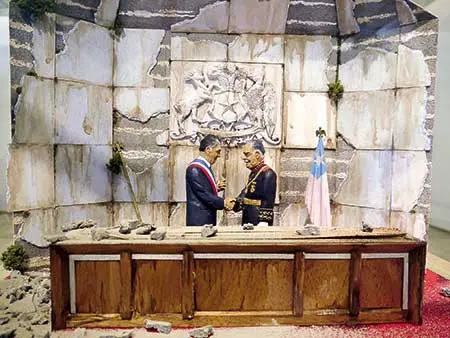
If there is a common thread running through Nicolás Grum’s entire production it is humor. On this occasion, he relies on the Chilean intrahistoria [Translator’s Note: term coined by Miguel de Unamuno to refer to small stories of anonymous people] in some of his more equivocal episodes. But the exhibition definitely finds pieces that have and deserve further reflection: in Historia Oficial (Official History) Grum enlarged images from the Larousse Dictionary published in 1981 in Brazil. Some parts of the copied pages have been crossed out or hidden, while the content of some definitions in other pages has been intervened for political purposes. For example, removing one of the marks created during the 1980s confirms that a geographical area called “Argentártida,” a stretch that is inside Antarctic land has been covered by a Chilean-owned recreation of the same area. Although today that historical manipulation seems quite ridiculous and crass, we must not forget that this is how “reality” was explained in past decades. But this exhibition should not be misunderstood as the caricature of a form of lying from the past. In the review of the show printed by the largest newspaper in the country, El Mercurio, the reviewer described the piece El Gran Pacto (op. cit), as a depiction of the “passing of the presidential sash between our two presidents,” as if Pinochet had been a president, not a dictator. Schizophrenia about facts, whose codification and translation depends on who interprets them, continues today (it suffices to dive into the social networks to see how the facts have become malleable, ambiguous material). Nicolás Grum proposes that the official story no longer exists and we only get glimpses of it. His approach for handling this premise has been through minimal interference. To present this concern he relies on the “three-dimensioning” of news and his inclination to imitate a historical museum. History is the only intervention needed in this museum of hysteria for viewers to shrug and grimace.
JUAN JOSÉ SANTOS