In the short span of
five years, after four years of an emphatically independent career in the arts
(this is to say, against all odds, be it Brazil’s archaic dictatorship or merely
the institutionalization of art), Paulo Bruscky (Recife, 1949) has seen his
hybrid, polyglot, heterodox, interdisciplinary production on display at several
institutions, the two most recent being the Bronx Museum (New York, 2013) and
now the MAM (São Paulo, 2014). As in previous cases, where the emphasis was
placed on historical work (with the character of a hidden retrospective), the
exhibition that motivates these lines has been able to avoid, at least in part,
what emerges from any critical aggiornamento
of this kind: inventories and anthologies. It has achieved a temporal
equilibrium: recovering ideas from a different time and making them possible
(performances conceived in the past but executed now). This, let it be said, is
not that difficult, given the abundance of works in the project stage contained
in the artist’s idea banks, a kind of
images nursery almost in a stage of conceptual psychography, recognized here
via some pages on display (something that was generously done in a show at the
Tomie Ohtake Institute in São Paulo), always in the image of the insert seen in
the book Poiesis Bruscky (Cosac
Naify, 2013).
If Bruscky’s poetics was always to escape from any artistic constraint—opening the field’s doors—and thus to establish a moveable, almost fugitive radius for action, of impossibly absolute visual fixity, the best element of this exhibition—in medium format, misleadingly pocket-sized—is what comes out of it, or better yet, what comes in and out, since there are works and actions that belong to the streets or to the museum itself, exteriorized: to the outside world, and to the world of communication with its inside-outside back and forth (Quadro de avisos is seen as a work-in-progress). As is the case of some performances that traversed such division lines, which has also been illusory for the artist: for example, Carregadores de espelhos (1970s), created by a line of young people clad in transportation coveralls who carried around horizontal mirrors and, in consequence, their visual horizons via images-reflections in transit, presented as they moved by the exterior and interior spaces of MAM. Recorded in the video, this performance is one of the charms of an exhibition tightly structured around the documentation of visual performances.
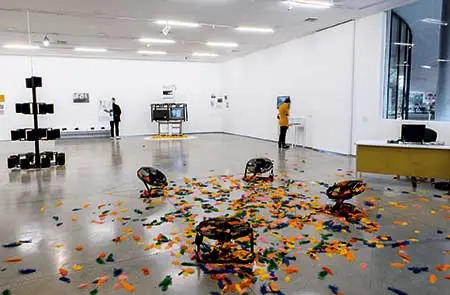
Another aesthetic apex, however, is a totemic installation of industrial stoves, bread, flour, and TV (Sem titulo, 2000), with a video diptych showing the hair-raising alimentary reality of the quest for food and the preparation of a meal by destitute individuals in a landfill (with birds of prey seem to fly from one side of the image to the other), as paradoxical and critical geography of hunger. Already in Penas de galinha (the 1960s), a performance resulting from colorful feathers blown around by fans is another proof of a visual enchantment whose formal simplicity touches on asceticism. As in the re-installation of Fontes, a tower with speakers producing the sound of fountains from around the world, recorded by the artist (a liquid, water-based veneer is recognizable in Buscky’s oeuvre), reconnecting the immaterial and its reverse. Or Meu cerebro desenha assim (1974/2014), performed for the first time in public here, where the artist draws his thoughts-sensations graphically by means of an encephalogram: another visual and chromatic map of conscience and senses.
Art of the frontiers, and not only spatio-temporal ones, but also genre and linguistic ones, as everything ends being inscribed in the reduced space of a museum hall, for reasons that connect art and life in ways that are more dialogic than dialectic, and relationships never entirely exempt from noise. Whole incorporation of signals, accidents, signs that go beyond convention. Against the commonplace, and with irony: see the update of Expediente (198-2005), with museum functionaries working openly on-site in the gallery or in the souvenir stand, saleswoman included (a replay of another work with an acarajé vendor, from 1974), as ironic artworks dislocated at the frontier of the art-culture institution or at the border between the museum and the street, respectively.
Recent and not previously exhibited are two toponymic visual poems: Com passos em A2 (2011, imprint of shoe heels and soles as graphic impressions on the floor and echo sounds) and Ondulações (2008, wheelbarrow tracks on paper, rippling like furrows). Although, in all truth, the remaining works on paper suspended on acrylic plaques function as an informational complement—more pedagogical than an exhibition, given their scarce and irregular presentation—that detracts from the potency of the highlighted works.
In sum, seldom do we encounter such an alliance of perceptual freedom and humor, a cognitive machine for the de-sacralization of things, including the artist’s own presence, so many times featured in the foreground as part of the performances, in fun envelope-pushing ways. (For instance, A Plateia, 2014, presents the mirrored audience patio on a screen: the image we await is our own image, and the audience is the work watching itself, and watching Bruscky pay homage, in his oblique way, to Alfred Hitchcock). Far from him, however, doing art-as-charade or art-as-joke; his contribution as an artistic homo ludens avoids any conventional interpretation, and in his decharacterization of the prose of the world we find the image-based poetry that comes from any expanded field.
ADOLFO MONTEJO NAVAS