In 1990 I witnessed a discussion panel with Jeff Koons. At the time his name was already a bad word for many members of the U.S. art circle. Yet, he probably was the star of the presenters, and the room was overflowing with public. I attended with my own reservations about his work and was among those ill-disposed. Koons proceeded to show slides of his work and gave explanations as any other artist would in this format. Contrary to my expectations, he gave a memorable performance. With humor and self-deprecating cynicism he managed to fill the relatively empty images of his work with unexpected life. I left convinced his work should only be seen in his presence.
Now, twenty-five years later, Koons has filled four floors of the Whitney Museum in New York with a retrospective that is also the last exhibition to be held in the Marcel Breuer building before the museum moves to a new home designed by Renzo Piano located further downtown. Knowing he wouldn’t be personally present to fill in the work, I kept postponing my visit to the show, maybe hoping I might not see it at all. Because for many people the exhibition became a favorite target of derision, I finally did go. Given all the easy negativity, I actually came well disposed, actually considering the possibility of a rave review. But there had also been reviews extolling the importance of his work, or at least some of them, so I also considered writing against it. What happened in short? It took me longer to read the labels for the pieces than to see the work, and I left concluding that each society probably has the art it deserves. The issues his work raises seemed too complex to glibly endorse or dismiss.
One of the problems is that overall the exhibition exudes a false populism. The works satisfy the expectation of something spectacular, without justifying the spectacle. This raises an ethical question: does an exhibition that doesn’t generate any thought or emotional process do more harm than good? Anything exhibited communicates, elicits feedback, and conditions the reactions of the public. Actors in TV advertisements are doing more than selling products, they’re also modeling a presentation of self. Their ticks and exaggerated expressions sink into consciousness, they slowly and imperceptibly influence popular expression, thus creating a vicious circle. An exhibit presenting bland emptiness as part of the canon of values espoused by a museum only can lower future expectations in the public and ultimately create bland emptiness in their minds. There may be practical reasons for the absence of a Hippocratic oath for the arts, but perhaps we need one.
Since there are a couple of interesting pieces in the show, this judgment may be too harsh for Koon’s retrospective. Yet, in order to deal with his show, one has to wonder why it exists at all. The problems addressed by Koons were already pretty much exhausted by Claes Oldenburg when he used quotidian meaningless objects and blew them up to the scale of monuments, by Andy Warhol making consumer icons out of meaningless consumer items, and by Rosenquist breaking up and combining images in larger than life realistic paintings. Those three artists managed to more or less establish art ruptures that were valid during the 1960s. They did so by picking up on, distilling, isolating, and throwing back to the public, some of the cultural characteristics in U.S. society. That is how they established Pop Art. U.S. Pop Art was an apolitical and quasi-anthropological aesthetic. With the exception of some of Rosenquist’s work, which sometimes had a political bite, these three artists were more celebratory than critical. Their work didn’t aim at cultural change like the original British version of Pop but rather exemplified an appreciation of stability. The phenomenon of U.S. Pop Art had a tribal aura and in that sense was somewhat provincial, despite the global prices it commanded. Their formal ruptures, half a century later, have been assimilated into the culture, losing their sharpness.
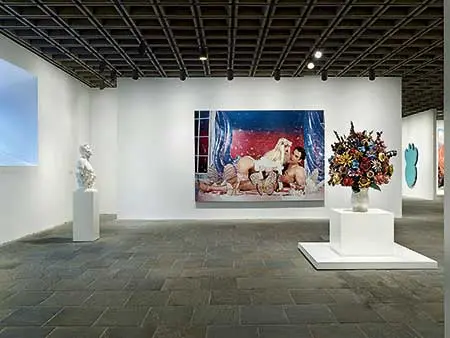
Picking up problems previously presented and solved is always a risky proposition. It only makes real sense if there is some overlooked feature that justifies the continuation of the research. It’s here where the works of Koons become controversial and divide the public, at least in the U.S., into those who revile and those who extol his production. There is certainly an enormous amount of explicit and off-putting narcissism through the exhibition. This is brought to an exaggeration in his Made in Heaven series of paintings. One could say that this spectacular degree of narcissism sets him apart from his predecessors. What is not clear in these paintings is if they reflect a true narcissism or are actually a satiric reflection on narcissism. But Koon’s conversations with Norman Rosenthal would suggest that satire was not his intention.1
Made in Heaven celebrated Koon’s marriage to Ilona Staller, a star in her own right. Known under her professional name Cicciolina, Staller was a famous Hungarian porn star active in Italy. Eventually, she entered politics and in 1987 was elected to the Italian parliament. Merging her multiple talents, Staller offered sex to Saddam Hussein and Osama Bin Laden in exchange for peace in the region. (Perhaps her defeat in the next election was due to the failure of her diplomatic initiative.) Staller married Koons in 1991. When they divorced a year later, she left the U.S. and returned to Italy, taking their son with her. In 1998 a U.S. court gave custody of the child to Koons, but Staller ignored the order and kept the boy in Italy, in legal terms, abducting him. Koons refers to this “kidnapping” in the signage for his series Celebration, one that follows Made in Heaven after some years of withdrawal from making art.
Made in Heaven depicts Koons’ sexual encounters with Staller in explicit hardcore, all genitalia in action, with Koons in some instances looking directly into the camera. In hindsight, this series seems to be more of a cause for embarrassment than to function as a work of art. In any case, the work in this series, as well as the rest of the paintings, are the least original and most uninteresting pieces in the exhibition.
Koons created two, maybe three, memorable pieces during the three and half decades of his work exhibited at the Whitney, all produced in the 1980s: One Ball Total Equilibrium Tank (Spalding DR. J241 Series) (1985), Baccarat Crystal Set (1986), and Rabbit (1986). These works were part of his first series, titled The New. In that initial group, he started by displaying everyday objects in plastic cases, in a post-Duchampian readymade vein. The New was an exhibition in the windows of the New Museum of NY in 1980. Koons integrated the aesthetics of bought appliances with the look of display cases, using clear plastic boxes and illuminated with batteries of fluorescent tubes. In the 1980s, because of this work, Koons was temporarily considered part of the fleeing “Neo-Geo” movement, along with Haim Steinbach, whose work at the time was similarly motivated but probably more interesting.
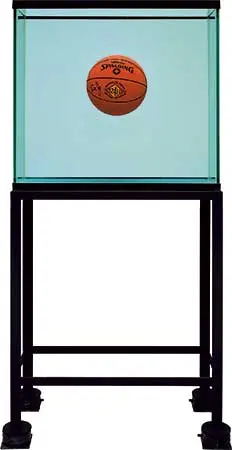
Koon’s Equilibrium, a basketball perfectly suspended in the center of a glass case filled with water, refers to a “new” object. The striking feature of this piece is not its “newness”, though, so much as its mystery. The improbability of the ball neither floating nor dropping, just being perfectly located in the center without any visual illusion, conjures a magic trick. It was Nobel Prize winner Richard Feynman who helped figure out the exact relation of pressure between the air in the ball and the distilled water with salt that explains how the ball is held in place. Koons himself was clearly among those impressed by the result, for he went on to do several variations on this theme, none going much beyond the first insight. (Eventually, the work must have also impressed Damian Hirst, leading him to produce The Physical Impossibility of Death in the Mind of Someone Living, (1991), a shark in a big glass tank filled with formaldehyde.) That Koons is not an artist prone to work with mystery becomes evident from his descriptions of these pieces. He trivializes them with an affected pomposity (the basketball is male and the water is female, being the womb).2 Still, Equilibrium and its variations stand out in his career and deserve the iconic status they hold in the art of the last decades of the twentieth century.
The second piece, Baccarat Crystal Set, is a crystal set recast in stainless steel. Fragility is eliminated and exchanged for timeless durability so that memory may have the hope of becoming eternal. A similar idea can be found in the cultural phenomenon of chromed baby shoes. In Koons’ piece, though, he’s freezing and preserving the quality of newness, which in daily life is painfully short-lived. The moment a new car is driven out from a U.S. showroom it becomes a used car and loses a huge percentage of its resale value. The most minimal scratch or stain obliterates the virtues of any mint condition and so the object loses desirability. Obsolescence is built in so as to ensure a continuing need to acquire a new newness. In this vein, it’s worth noting that all of Koons’ work, no matter when it was made, bears a warning about the sensitivity of the surfaces and an admonishment to avoid any contact whatsoever. A panic about deterioration seems fitting for work about the cultural desire for permanence.
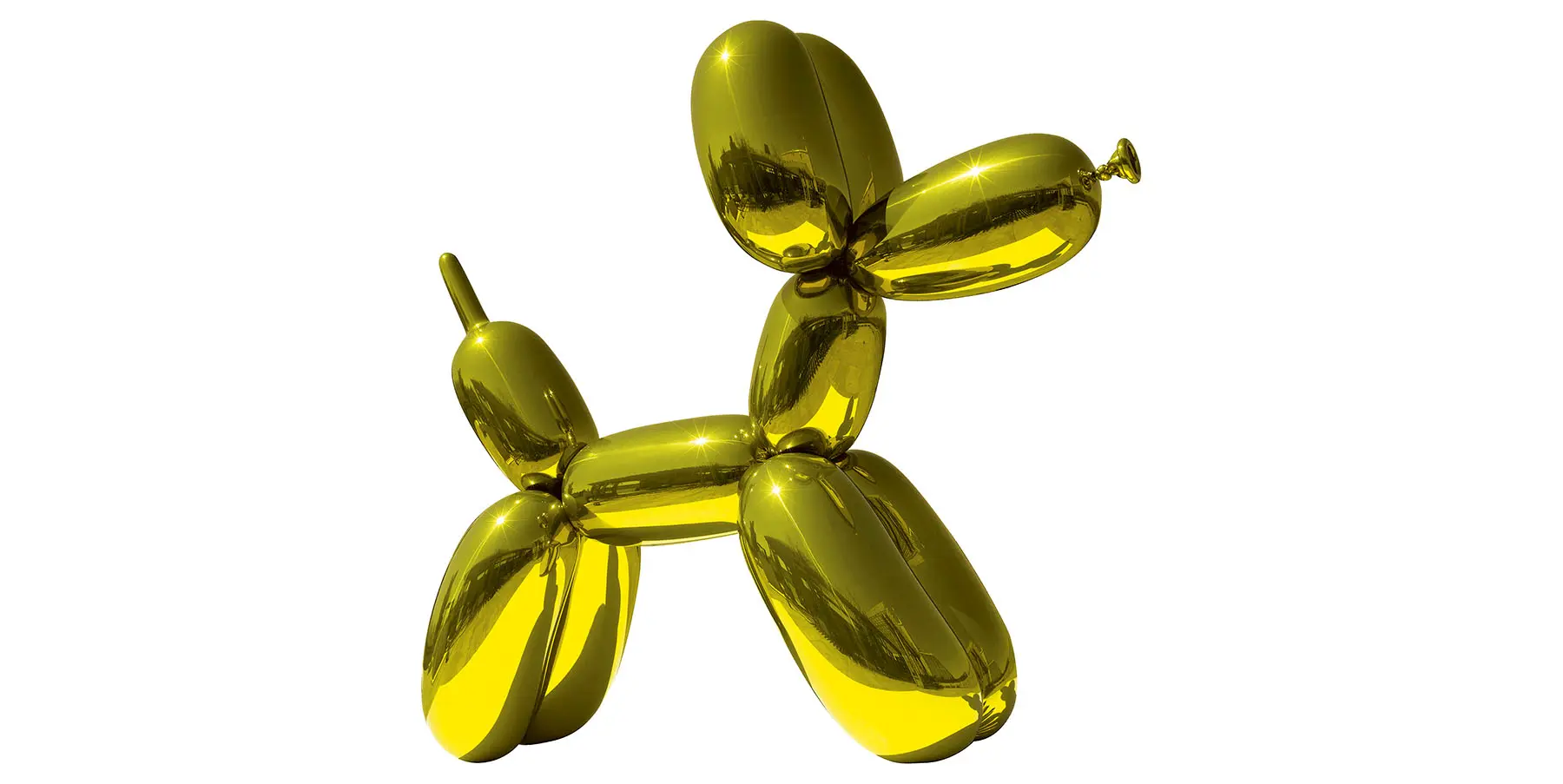
Since the 1980s, the technique of recasting objects took over Koons’ work. Rabbit, the third example from the 1980s and part of the series dedicated to newness, prefigures his later recasting of toys and balloon sculptures where dogs and bunnies are made from assorted and knotted inflated balloons. All these objects are remade in metal: the balloon ones in aggressively intense anodized colors, and the others carefully painted to reproduce the original effect of the object in the utmost detail. These reproductions become exercises in extreme realism, updating the outmoded hyperrealist aesthetic of the 1970s to a point only possible in the computer age. The realism is quite astonishing. The original object is carefully scanned in 3D and saved in voxels (3D pixels that may be vectorized to avoid loss of information).3 The process is a serious update of the old three-point pantograph compass used to enlarge sculptural models since the seventeenth century. In the best example, the objects recast are inflatable swimming pool toys. The technical achievement is breathtaking, each slight wrinkle of the “rubber” surface at its seams rendered with a precision that makes it seem real. But the question arises, to what end, with what meaning, beyond a possible autobiographical reference? There really is no affective resonance or mysterious suggestion. The viewer is left with the question “How did he do that?” rather than pondering “What may I learn from this?” Ultimately, the question is what’s the point?
Another issue arises in contemplating the relationship between the artist and the product. While the work is obviously a stunning example of what industrial technology can accomplish, it’s also the case that Koons is feted as a craftsman for this achievement. This suggests a serious conceptual shift in the use of the term “craftsman”. The virtuosity attributed to the hands of an artisan is now recast as the ability to manage a studio with 120 workers and expensive equipment, and a network of satellite industrial factories. While this shift in the notion of craftsmanship is sad in some respects, there is nothing intrinsically wrong with it, except perhaps the exorbitant cost of production. The enormous prices of Koons’ work, reaching several millions of dollars, is not merely a reflection of the market demand for his work, but also of the heavy investment that’s gone into the process of production itself, in an obsessive drive to make “perfection” more perfect.
In a recent interview, Noam Chomsky commented on the displacement of knowledge in the average U.S. citizen. Interested in how much they know about sports and ignore other things, Chomsky commented: “They know all sorts of complicated details and enter into far-reaching discussion about whether the coach made the right decision yesterday and so on. These are ordinary people, not professionals, who are applying their intelligence and analytic skills in these areas and accumulating quite a lot of knowledge and, for all I know, understanding. On the other hand, when I hear people talk about, say, international affairs or domestic problems, it’s at a level of superficiality that’s beyond belief.” He added: “They might as well live in a fantasy world, and that’s in fact what they do. I’m sure they are using their common sense and intellectual skills, but in an area which has no meaning and probably thrives because it has no meaning, as a displacement from the serious problems which one cannot influence and affect because the power happens to lie elsewhere.”4
Chomsky’s description gives a precise context to Koons’ exhibition. In fact, during his conversations with Rosenthal, when Rosenthal suggests that art might be something more complex than football or soccer, Koons answers: “If somebody really focuses attention on the sport I believe it can take them to a metaphysical state.”5 Rosenthal, who notably guides the conversation with a light touch of irony, expresses a gentle puzzlement. Koons responds by navigating the dialogue with intense seriousness, focused totally on himself (at least, so it seems). He makes declarations such as: “I think that awareness of self is very, very critical as a step of self-acceptance.” and “What I love is that art lets you connect to what it means to be human.”6 His best comment, somewhere between Warhol and George W. Bush, is: “Vocabulary is important to discuss; it’s an interesting subject, a profound subject.”7 These verbal gestures are a delight, funny and suggestive. But their charm and meaning are lost when inflated from a throwaway line in a conversation to elephantine empty shells of high polish.
After reading the Conversations, and looking back on Koons performance at the panel discussion I attended back in 1990, I think it was a good thing Koons wasn’t in person at the Whitney to describe his work and that Chomsky should be an art critic. For years now I’ve been considering the possibility of organizing an exhibition under the title Small Ideas in Grand Scale. No need for that anymore.
(Edited by Selby Hickey).
NOTES
1. Jeff Koons: Conversations with Norman Rosenthal, the Thames on Hudson, London, 2014.
2. Rosenthal, p. 99.
3. A good description of the process is in the catalogue of the show: Michelle Kuo, “One of a Kind,” Jeff Koons: A Retrospective, The Whitney 3. Museum of American Art, NY, 20014, p. 247-252.
4. Noam Chomsky, “Why Americans Know About Sports But So Little About the World,” AlterNet, 16 September 2014
5. Rosenthal, p.13
6. Rosenthal, p.18
7. Rosenthal, p.268
* All works illustrating the article: © Jeff Koons.
LUIS CAMNITZER