
When work is
intended to bring the issue of representation to a level that virtually verges
on the radical, and when such work itself cannot be documented or cannot be
faithfully portrayed, it is then possible to affirm that it has fulfilled a
real cycle and that any frustration by the media is consistent with its own
nature or its original intentions.
This is what happened in Time, Memory, Context, a personal exhibition by Rafael Domenech presented in October at the Frederic Snitzer Gallery, in Miami. It is a proposal that cannot be described in a dossier and that is difficult to reproduce on support for “show” because its goal is to discuss the presence or absence and vice versa, not only in terms of meaning but, most importantly, visually.
In the five years that Domenech has lived in Florida, he has transitioned from a discourse that addressed the mental state of immigrants to focus on the relationship between art and institution—both approaches rendered in figurative works that rely on the predominant use of watercolors—and then to a series of sculptural and two-dimensional abstract works from 2013 based on math and spatial relations titled Symplectic Structures, shown at NWSA Art seen Gallery, in Miami. In the latter—a creative milestone in his career—Domenech disposed of any narrative elements in favor of a less referential approach free of correlations.
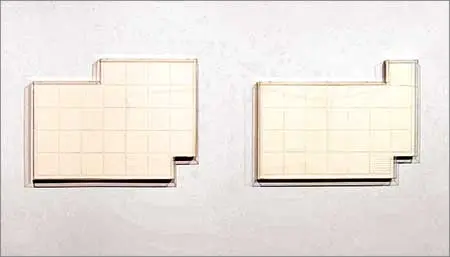
Time, Memory, Context constitutes the logical radicalization of that process and the mise-en-scène of an entire exercise in introspection and contemplation of another a priori state of consciousness: time. Although Symplectic Structures is the natural and organic precursor for this current exhibition, the inspiration actually came from the vital fascination a visit to DIA Beacon caused on Domenech, the encounter with the work of Carl Andre, Sol Lewitt, and, especially, the work by Robert Ryman. The visual impact attained by the works of these artists—based on the radicalization produced when all kinds of references are banished from them—along with the notion of art that each manages, has contaminated—in a good way—the current production of Rafael Domenech .
In Time... save for his sculptures made with sinuous and chaotic looking wood strips—which may well be seen as a beautiful somatic derivation of the frames— and the installation of benches stationed in the patio of the gallery—with a design based on the Gregorian calendar and that retains the natural color of the plank—the rest of the parts are mostly white. Only the frame—if one can call it that—provides another tonality as it is not merely an attribute of the work but part of the work that gives it meaning.
Approaching the philosophical notions of Henri Bergson on duration, and based on the thesis by WJ Friedman proposed in his work Memory and Time, Domenech insisted on experiencing abstraction from the perception of time through memory and started a practice that consisted in dealing with absence, in partially turning to isolation as much as possible—but not a follower of some Eastern practice.
During this sort of period of withdrawal, Domenech began rubbing—-printing—pieces of cardboard over a variety of surfaces that contextualized and were connected to his everyday life. He then subjected only those about which he managed to remember when and where they were rubbed were incorporated, according to the date, within the framework of the linear calendar that we all know and use—Friedman’s Strength Model of Time and Memory, in which each month represents a relatively independent piece—or on large areas of cardboard that turned memory into single, and perhaps an exact, graphic record of the existence of time. So time is only detectable through subtle and light traces—offshoots—on the white support as if that stamp were the only possible time, and everything else was emptiness, pure fabrication.
Such methodology resulted in a display of all-encompassing abstract, reticular and minimal visuality. All the while its origin is rather existential, autobiographical, and documentary, derived from experience within the duration of an inner journey that began and ended with absence. Each printed grid (sometimes there are two impressions in a month) represents a vital, warm and unique sign inside the white tide. They are to some extent self-portraits... and unrepeatable records of consciousness.
In Time, Memory, Context the “great narrative” disintegrates and is offered, not as succession, but as the result of the perceptual and emotional ups and downs of the individual memory. History is a matter of the “self” and memory is made of finite and sporadic short-circuits within the temporal violence dictated by the exact sciences that govern our lives. In this sense, the exhibition also offers a liberating approach and the gallery assumes the role of space with two cultural offers: as a venue for exhibiting artworks and as a place of non-referential worship. A space for Zen meditation and seclusion in which the artistic discourse, rather than activating, invites you to deactivate; instead of saying, invites you to unsay, to flow, and to contemplate; to let ourselves go.
ELVIA ROSA CASTRO