
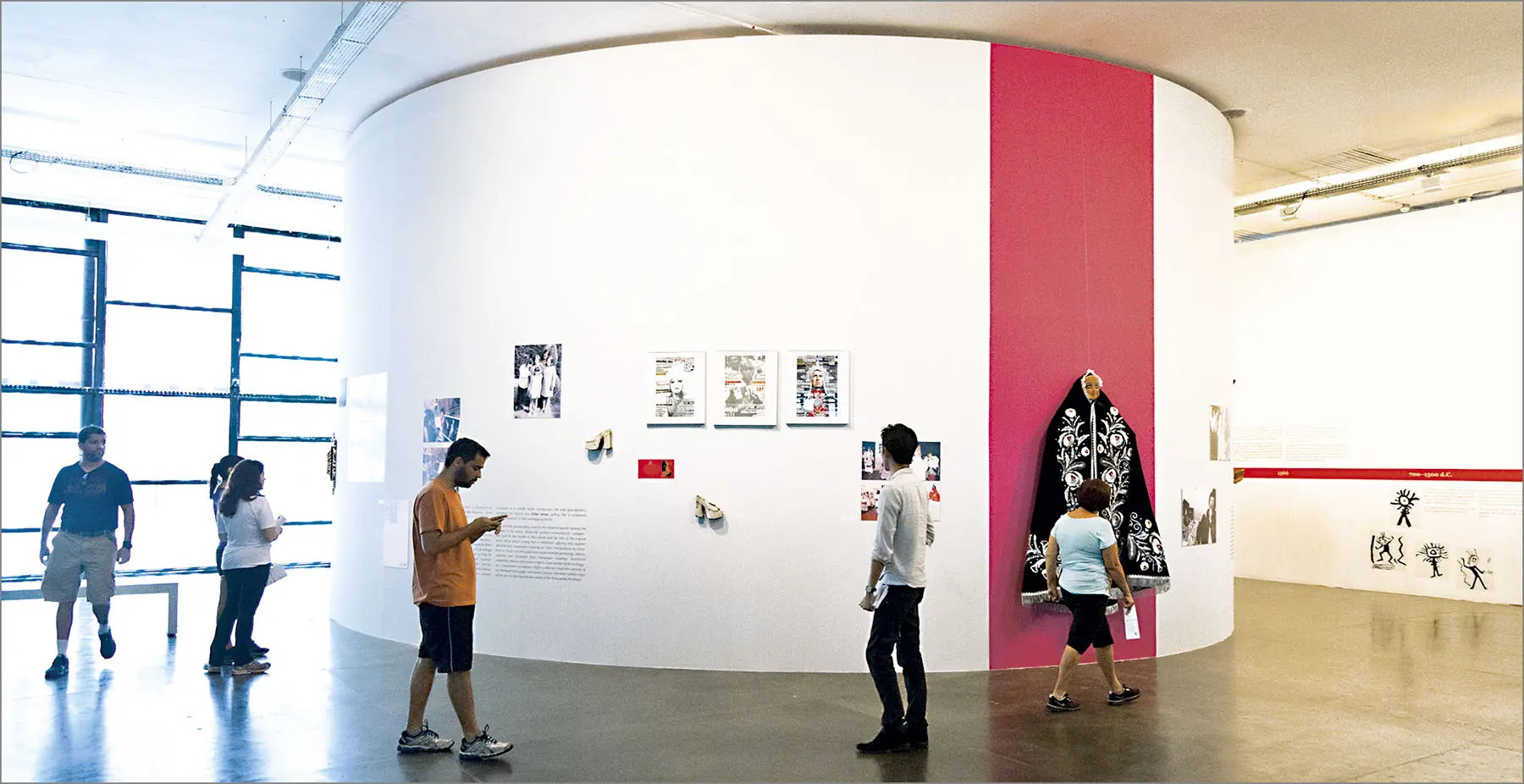
Open to the public on September 6th, the 31st São Paulo Biennial presented the proposal of an event not only expositive but also constituted by the practice of debate around art topics: it presented us with the challenge of thinking reality through aesthetic experience.
The exhibition part featured 81 projects, with more than 100 participants and 250 works of art. The curatorial team led by Charles Esche preferred using the term “projects” to emphasize a wider range of contemporary cultural practices and to foster multi-disciplinary collaboration among the participants: artists as well as architects, performers, sociologists, and teachers. In this way they highlighted individual as well as group production. Most of the projects were specific to the biennial, and many of the artists coming from abroad did their work in art residences in São Paulo or other Brazilian cities.
The title of the 31st biennial, How to (…) things that don’t exist, was constructed, according to the curators, as a poetic invocation of art’s potential and its ability to act upon and intervene in the sites and communities where it manifests itself. The idea was for the reticence of the title to be compensated by our insertion of terms like “seek” (How to seek things that don’t exist), “recognize” (How to recognize things that don’t exist), “fight for” (How to fight for things that don’t exist), “read about” (How to read about things that don’t exist), “use” (How to use things that don’t exist), imagine (How to imagine things that don’t exist).
The intent was for the range of possibilities for action and intervention on offer for viewers-interlocutors to remain always open, thus the suggestion of a constant shift in the first verb in the title sentence. A visit to the biennial was to be like an experimental course, and audiences had to explore, at their own pace and will, some of the possibilities it featured. The curators wanted to emphasize the moment of interaction with the exhibition so that it fostered the sharing of experiences between curators, artists, and public, taking also into account, beyond a contact with the art projects, the ideas that emerged in the debates and situations that occurred during the event. Thus, what doesn’t exist could acquire existence and produce a transformative outcome for the visitor. This potential of the arts is what the 31st São Paulo Biennial intended to activate.
The introductory text signed by the curatorial team1 tells us that the intention was to:
“Engage the contemporary condition of São Paulo, in Brazil, and other places by means of an articulation of artistic and cultural projects that maintain a specific relationship with the current moment, a moment which, along with a sense of profound disappointment with regards to the exciting modalities of social, economic and political organizations, is witnessing the birth of many initiatives in response.”
A central point in the curatorial project was, in consequence, bringing to light situations of social conflict. The drivers for the projects had at their base unresolved relations of confrontation: the emphasis was placed primarily on the crisis that emerged around issues of gender, religion, and ecology, as well as on social and political matters, as significant vectors in the biennial. Of special note is the presence of Latin American and Middle Eastern artists.
Based on information published by the institution, be it in its publications, be it in visitors’ orientation activities, we shall highlight and comment on some of the works on view to illustrate what the 31st São Paulo Biennial intended to present. We will underscore some works that especially interested the public.
Palabras Ajenas, by León Ferrari (1920-2012), dated from 1967, was the point of reference used by the Etcétera collective for the creation of their project, titled Errar de Dios. Built using fragments of statements by political figures as reported in the mass media—on religious issues, the economy, world culture—and quotes from the Bible, this work intended to shed light on the responsibilities of US imperialism, Nazism, and the Catholic church in the wars of the Twentieth Century. It was a participatory installation. There was a recorded text that could be listened to and functioned as a script. The text was written by Loreto Garín Guzmán and Federico Zukerfeld, along with philosopher Franco Berardi (Bifo). It was an essay on the 2008 financial crisis, in the voice of the Pope, Angela Merkel, God, Saint Paul, Monsanto, and Goldman Sachs. The presentation was on two stages facing each other, where visitors could become actors and intervene spontaneously, overcoming at times the recorded text.
Since its launch in 1997, the Etcétera collective has used the strategy of combining drama, literature, artistic practice, and political activism. The group participated actively in the social movements that emerged after the Argentine crisis of 2001, and in 2005 they founded, with their network of activists, the Surrealist-inspired Movimiento Internacional Errorista. The movement’s strategy is to emphasize error as an essential experience and to demand a shift in the speculative paradigm of contemporary capitalism.
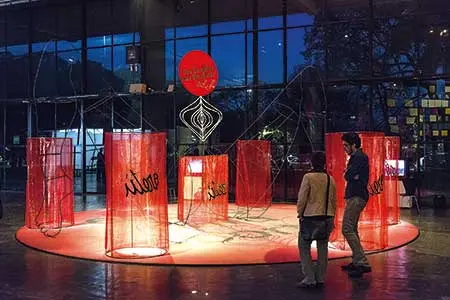
Espacio para Abortar was the project developed by the Mujeres Creando group, which acts in La Paz and Santa Cruz de la Sierra, in Bolivia. It is an intervention and participatory performance against the “dictatorship on female bodies,” and their intent is to promote dialog with the help of the image/simulacrum of an immense ambulatory uterus, placed on this occasion in the biennial’s ground level, at the right of the entrance.
The group’s discussion program includes the implications of abortion, the meaning of free will, freedom of conscience in contemporary society, especially in Latin American countries with their colonial past, where abortion is mostly illegal and persecuted as such. In São Paulo, a multi-ethnic society with a heavy presence of immigrants from many countries, their work acquired, according to the group, new characteristics, prompting a renewed debate on these topics.
The Mujeres Creando group was formed in La Paz in 1992 and brings together poets, journalists, market sellers, domestic laborers, artists, seamstresses, teachers, and prostitutes, all united in a struggle against Bolivia’s and the world’s “institutionalized patriarchy.”
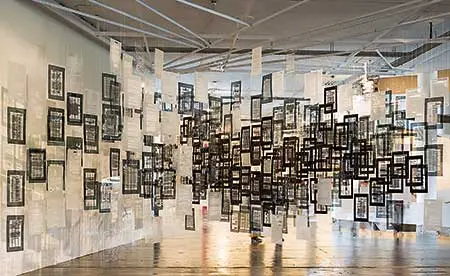
Voluspa Jarpa’s Historias de aprendizaje was a labyrinthine and irregular installation made using documents on the Brazilian 1964-1985 military dictatorship from the CIA archives, declassified some years ago by the US government, and documents from the Brazilian secret services produced during the presidencies of Getúlio Vargas (1951-1954) and João Goulart (1961-1964). Of Goulart, overthrown by the 1964 military coup, Jarpa included records of his exile in Uruguay and his supposed assassination in Argentina, in 1976, investigated as a joint action by the Southern Cone dictatorships.
Jarpa highlighted the symptomatic fact that all the declassified documents include redacted sections, absent text. The structure she developed for her installation reiterated the impediments to access in these documents and the enclosure of information: between acrylic plates, the documents superimposed on one another and there was no ideal space for approaching and reading them. It is, the curators say, a “possibility as an impossibility,” a “revelation as repression,” a “poetic and political use of the archive which creates shadows on the present.”
The Incidental Insurgents, an installation by Basel Abbas and Ruanne Abou-Rahme, presented a multi-layered narrative in reference to the contemporary political crisis and the potential of the social imaginary. The installation comprised images, texts, objects, sound, and video material. All these documents sought to be an investigation about the potential of the future, on the basis of literary texts and events.
The first part of the installation combined four stories: the anarchist life of Victor Serge and his bandits in Paris, during the 1910s; a story about Abu Jilda, Arameet, and their group; a review of the figure of the artist as “the quintessence of banditry” in The Savage Detectives, Roberto Bolaño’s 1998 novel set in 1970s Mexico; and the story of the authors, Abbas and Abou-Rahme, in contemporary Palestine. With this strategy of putting together different narratives, this first section of the installation questioned the stories of foreign rebels that are cast aside from revolutionary struggles, like criminals.
The second part examined the metamorphosis of the characters after their deaths, noting how their final gestures had an impact on the social space. With this, the work of the Palestinian artists attempted to “reject the apparent permanence of the capitalist present,” shedding light on the permanent drive to refuse, which continues to reemerge.
Handira 1997 / Bert Flint 1997-1998 / Granada 2002 are a series of works by Teresa Lanceta, an artist who deals with the communities of weavers of Morocco’s Middle Atlas region and Granada, Spain, where textile traditions represent a collective and silent medium for permanence and communication. These series were brought in for the exhibition.
For Lanceta, art is an open code that, when known, can be read, transformed, and communicated. The issues of survival and memory are present in her work, as is the idea of collective aesthetic creation with deep cultural roots.
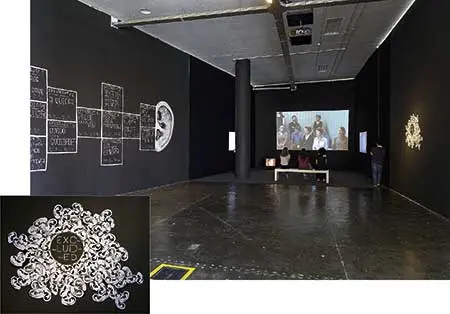
The Excluded. In a Moment of Danger was the project of the Russian collective Chto Delat, whose name translates as “What to do.” It is a film about the prison system, connecting different historical moments when entire worldviews are in conflict. The artists use theater techniques and references in the manner of Bertolt Brecht. The film explores the prison environment as a place of isolation, a punishment for crimes committed, and a site for those who are outside the social norm. Prisons symbolize social control, displaying the power of the State, which is at the same time protective and repressive.

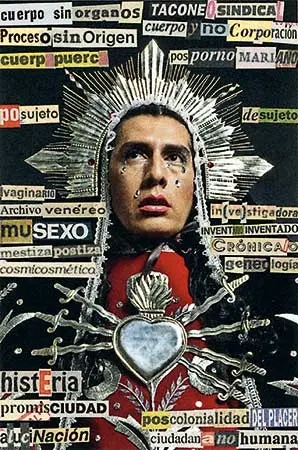
Líneas de Vida / Museo Travesti del Perú is a project by philosopher and drag queen Giuseppe Campuzano (1969-2013), intended to construct a gay counter-narrative. Campuzano gathered objects, images, texts and documents, news clippings, and art objects to build actions, dramatizations, and publications that transgress the idea of the body and its conventional image. The project also proposed a critical tour of Peruvian history, through the gaze of a fictional character presented by the artist as an “androgynous Indian-mestizo crossdresser.” These are posited as the central interpreters of history. Campuzano’s is a nomadic museum that dramatizes fictional stories and disarticulates the conventions of heterosexuality. The curators note that the museum’s portable nature and its potential to function in public squares, street markets and fairs, university conferences, and exhibitions like the Biennial, have fostered a questioning of orthodox activism.
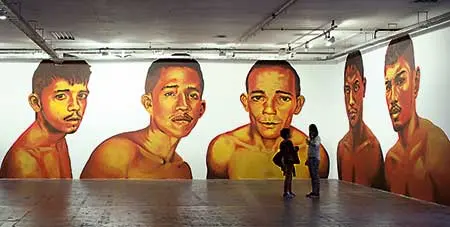
The public was also captivated by a mural by Eder Oliveira, who created outsize portraits of characters from the news reported in the crime section of newspapers in the state of Pará, in the Brazilian north, where the artist lives and works. His project is a reflection of how respect for civil rights is not a consideration in news coverage that also displays a tendency toward ethnic discrimination in their narrative of violence in the country.
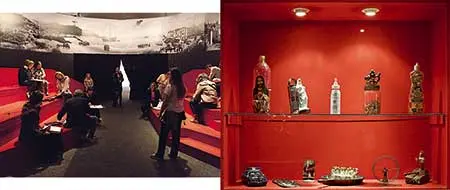
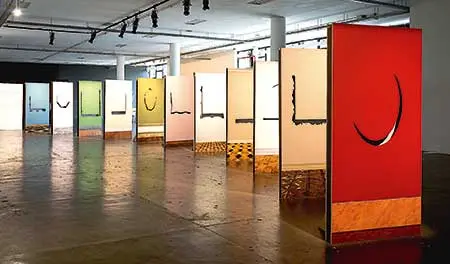
Walid Raad’s work in this edition of the biennial integrates an artistic project in progress since 2007, Scratching on Things I Could Disavow. Art in the Arab world, modern and contemporary Islamic art, is found in objects and stories by individuals and institutions. Raad’s work salvages archival information and arms itself with inscriptions on prefab wood plaques, arranged as parts of walls and aligned in the middle of the exhibition space. The inscriptions are attributed to Suba Traboulsi and were recovered in 2012 from the basement of São Paulo’s Syrian-Lebanese Hospital. Suba Traboulsi created his sculptures in 1933 and stored them in his basements. Convinced of the “end” of Arab art, she saw her work as “magnets for lost shadows,” necessary for the resurrection of Arab art. Traboulsi was able to build 11 of the 276 Walls she had projected. This statement, the only one Raad has found in any archive, was made to a Norwegian journalist in 1941. With his installation, Raad publicized the discovery of these records and interpreted their meaning.
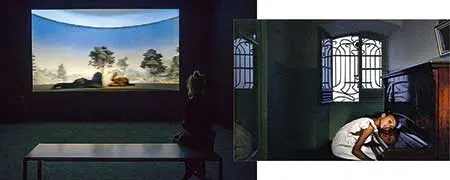
Sarajevo-born Danica Dakic, now living in Germany, explores in her art the experience of migration. For the 31st Biennial she presented El Dorado, a video installation (video: 13’39”, with sound and color) focused on the issue, pointing out the matters of identity as well as the cultural and political tensions that affect immigrants. The video is presented in front of a painted panel, and it features individuals who experienced migration in their own lives and become, in Dakic’s work, the agents of history.
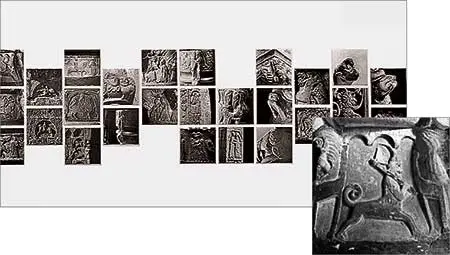
Two figures of historical importance in contemporary art were highlighted by the 31st São Paulo Biennial for their continued relevance. They are Asger Jorn, with his 10.000 ars nordisk folkekunst (“10,000 years of popular Nordic art”), dated from 1961-1965 and comprised of photographs by Gérard Franceschi, and Brazil’s Hudinilson Jr., with Zona de Tensão, a project from the 1980s.
The curators interpreted Asger Jorn’s work as a project intended to recover all that was lost or forgotten in a culture, which can be understood as a path towards the construction of the future. His images recover aspects of medieval, Romanic, and Gothic architecture. Nearly 20,000 photographs of architectural details and sculptures from the era were taken, and a poetic sense is built through the association and articulation of these images. Together, the curators say, these images “speak of a world in constant shift, one where everything is of the same value and where what matters is the search for or the creation of connections.”
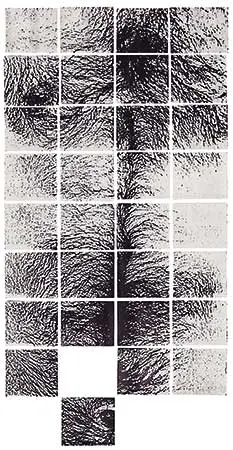
Hudinilson Jr.’s pioneering work—he was a creator of what in the 1980s he deemed “Xerox art”—also illustrated his use of the grid. The artist used photocopied images blown-up to the A3 and A4 formats, with gridded structures. Hudinilson Jr. investigated the theme of the male nude, pointing out the political and moral obstacles faced by homoerotic thought. It is important to note that these took place under the Brazilian military dictatorship.
The spatial montage of the exhibition was delegated to Oren Sagiv, a member of the curatorial team, with the collaboration of Anna Helena Vilella. The design of the space wanted to articulate the show with the building’s architecture, a project of Oscar Niemeyer. It defined a well-organized path for visiting the exhibition.
We must also note the educational project developed in perfect harmony with the curatorial proposal, allowing for special attention to many schools and groups. There are still some sequels, with the traveling of segments of the exhibition to other cities in Brazil at the end of the São Paulo event.
Starting with its slogan—How to (…) things that don’t exist (seek, recognize, fight for, read about, use, imagine)—the São Paulo Biennial invited visitors to exercise their own imagination around its essayistic project. The Biennial was open from September 6th through December 7th.
NOTES
1. The team is comprised of Charles Esche, Benjamín Seroussi, Galit Eilat, Luiza Proença, Nuria Enguita Mayo, Oren Sagiv, and Pablo Lafuente.
2. Voluspa Jarpa (Rancagua, 1971) is a Chilean visual artist.
LISBETH REBOLLO GONÇALVES