
At the entrance of
the Museum of Contemporary Art in Massachusetts, where the artist Teresita Fernández
presents an exhibition of large format works, the receptionist offers visitors
the opportunity to touch a miniature model of one of the installations that
viewers will see in the gallery: the work Lunar
(Theatre). The work consists of a sea of small glass spheres
placed on the floor in a space delimited by steps that flow into the corridor
where visitors walk through and a wall in the background with a sequence of
tall windows throughout that offer a view of the landscape of North Adams.
Fernández had already employed these spherules numerous times because of their capacity to reflect the surroundings. In this case, the reflection of the ceiling, windows, and the exterior landscape offer an image of the vastness that exists in the miniscule. Standing on the corridor, looking at the image from a low vantage point, viewers are able to observe that sea of glass as a continuation of the natural light entering the building. It is an effect similar to those achieved by some of the architectural works of Frank Lloyd Wright—particularly the Fallingwater house—that translate traditional Japanese aesthetics into a modern constructive language of continuity and flow. It is no coincidence that Fernández maintains a close dialogue with the culture of Japan, where she lived for a few years and visits often.
The tension between opposites manifested in this work—such as interior-exterior and big and small—is in fact one of the central themes of the exhibition that Fernández titled As Above So Below, inspired by a poem from the Vedic tradition. This tension results in an argument between materials, shapes and iconographic motifs given the essentially symbolic nature of Fernández’s work despite its abstract appearance.
Displayed across the walls of a perpendicular corridor, marking the beginning of the walk through the exhibition, the site specific installation titled Sfumato (Epic) consists of a shape formed by hundreds of small mined graphite rocks attached to the wall and a long shadow underneath drawn by Fernández to achieve an attractive trompe l’oeil effect. The overall form of this installation is like that of a constellation that accompanies visitors on their walk through space. Irregular in their individual shapes, the stones merge into a homogenizing wave along the horizontal plane, but the vertical weight of the shadows produces a visual effect that attenuates the movement. Likewise, the work highlights the paradox that is implicit in the rocky mass of graphite being the element that gives dynamism to the form, while the lightness of the drawn shadow actually contributes to its pause.
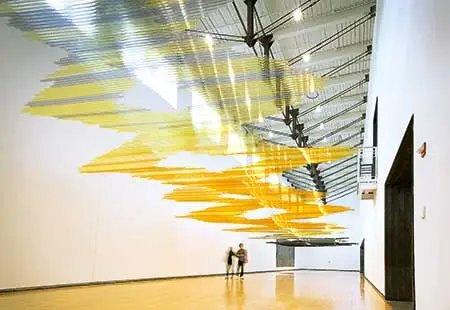
The tension effect of the visual forces moving in opposite directions has a counterpart in the piece Black Sun, another gigantic installation made up of translucent polycarbonate tubes, colored in blacks, yellows and oranges. Fernández hanged the tubes from the ceiling in descending order from the gallery on the third level to the first floor, or vice versa. In any case, the work creates a contradictory feeling in that, on one hand, it appears to be a sort of cascade of dark and bright moving stripes while, on the other, it suggests an architectural form—a roof when viewed from below or a staircase when observed from above. Just like in the piece Lunar (Theatre), where the transparency of the windows allowed an effect of continuity, in Black Sun the translucent tubes integrate the roof into the image of the piece when viewed from the first floor.
These three works represent the core of the exhibition. Not only because of their expansive nature and large scale, but also because they clearly illustrate Fernández’s artistic approach for this exhibition. It is a reinterpretation of the landscape genre through works that demand a different perceptual experience: that of a moving viewer. Rather than contemplating a still image, Fernández proposes a visual-motor experience, a tour of the body that becomes a visual tour. In the text of the accompanying catalog, Denise Markonish, curator of the exhibition, wrote “... [viewers] walk by Fernández’s installations and experience them just as they would a landscape painting and, in the process, they compose an image in parts based on the artist’s complex sequence of materials, light and space.”1 However, the works do not differ much from the usual exhibitions and environments of solo shows presented at museums and international biennials.
These three installations are complemented by a series of two-dimensional works on the wall (chrome panels of various sizes) and two sculptures that interact with each other titled Bonsai and Rorschach. Both consist of sculptural forms in gold and cast nylon on a rectangular base. With these, Fernández again illustrates the tension between opposites: the flat and symmetrical patch in Rorschach acquires a volumetric form and resembles rock formations; it is the abstraction of a landscape. On the other hand, Bonsai resembles the miniaturized mockup of the domestic landscape cultivated in Japanese tradition. In the context of the exhibition, this miniaturization is accentuated by its placement next to the huge panel Golden (Obsidian Sea). In these works, Fernández continues to develop a type of production that relies on the formidable expressive power and beauty of mineral materials (graphite, gold), but without allowing them to overshadow the symbolic meaning of her images. There is no lack of allusions to significant motifs such as mountains, stairs, and landscapes. In a sense, they are works of impressive technical achievement with a strong aesthetic foundation.
Born in Miami, Fernández studied arts at Florida International University and the University of Virginia. Her ascending career received a boost when US president Barack Obama appointed her to serve on the U.S. Commission of Fine Arts. She became the first person of Hispanic origin to occupy the position. With this solo exhibition at the Massachusetts Museum of Contemporary Art, Teresita Fernández solidifies her strong position among US contemporary artists.
NOTE
1. Denise Markonish, “Nothing rests; Everything Moves; Everything Vibrates”. Teresita Fernández, As Above So Below (North Adams, Massachusetts: Museum of Contemporary Art, 2014): 68
ELVIS FUENTES