
It is the afternoon of October 22, 1998. We are at La Chascona, Pablo Neruda’s home-museum in Santiago de Chile. Poet and artist Raúl Zurita is to receive the Pablo Neruda Prize. Not too far from there, Pancho Casas and Pedro Lemebel take off on their way to the event from the Del Cerro bookstore, in Bellavista. They are two blue-collar youths from the Pudahuel and San Miguel neighborhoods respectively. Arriving at La Chascona, they immediately grab the attention of everybody present with their outfits and their attitude. Casas and Lemebel approach Zurita and place a crown of thorns on his head, at once a tribute to and a jibe at the Christian references found in some of his writings. Nobody claps or cheers. The poet refuses the coronation. A journalist comes to the young man and asks, Who are you? “Las yeguas del Apocalipsis” (“The Mares of the Apocalypse”), is the reply.
October 25, 2012. The Reina Sofía museum in Madrid. Present at the inaugural act of the Losing the Human Form exhibition is the museum’s Director, various political office-holders, and her Highness the Queen herself. And Pancho Casas, who, in cross-dress, breaks all protocol and kisses Queen Sofía on both cheeks. Here, however, he garners all kinds of applause, salutations and, later, entire seminars filled with prominent intellectuals, artwork sales (the museum would acquire, the following year, Pedro Lemebel’s Manifiesto. Hablo por mi diferencia), nominations (Lemebel again, for Chile’s National Literature Award in 2014), and recognitions in events like the 2014 São Paulo Biennial.
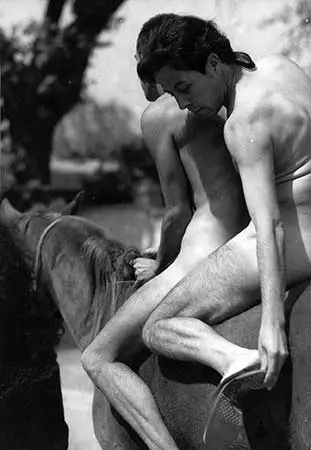
Want it or not, Las Yeguas del Apocalipsis, the duo established in Chile in the mid-1980s are been relaunched since the late 2000s, after more than a decade when their work was not exhibited at all, anywhere. Museums, academic institutions, and collectors are taming an animal so willfully ignored in its time (their performances, which so many people now claim to have been there to witness, rarely reached an audience of fifty); a rebellious beast often insulted, scorned, and censored, for instance by the Museo Nacional de Bellas Artes de Chile in 1990. Luis Alarcón and Ana María Saavedra (now the proprietors of Galería Metropolitana) were friends and collaborators of the yeguas in the late 1980s. Remembering those times, they say: “back then, no doors would open for them. People even threw them out of galleries. And look at them now.” But let’s not go to the opposite extreme: they were not two crazed night queens flashing their cocks at schoolchildren in Santiago. They were two highly cultivated and well-read artists (Severo Sarduy and Néstor Perlongher are among their references), versed on contemporary art (admirers of Carlos Leppe, Juan Dávila, Joseph Beuys), and they were also very professional: all their performances were presented on time and in a sober state.
Pedro and Pancho met at the Del Cerro bookstore, owned by poet Sergio Parra, who accompanied them in almost all their actions. Pancho Casas was a Literature student at Arcis University, where several intellectuals who returned from exile taught at the time, such as Diamela Eltit and Soledad Bianchi. Pedro Lemebel was a writer and a leftist activist who had already published his Cuentos inconfesables and sold trinkets, such as pornographic postcards, on the street across from the bookstore. They came together based on a mutual project: to speak through the body, through gestures, through action. To act in committed political ways, celebrating difference, homosexuality, and transgender identity as well as indigenous peoples and the oppressed. On the basis of such shared concerns, they prepared and staged around twenty performances that challenged the conservative mores of the era, the legacy of dictatorship in the newly minted Chilean democracy, homophobia, class discrimination, and even the embourgeoisement of the left like no other artist during that period. As Sergio Parra notes, they “generated conversations in poor neighborhoods, street barricades, and their performances, attended by a handful of people who learned of them via word of mouth. At the end of their actions, we would go to some local dive or to someone’s home, for dance parties where people were kind of afraid, not knowing how the whole thing would end.” Luis Alarcón and Ana María Saavedra contributed with whatever they could so that the yeguas were able to perform. “Each brought in what we had. I (Luis) lent them amplifiers or a slide projector. They did not have a cent. Also as a group, because we were a circle of friends, we tweaked small details of discourse: the titles for the performances, what outfits would be more meaningful… It was a transdisciplinary group, with people who came from literature, feminism, the arts…” Pancho Casas and Pedro Lemebel ceased performing as Las Yeguas del Apocalipsis in 1997, but they never stopped caring for their legacy. The fact that they are now celebrated and acclaimed is, despite the delay, great news. But let us continue with our chronology.
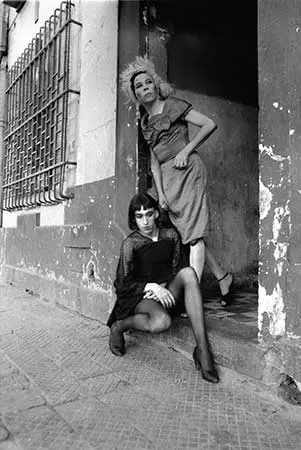
One of their earliest actions was Refundación de la Universidad de Chile (August 1988, Universidad de Chile’s Fine Arts School). Casas and Lemebel entered the university in the nude, mounted on a mare. Casas explained later: “We had the idea of riding a horse, like Pedro de Valdivia, and nude, like Lady Godiva.” In this way, they symbolized the liberation of the University (until 1987, its president was appointed by the military regime) and their own nude bodies and homosexual identity. At this point, it is perhaps pertinent to analyze the group’s name. It has an obvious sexual connotation, as Fernanda Carvajal has pointed out (in Ensayos sobre Artes Visuales Palacio La Moneda’s Visual Arts Documentation Center, LOM Ediciones, 2011): “A yegua is always mounted, both in the military and the sexual senses of the term. This is the trauma residue that returns and operates in the Latin American uses of the term, where yegua names both an exuberant or a vulgar woman, as well as a homosexual man.” According to Justo Pastor Mellado, the biblical reference could be related to the military dictatorship, establishing a parallel between the four horsemen of the Apocalypse with the four members of the Chilean junta. For Carvajal, it could have an added meaning as well: “they appropriate the figure of the Apocalypse, translated by them as a reference to AIDS.”
The Yeguas are always associated with gender-themed art and categorized under the label of “homosexuality.” But this limits the range of their influence. If we needed to situate their work under one label, it would have to be the defense of human rights. In 1989 they did a performance at the Sala de Arte in Garaje Internacional Matucana 19. Casas and Lemebel appeared painted in white, with Chinese characters written on their bodies. They stuffed themselves inside bags; the bags were then filled with animal viscera until they exploded. It was a tribute to the students massacred at Tiananmen Square. This work cannot be framed as “gender” art, much less as under its “homosexual” subcategory. Another example of the Yeguas’s political gestures, as Sergio Parra defines them, was De la nostalgia (Normandie Cine-Art House, 1991). And this work allows us to introduce another question around their oeuvre: how much there is in it of improvisation, chaos, and carnivalesque celebration, and how much is there of meditation, reflection, and planning. In De la nostalgia, the Yeguas dramatize a farewell to the Normandie, a mythic meeting point and debate center for Chilean cinephiles, which presented on that date its last show (the film was Munchausen). Casas and Lemebel shared the show with the rest of the audience and after it they made their own movie: cross-dressed and made up, their eyes filled with artificial tears, they paraded in this guise among the audience like Hollywood stars, catwalk to two stars they had previously drawn on the street asphalt and urinated on them. This delirious scene appears to have been planned thoroughly, and it was. But of course, there was room for spontaneity and for accidents, as Luis Alarcón describes them: In that performance, I was in charge of the music, but, by mistake, the song we wanted didn’t play, in fact, the tape ran backward. Later, Pedro really chewed me up (laughs).” Ana María Saavedra also remembers ‘complex’ moments: They had to pee on the stars, but they weren’t ready. So, we had to gulp down a few beers rather desperately. In spite of such unprogrammed mishaps, the performance was a success. They didn’t care whether it came out exactly as they wanted; for them, the actions always came outright,” says Sergio Parra. At any rate, music or no music, with urine or dry, De la nostalgia achieved what it set out to achieve: to provoke controversy about real estate speculation (which steamrolled over a cultural institution), cultural imperialism represented by the American film industry, and the allure of the celebrity world.
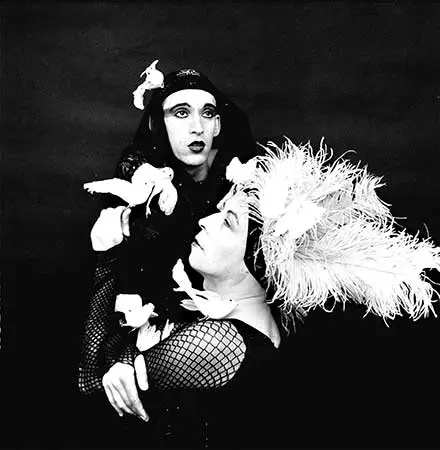
Their immersion—or, rather, intromission—in the world of politics was always predicated on their character of outsiders. Widely commented was their Almodovarian intervention of Teatro Cariola in 1989. Patricio Aylwin, from the strange conglomerate that was Concertación por la Democracia, candidate for president in Chile’s first democratic elections after the dictatorship, was presenting his cultural program, with important intellectual figures invited to attend. The Yeguas, of course, not among them. But a mare is a stubborn animal. They came anyway, dressed in suggestive corsets, and interrupted the speech by actress Ana González. They were carrying a canvas with the slogan ‘Homosexuals for change.” The intellectuals sitting in the front row, stunned and open-mouthed like porno actors, tied themselves all up in knots as they watched Pedro Lemebel coming down to the sitting area in his most flamboyant style. He grabbed Gabriel García Márquez and kissed him on the mouth better than Marlene Dietrich. “Uy!” said the writer. Lemebel’s next victim, senate candidate Ricardo Lagos (later the country’s president). The performance title was: ¿De qué se ríe, presidente? (“What are you laughing at, Mr. President?”). Retroactively, this action signaled the turn of the Concertacion’s future behavior, open to adopt and take advantage of any position if it could be translated into votes.
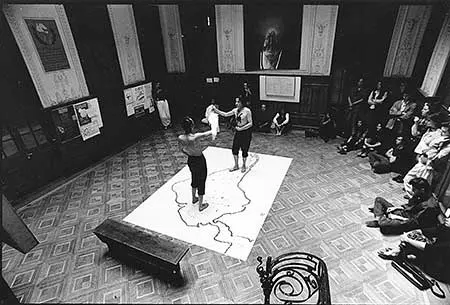
Many readers may be wondering at this point how precisely are these boutades and pranks art. The Yeguas actions are anchored not on the provocation they entail, but on their visuality. Their inspiration in the Baroque, for instance, or their use of local creole folklore, as well as the connections established with classic films or the inner history of Chilean art. Obviously, some of their works are a bit more deeply than others, but all are justified by their political necessity. Both elements, depth, and necessity come together in La Conquista de América (1989, headquarters of the Chilean Human Rights Commission). The so-called “Day of the Race” is celebrated on October 12th, commemorating the European unrequited) conquest of the Americas. The Yeguas wanted to celebrate in their own way: with music and dance, yes, but not in joy. The audience was mostly comprised of art students, and the photographic record was in the hands of Paz Errázuriz. On the floor, a map of South America was covered by broken glass from Coca-Cola bottles. The torso is nude, decorated with a walkman stuck to the chest. They begin a traditional cueca, the national dance as decreed by the dictatorship, and which according to conservative mores must be danced as a (heterosexual) couple. To contextualize: the cueca is a creole dance, influenced by the Spanish jota (remember the performance’s title). In 1978, the folklore troupe of the Families of the Disappeared Association, in an International Women’s Day event, presented for the first time their cueca sola (“cueca alone”), underscoring the absence of the partner. Since then, the cueca sola is associated with widowhood, and, more specifically, with the mothers and spouses left alone after the dictatorship disappeared their loved ones. The Yeguas had these and other references on their minds (Violeta Parra) when they danced barefoot on the broken glass, following a cueca that only they could hear. Their blood stained the map of South America, geography violated by the Condor Operation, the sinister program for the capture, disappearance, and murder of opposition activists by “friendly” regimes. All of this, as I said, at the headquarters of the Human Rights Commission. Poisoned darts against the legacy of the Spanish conquest, US imperialism, and decades of dictatorship across the continent. Nobody clapped.
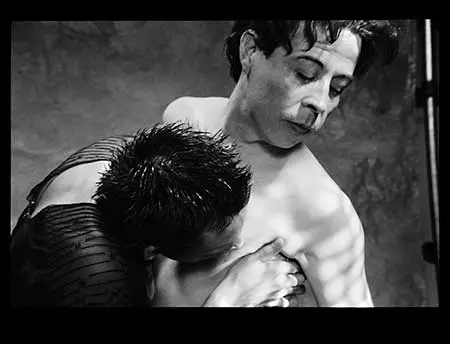
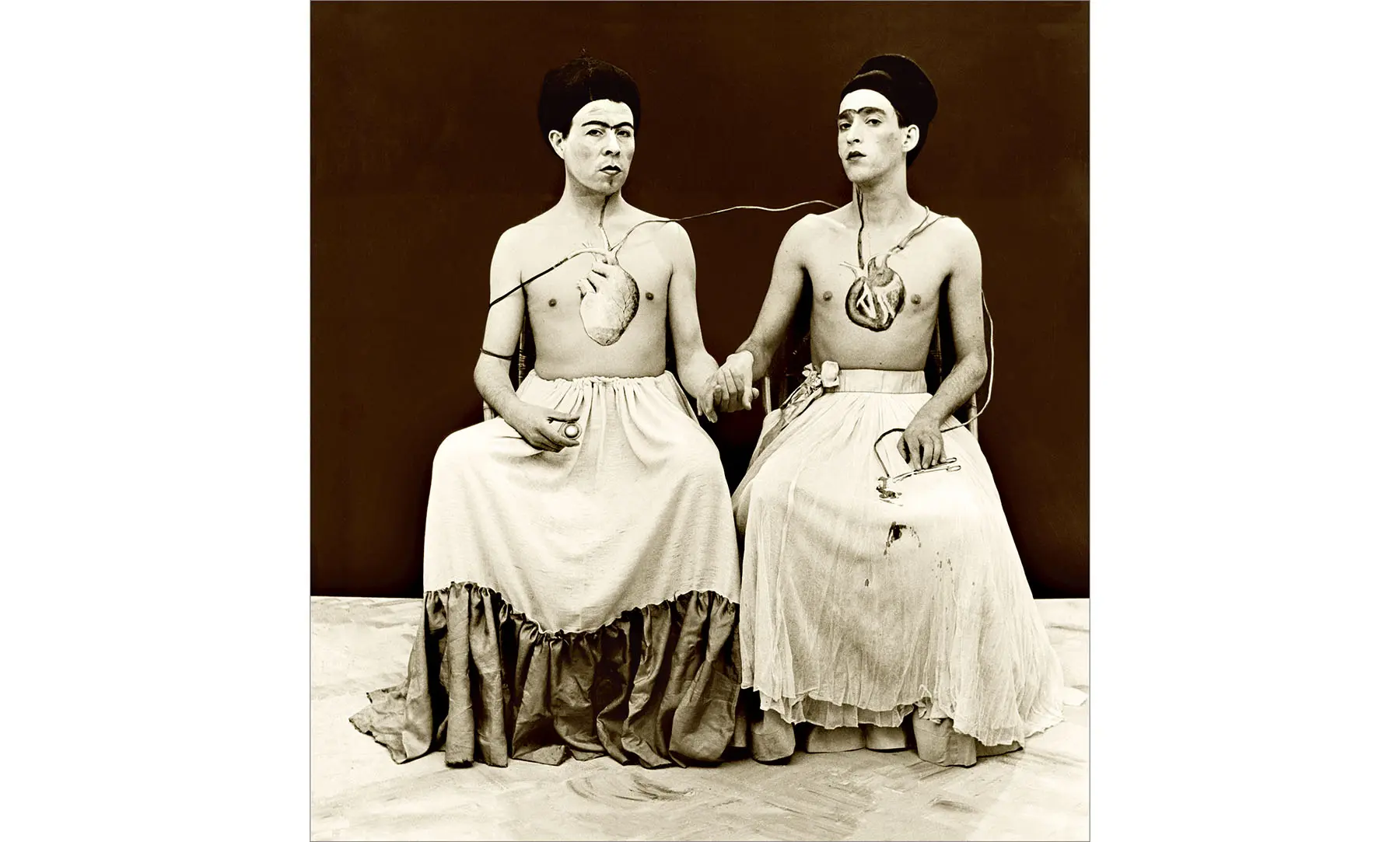
The origin of the Yeguas del Apocalipsis’s most iconic image dates back to 1989. Photographer Pedro Marinello held a session with Casas and Lemebel both in character as Frida Kahlo, Casas clad in Victorian dress with his heart out in the open, Lemebel in Mexican garb with his heart closed. Holding hands, they are connected by a blood-transfusion catheter. A year later, at Bucci Gallery, they presented the image inside a display window. For more than three hours they reproduced the photograph. Las dos Fridas brings several things into question. Again, cultural colonialism, understood as a process with a point of origin (the Conquest and the Colonial structure) and evolution over time, the tourism and commercial colonialism Nelly Richard alludes to in this quote: “The work dislocated the market of identity representation with its cross-dressing parody, carnivalizing both the feminine and the feminist iconization of Frida Kahlo, which, after having been raised as en emblematic banner of female struggle and resistance, became commercialized in the Frida fashion” (Residuos y metáforas, Nelly Richard, Editorial Cuarto Propio, 2001). And, of course, AIDS. The work was acquired by Museo Rufino Tamayo; this is to say, it is on permanent exhibit in Mexico City, Frida’s hometown.
1989 and 1990 were the Yeguas’s most active years. In the 1990s they did a few performances, before their farewell as a collaborative duo. Both Casas and Lemebel began to reap accolades as literary writers and decided to focus on that aspect of their careers rather than continuing their artistic legacy as a collective. Their swan song happened at the Havana Biennial in 1997, with Ejercicio de Memoria. In cross-dress, they gave a conference about their work and their actions, under a large banner on the wall that read “I speak through my tongue, my sex, my social popular.” The anthem of the Socialist International was played. A year after the dissolution of the duo, Article 36 of the Chilean Penal Code, which punished with jail terms those who engaged in homosexual relations, was repealed.
After their separation, silence. More than ten years without having their art exhibited, acquired, cited. For Sergio Parra, the reason behind it was a presumption on the part of local collectors that “they would always be there,” and that, consequently, there was no hurry to acquire their work. “They must have thought the Yeguas were like their wives, always expected to be there when the man comes back from work.” According to Luis Alarcón and Ana María Saavedra, they were not included by Chilean curators: “They had no recognition in the 1990s art scene, neither Justo Pastor Mellado nor Guillermo Machuca, the most active curators, worked with their oeuvre.” At any rate, the Yeguas del Apocalipsis were the mules of Chilean art: they left no descendants. No one took the post of their way of understanding performance: political, bold, visual, festive.
August 2014. A 22-year-old transsexual woman, Zaconi Orellana Acevedo, is shot twice on the corner of Americo Vespucio and Paulina streets, coming out of a party in La Florida, Chile. It was a homophobic crime. Nobody cheered.
JUAN JOSÉ SANTOS MATEO
Art critic and curator.