
Valdir Cruz has been
engaged with photography since the early 1980s, and in the ensuing time, his
photographs have been the subject of more than fifty solo exhibitions and
become part of collections throughout the world. He has lived in the United
States for the last 25 years, and in 1996 Cruz was awarded a Guggenheim
Fellowship for Faces of the Rainforest,
a project documenting the life of indigenous people in the Amazon Rainforest.
During all this time, however, he maintained an ongoing project of revisiting
the town of his birth, Guarapuava, in Northern Brazil, and the result is a
photographic essay thirty years in the making, which has also been produced as
a book. A selection of these images is currently on view at Throckmorton Fine
Art in New York City.
Cruz was trained in photography by George Tice, who emphasized mastering the craft of photographic printing, a skill Cruz then exploited more fully by developing his own printmaking process.
Cruz, who unabashedly continues to work with film in an increasingly digital age, has refined a technique that allows him to make large format prints (the largest in the current exhibition are 40x40 inches) using pigments that are actually embedded onto the paper. This leaves a tactile physical imprint as the pigment actually resides on the surface. The resulting work is therefore impressive not only for its scale but also for the rich velvety textures it exudes while retaining the crisp sharpness of a high contrast photograph. The works have also been produced as smaller scale high contrast gelatin silver prints, and it is instructive when one is able to compare the two formats in person.
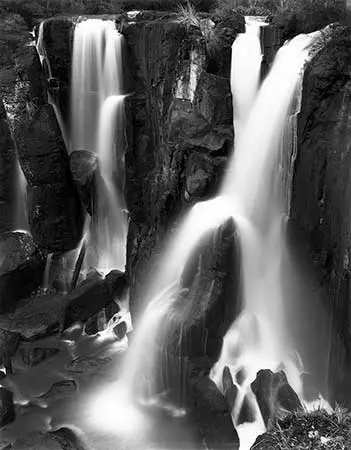
Some of Guarapuava’s images are masterpieces of landscape imagery with rich textures and a full range of greyscale. Salto São Gerônimo II, a majestic scene of a waterfall, is powerful in its large vertical presence but also for the deep contrast of the black rocks against which the almost pure white of the water is set in relief, whereas Landscape with Lily Lagoon/Paisagem com lírio-da-lagoa has a more dreamlike quality as the layers of atmosphere and depth create hazy washes of grey. Cruz’s portrait of this place is also a portrait of its people. Cruz’s figures manage to be formally posed and casually familiar at the same time, and while they evoke a sense of impoverished rural existence they are by no means exploitative or pathetic, thus distinguishing them from works by, for example, Dorothea Lange, Walker Evans or Tina Modotti. Works such as Potato Picker/ Catador de Batatas and Girl / Menina all have a timeless immediacy that can belie the actual year in which they were taken. The entire body of work evokes a place that is both very specific and at the same time otherworldly.
In fact, this lack of temporality maybe this project’s one major detraction; taken as a whole, these images present a sense of a land that is somehow displaced in time and space, not quite of our world. Whether this fantastic ethereal timelessness is simply the result of this community being at a remove from most of the conventional Western markers of progress and process, or whether Cruz deliberately chose to create this sort of nostalgic mythology (for example, why not revisit certain figures over the years to see how they have changed?) is uncertain and might be addressed more fully in the text of the catalogue. Regardless of intent, the photographs themselves remain technically impressive and visually stunning on their own and transporting when experienced as a whole.
JOHN ANGELINE