
In the brief profile printed on the back cover of Mudanza, her first book (Taller Ditoria, 2010), Verónica Gerber Bicecci is defined as “a visual artist who writes,” and her work is described as “artworks that are texts and texts that are artworks.” The items gathered into this book are true, in a strict sense, essays, as they explore the career of figures like Ulises Carrión and Sophie Calle, who at some point moved from one discipline to another in response to formal needs (thus the book’s title), yet they seek to differentiate themselves—even if minimally—from the domain of the literary via various stylistic and formal strategies that are nevertheless inherent to the essay genre. Verónica Gerber Bicecci is not after the construction of a strict taxonomy that separates objects—in the same terms in which a narrative or an installation would— in the free zone that exists between art and literature. I guess this was due to how obvious such free zones become when represented through Venn diagrams that the artist decided to use them as the formal and theoretical basis for the visual essay that anchored her interventions (in vinyl paint and graphite) on the patios and terraces of the Museo Universitario de Arte Contemporáneo at UNAM.
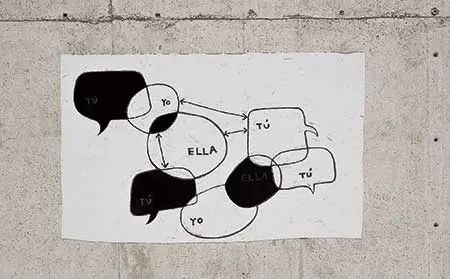
I suppose that it was for the same
reason—attentive to formats made possible by hybrid products, rather than the
possibilities of hybridity in itself, or its deployment as a banner—that she
synthesized a sign that is at once a Venn diagram and a text balloon of the
kind used in comic strips and all their derivations. What is said is said, and
what isn’t (what one doesn’t get to say) is said as well. This has to do with
Brazilian concrete poetry and has its precedent in Poema invertido, her intervention based on Mathias Goeritz’s visual
poem and the possible keys for its interpretation, presented last year at El
Eco Experimental Museum. This visual essay—which is also a research process
and, as such, a narrative—had as its premise a deciphering of the poem, but it
quickly became—thanks to a degree to the results of the research, but also, I
want to think, in spite of them—a new code: a cipher that reveals the cipher (I
would even say, that sublimates it) thanks to the elements suggested by the
investigation (visual representation on the basis of runes, or the tiger in the
poem that Goeritz used. It can be said that the working process in Poema invertido and Los hablantes—as revealed by the artist—is very similar, at least
to the point she allows us to glimpse as she makes the process itself part of
the work. It could be that the very evidence of these black zones (between what
she can say about the process for her works, which becomes a key and
substantial element in them) prompted the need to represent them in a visual
meditation that begins with the artist’s own inner dialog (supported by a
statement attributed to Pascal: “Man is an inner dialog”), which the artist illustrated
with a diagram (which is also a drawing) in which a painting is arranged with
the word “I” inside a speech balloon placed on a circular black field. It is on
the basis of this drawing (and her annotation: “we converse, above all, with
our own selves”) that the artist multiplies the number of speech balloons,
intersecting like Venn diagrams on that circular black field. Later, resigned
to the fact that “there are many things we never get to say,” she covered some
of the intersections in black. In the introductory text that accompanies this
visual essay, Amanda de la Garza called these black fields “negative space,” as
they symbolize the paradox of what is not said. Starting with this formal
dynamic where what is said (and not) is represented by black and white fields,
the artist projected the representation of interactions resulting from this
conversation—from the personal, private sphere to the social sphere—in order to
transform them into the sculpture-poems (this name, also used by Amanda de la Garza,
is not entirely adequate: it is too obvious with regards to the role played by
that free zone I mentioned before). Transformed into interventions, the appeal
at the same time to hieroglyphic writing and to neon signs. It is precise
because of this that the research process (at the same time, a codification
process) is of such importance. It is that whose absence renders any content
incomprehensible, and whose presence automatically grants us access to its
meaning and intent. The work of Verónica Gerber Bicecci comes accompanied by a
manual that doesn’t explain it, but illustrates its process. This helps her separate
the object from its narrative and ask herself—and us—what could be the meaning
of one without the other.
RICARDO POHLENZ