
Regarded as one of the most important conceptual artists of Mexico’s contemporary art scene, Abraham Cruzvillegas (1968) has spent the last twenty years establishing his artistic practice on a conceptual platform that is generated from what he calls “self-construction.”
In a constant search for improvised materials and elements, Cruzvillegas associates the construction and intervention of a family home erected in a volcanic area with the construction and transformation of his own person, creating a parallel between the constant construction of the context in which he grew up and his search for identity, both as unfinished acts and metaphors for change and adaptation to the environment.
The exhibition includes over 30 sculptures and five large installations, along with a work specially created for the lobby of the museum.
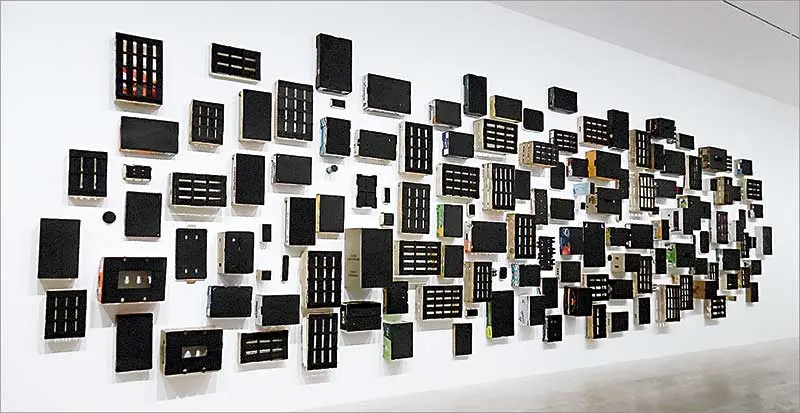
The site-specific installations were inspired by several cities from around the world where Cruzvillegas completed residencies and presented exhibitions—London, Oxford, Paris, and Kwangju. Taking into account the local materials, historical contexts, and elements from each place, the installations have an unfinished quality to them, but also contain introspective values and characteristics drawn from his experiences in those cities as well as from his own personal history. As he associates the landscape of the Ajusco mountains, where he grew up and where families were forced to use discarded or makeshift materials—like glass, bottle caps, metal sheet scraps, etc.—in these installations the found objects reveal a build-as-you-go construction process, the influence of each of the cities that he visited, and his interaction with the notion of the urban.
In addition to the installations, the sculptures also explore these notions of the unfinished and unstable, of seemingly discarded materials that nonetheless serve a practical and architectonic function in construction. According to Cruzvillegas, the construction process in certain urban areas generate aesthetic forms and, to a large degree, also a sense of community and collaboration.
These installations and sculptures reveal a deep interest in showing creativity under adverse and hard economic circumstances. They demonstrate that necessity leads to finding creative alternatives for meeting the requirements to consolidate architectural or artistic works; something that has been instrumental as a creative and ideological process.
Cruzvillegas also shares the photographs, texts, posters, newspaper clippings, and even sounds that have shaped his creative process and his intimate world. He uses those writings, images, and evocations as materials with which to build his own roof and walls.
In the piece Autoretrato Ciego Como un Lemonhead Sordo Posthatcherista. Para ‘K.M.’ (Blind Self Portrait as a Post-Thatcherite Deaf Lemonhead. For ‘K.M.’, 2011) is possible to observe Cruzvillegas’s desire to share his personal history, his journeys, and the simplest and most domestic of activities, using newspaper articles and magazines, napkins, bus tickets, streetcar tickets, business cards, receipts, maps, invoices, and labels. These elements from everyday life and from his travels were covered with white paint and placed on a wall with pins. With this simple act, the individual identity and symbolic functions are canceled; they are turned into a group of rectangles that no longer appear to have any value, but that still contain the history, context, and identity of a person who vanishes under the homogeneous white paint surface and white surroundings. Similarly—and continuing with the analogy of the individual as his own house—the same thing happens in the surrounding of large cities, where individuality is canceled and homes merge into one gray mass.
Another important work in the exhibition is La Promesa Simultánea (The Simultaneous Promise, 2011). Made with a tricycle, three megaphones, an amplifier, a car battery, and bike mirrors, the installation produces a continuous whistle that creates a feeling of warmth and comfort throughout the exhibition room. This work was recently acquired by the Tate Gallery in England.
Cruzvillegas’s consolidation as a prominent international artist is undeniable. He has participated in exhibitions and conferences in many countries in America, Europe, and Asia. He was recently invited to participate in a collaborative initiative between Hyundai and the Tate Modern, in which he was commissioned to create the first work. The piece in question will be shown in the English gallery’s iconic Turbine Hall where the leading figures of the contemporary art world have exhibited their works.
This exhibition was curated by Clara Kim and was first presented at the Walker Art Center in Minneapolis, and then traveled to the Haus der Kunst in Munich.
The exhibition Abraham Cruzvillegas: Self-Construction is currently on display at the Museo Jumex, with some installations being also shown at the Museo Amparo in Puebla, along with music, theater, and sculptures from the early 2000s, which are an important part of the Self-Construction works created by the Mexican artist.
ISAURA RUIZ