
The Instituto de Visión gallery opened its doors to the public last October with a series of exhibitions dedicated to several generations of Colombian women artists. The space is positioned not solely as a contemporary art gallery but also as a research institute exploring the historical roots of the current artistic context and the artists offering new artistic approaches. Utopian Dump is a retrospective devoted to artist Alicia Barney (Cali, 1952). In the manner of an archive, the show rescues work projects undertaken about twenty years ago. The curatorship by María Wills underscores two lines of action by Barney: on one hand, her work on the negative impact of mankind on nature and, on the other, her denunciation of the social conditions of those who depend on it. Today, when the relationship between art, nature, and science plays a pivotal role in the Colombian art scene, the visionary character of this artist—who since the ‘70s has been a national pioneer of Environmental Art or Land Art—has become even clearer to us. Highly conceptual and occasionally minimalistic in their execution, her works defy any formal classifications and contain socio-political and ritualistic components that give them a life beyond the purely material object.
In the center of the exhibition room, we find the work titled Río Cauca (Cauca River, 1981-2014). It consists of three display cases resembling water tanks with test tubes in them that contain water samples—of the river that gives its name to the exhibition. Collected by Barney to show the river’s pollution, the samples are distributed along with a map that outlines the river basin and points to the origin of the exhibition. At the time of its creation, the work represented one of the first times that art and science had been combined in such a manner. It signaled that Barney’s work was not solely confined to her studio, but that it also involved equally important fieldwork in preparation for the final execution of the piece, which was central for articulating the denunciation elements of her proposal. The display cases are complemented by a photographic archive that documents the collection of the samples. This entailed a decisive step when it came to understanding the photographic archive as part of the work of art. This collection of photographs serves as a visual map and evidence of what took place on the river. Both aspects—the installation and the archival—are combined to give us a vision that transcends the aesthetic and evidence of the artist’s commitment toward what she wants us to see. The sight of a dead fish in the water is an image that takes us instantly away from the aesthetic qualities of the display cases.
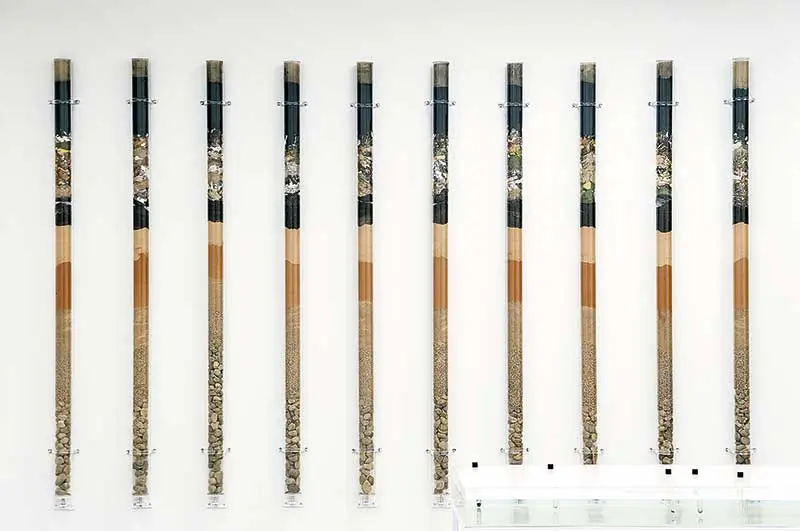
It becomes clear that Barney’s actions are not limited to the purely executional aspect of the work and that she also intends to make a mark that stands the test of time. Proof of this is the wall piece entitled Estratificación de un Basurero Utópico (Stratification of a Utopian Dump, 1985). It consists of ten acrylic tubes in which the artist introduced a geological stratum topped with garbage in such a manner that, when the tubes are sealed over a period of five years, the trash decomposes and renders the dirt reusable. This utopian dump is today a reality in landfills in which garbage is used in the same way; namely, it is mixed with soil to create a hill that becomes part of the landscape.
Although all of Barney’s works have a social component to them, the piece La Requisa (The Requisition) makes a direct reference to farmers and land. Conceived as a conceptual installation, it conjures the powers of the soil through aluminum triangles and copper seeds that represent fire, the feminine, and the fertile. In addition, there are ears of corn created with molars, which represent the teeth that the artist as a child would notice missing from peasants’ mouths. The molars, as relics of the martyrs that work the land, along with the symbolism behind the other elements used in this installation, reveal a Barney much closer to the magic power of ritual as a means to exorcise the evils of society. And lastly, the Diarios Objeto (Object Diaries), as exercises on collecting discarded objects, add to the exhibition the more mundane tone used by the artist; and even as she brings up the banality of existence, she does not convey it through intimate objects but with garbage found in significant places mapped through these objects.
Deemed an eccentric in the past for addressing environmental problems, today she is presented as the mother of an artistic current and an artist at the forefront of the cultural struggle against the deterioration of the planet.
CARIDAD BOTELLA