
Among the historical peculiarities of the visual arts field in Colombia is the absence of true photographic culture, noticeable in the dearth of spaces for technical and academic education, the slow establishment of a historical or critical field on the subject (reflected in the small number of existing publications and the indifference of the social sciences towards photography), and the scant cultural value ascribed to working tradesmen (studio photographers, photojournalists, editorialists).
However, the development of digital culture over the past two decades has created a demand for tools to understand and instrumentalize photography, exponentially increasing interest in the medium. The emergence of a number of specialized programs, the establishment of Foto Museo (1998) and its biennial event Fotográfica Bogotá and of the Fotología Festival (2002-8), and the appearance of the sudden trend that José Roca named “photo-taxonomy” in the arts, provided new conditions and spaces for creation, dialog, and critical interpretation.
Lagging somewhat behind, some of Colombia’s most important cultural institutions, such as the Luis Ángel Arango Library, the Museo Nacional, the Museo de Bogotá, and the Pilot Public Library in Bogotá in Medellín, confronted the urgent task of acquiring, before they are lost of dispersed, photographic collections and archives.
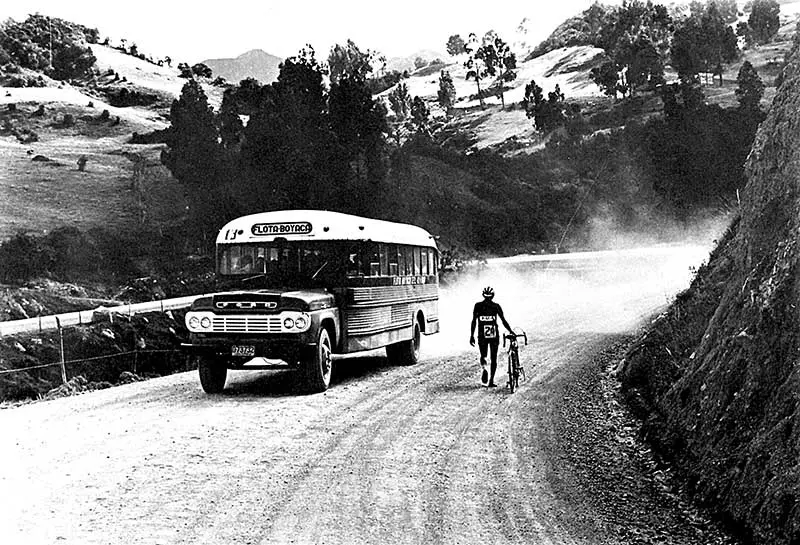
Albeit late in the game, a visual history hitherto submerged in shadows and silence has begun to be discovered, while artists like Carlos Caicedo, the greatest photojournalist in Colombian history, are newly valued outside specialist circles. Caicedo is a faithful representative of a generation of photographers who portraited Colombia’s modernization sans modernity in the second half of the Twentieth century. Like his colleagues Efraín García, Francisco Carranza, and Fernell Franco, he was born and raised in the countryside, the son of a poor family. Like many Colombian photographers of the period, he found his trade by happenstance. His arrival in Bogotá in the early 1940s was due to an aunt, who brought him there to work as a messenger and assistant at Foto Shimmer; later he began to work as a laboratory technician at Foto Sady, Sady González’s studio. But it was in 1949 when Caicedo found work in journalism. His reporting from the era deals, for example, with the surrender of the Liberal guerillas from the Llano region, and progressively moves on to record a good portion of the country’s visual history. Caicedo’s work, defined by the encounter of the decisive instant, which became his specialty, features diverse topics such as crime, sports, current events, social events, and political unrest. It can be said that the photographer’s most significant body of work is concentrated on three broad themes he developed during a four-decade career, until his retirement in 1987: sports photography; the use and contrasts of transportation in a rapidly urbanizing rural society; and images exploring what takes place under the rain in Bogotá.
Naturally, Caicedo acknowledges Cartier-Bresson as his greatest influence. He generously admits that his training in photojournalism is also indebted to his colleagues in Bogotá newspapers: Ignacio Gaitán, Alberto Garrido, Castro, Enrique Benavides, Cardona, and above all, Leo Matiz, in Caicedo’s own words “a wonderful photographer, a combination of graphic reporter and artist."1
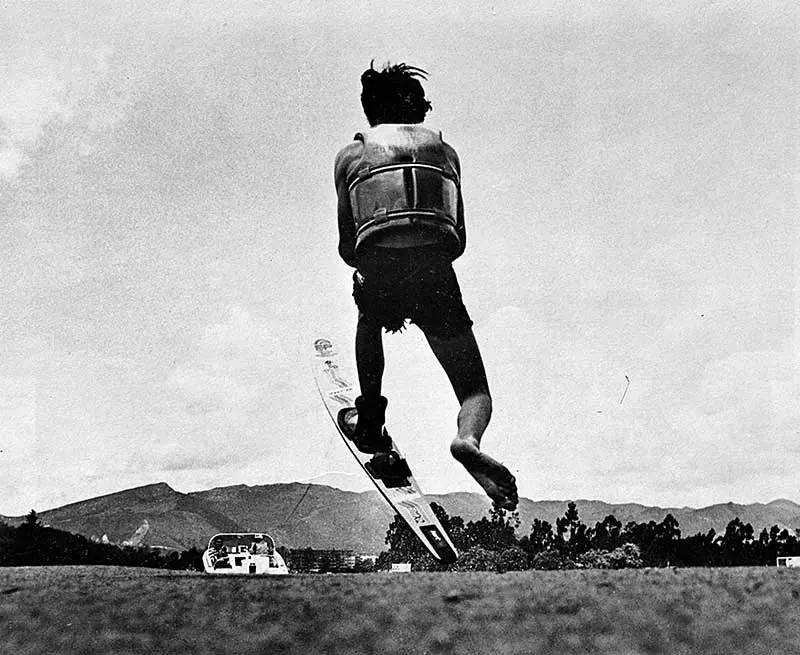
Caicedo’s talent is in full display in sports photography, where he achieves truly astonishing images. Like very few photographers, Caicedo was able to capture the precise millisecond, thanks to an exceptional understanding of his machine and symbiosis with it. Like a magician, he is able to predict what is about to happen, yet at the same time, his images are the product of calculated choices in his placement for the shot. As he puts it, “The first thing a photographer needs is to see the shot without a camera, as a film director does. The camera is nothing but a complement to the choices the photographer makes. This is why it is best to observe without the camera and to point and click only once you’ve found the precise frame."2
Perhaps the image that best illustrates Caicedo’s dual condition as a master of chance and a rigorous observer was his shot of a water skier suspended in the air, about to touch the surface of the water. The location he has chosen for himself is so unusual and original that we are perceptually disoriented until we finally understand that the smooth, seemingly solid surface is the water’s and that it will momentarily be broken by the dynamic figure defying gravity.
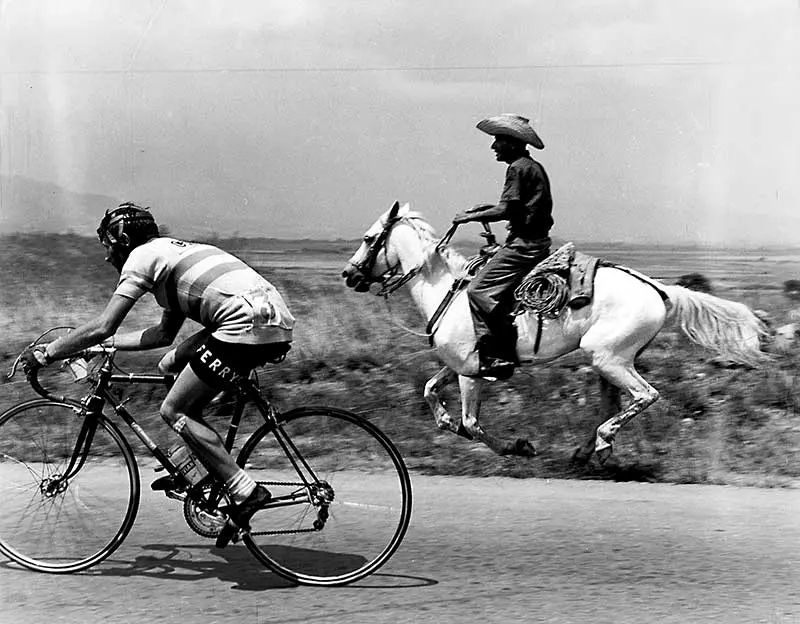
Another image from Caicedo’s sports photography that is emblematic of Colombian history in the second half of the Twentieth Century is La vuelta a Colombia (1963). Here, a laboring cyclist is accompanied by a rider on horseback, galloping. One shouldn’t forget that the Vuelta a Colombia was a sports event that captured the country’s imagination for decades, among other reasons because it celebrated the establishment of a road network that joined together a country historically fragmented by its mountainous geography. In that way, Caicedo’s image contrasts a pre-modern time, that of the use of animals as a means for locomotion, with that of the mechanization and technification of life, and the emergence of spectacle and deferred time. Caicedo pays discreet and possibly unconscious homage to Edward Muybridge and his series Caballo en movimiento (1878), where the photographer, using a system of cameras, was able to capture something as fleeting that the human eye cannot perceive it without the help of photography: the almost inconceivable positions adopted by a horse galloping, its four legs gathered up in the air for an instant, contradicting all prior representations of the animal with its four legs stretched, as was believed to be the case.
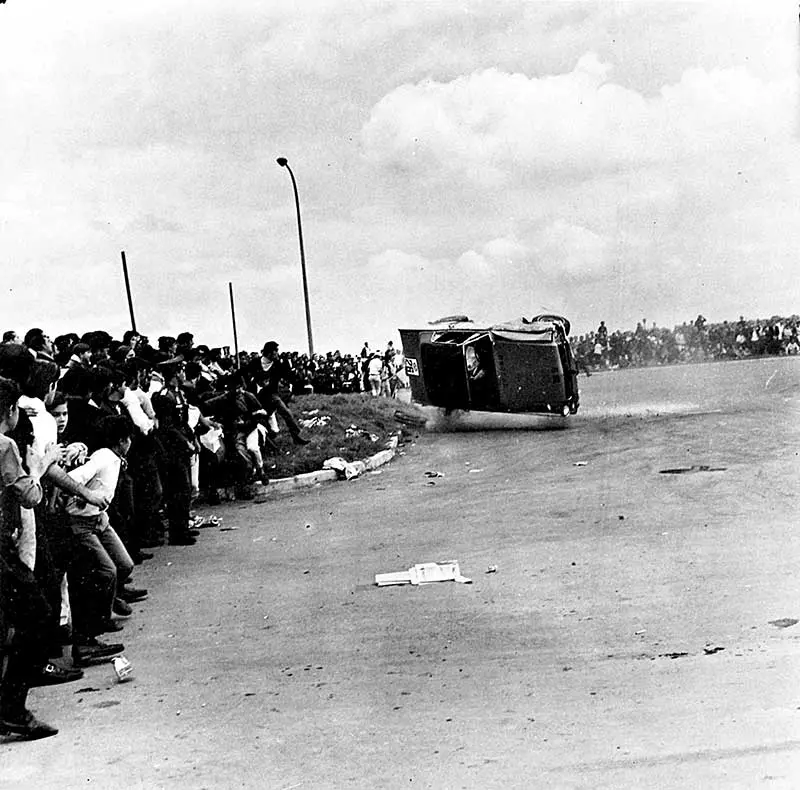
This image contrasts with the intense drama of Circuito automovilístico. Bogotá (1972), where a racecar overturns violently in the direction of an unprotected crowd. We are once again dazzled by Caicedo’s ability to capture forces and objects that defy gravity in a minimal fraction of time, but also his ability to find, and find himself in, the unexpected and the improbable, the instant right before the dramatic denouement.
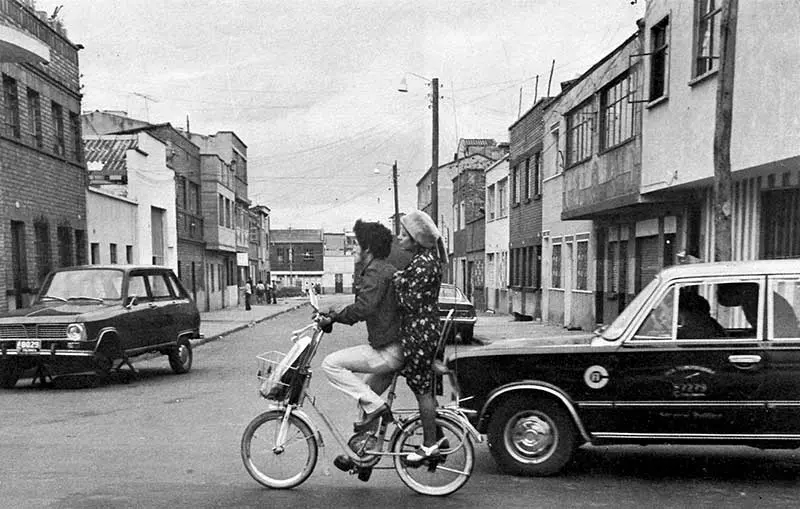
In another image, from his series Elecciones, Caicedo displays his discreet sense of humor. Once again, means of transportation are the subject: a bicycle-riding couple is overtaken by a taxicab in a poor neighborhood in Bogotá. The bicycle a local icon, of the kind known as monareta, with its banana-style seat, basket, and bell—serves this compact couple, sporting shoes that are rather inappropriate for their trip. In contrast, the unusable automobile to their left, with a single tire, underscores the ingenuity, precariousness, and dignity of the city’s inhabitants. Once again, Caicedo is able to synthesize a chance encounter in the narrow space of the photographic frame.
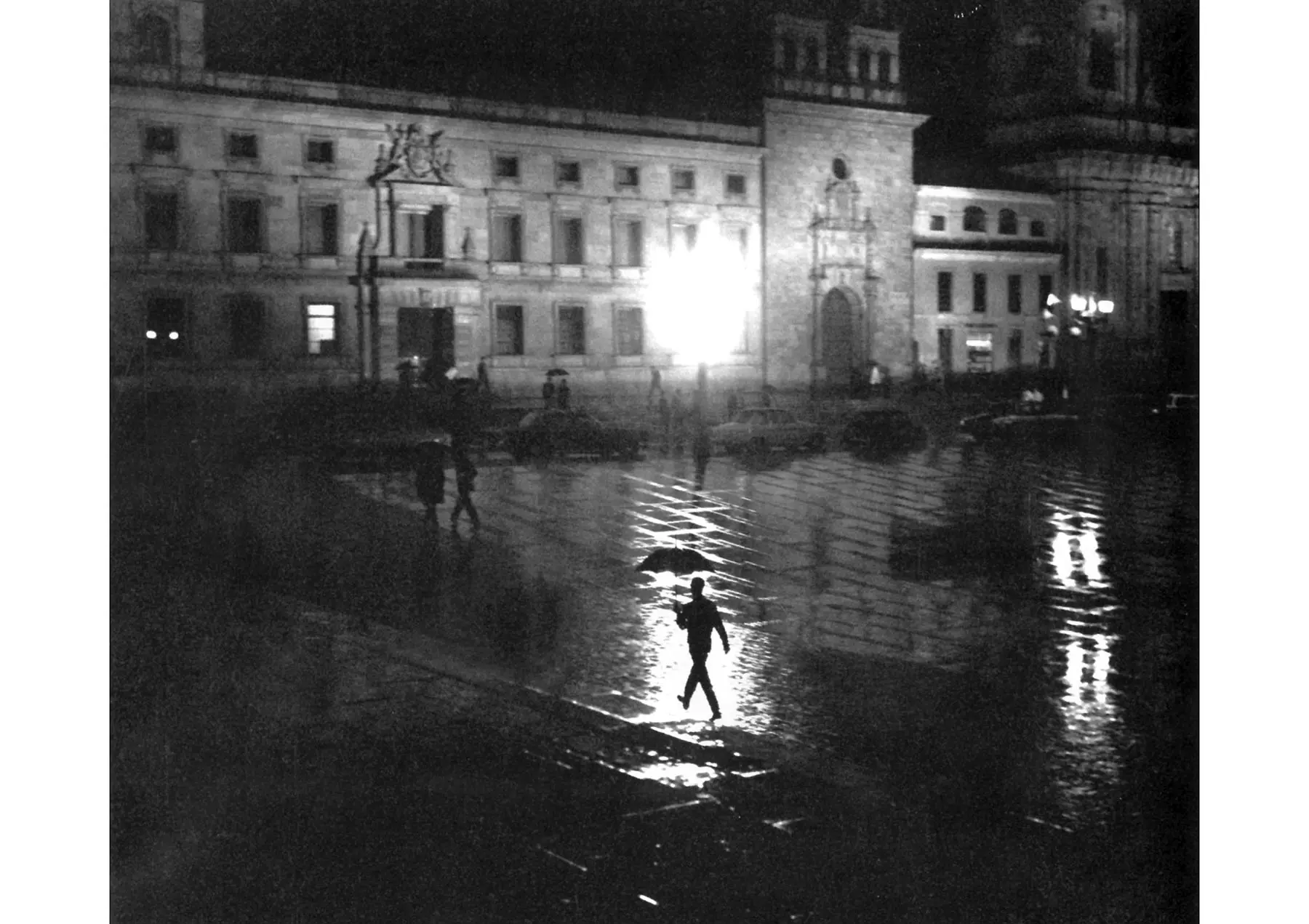
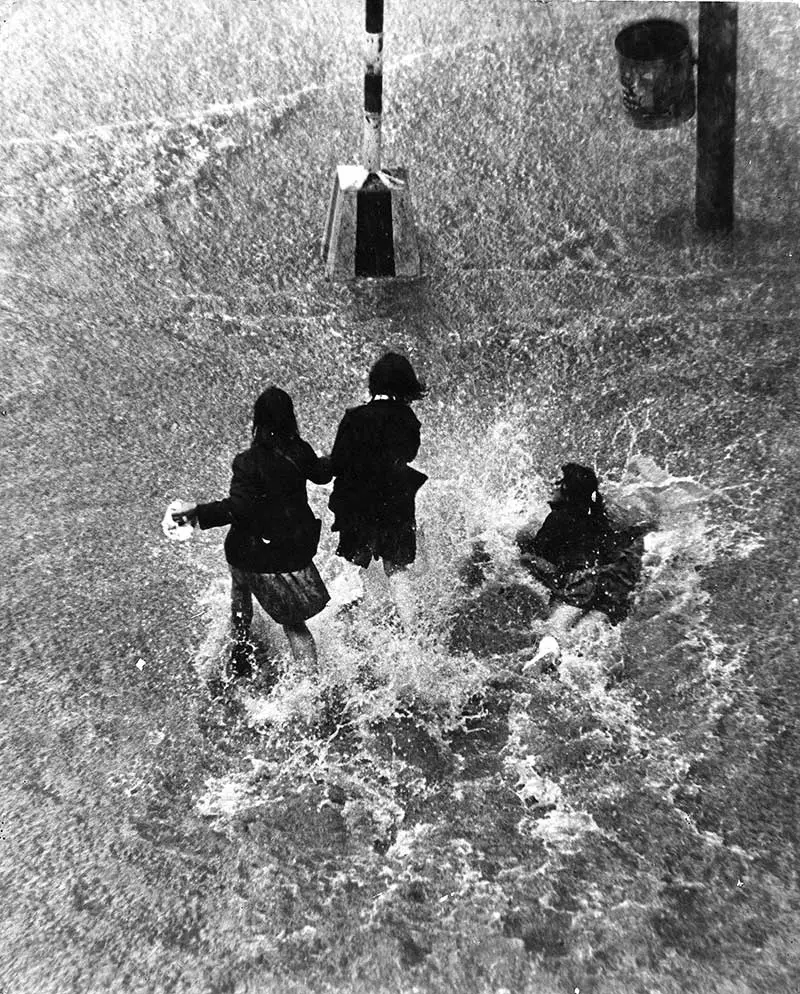
It is precisely in the streets of Bogotá where the photographer is able to capture outstanding images. The city’s unpredictable yet habitual rain, its most characteristic weather feature, has a special place in the region’s popular imagination and visual culture, expressed in illustration printed in Papel Periódico Ilustrado (1880), in Pepe Gómez’s caricatures for Bogotá Cómico two decades later, and in the work of a cartoonist publishing in El Tiempo and El Espectador during the 1940s and 1950s: Lisandro Serrano, Luis M. Rincón, Roberto Pinzón, and Adolfo Samper. Caicedo, who coincided in the newsroom with the latter, adapted for photography the caricaturist’s intelligent, entertaining commentary, covering the misadventures of citizens confronting the currents that flow from the mountains around the city to inundate the streets on rainy days.
In order to take a good part of these photographs, Caicedo located himself in the windows of the offices of El Tiempo, observing from them the people negotiating, several floors below, the fast-flowing rivers coming down Avenida Jiménez, formerly the natural bed of a ravine. From his perch, like a sniper, he was able to create over more than twenty-five years his first image of the rain dates from 1959 a set of images that display as few others do, the urgencies and emergencies of everyday life in Bogotá. Thus we see the 1959 flooding of Avenida Jiménez, razing everything as it passed, schoolgirls falling down, a shoeless beggar, and the common citizen leaping over puddles. In all of them, we find Caicedo’s innate ability to shoot his camera at the right moment when the force of gravity, at least for a brief second, is defeated.
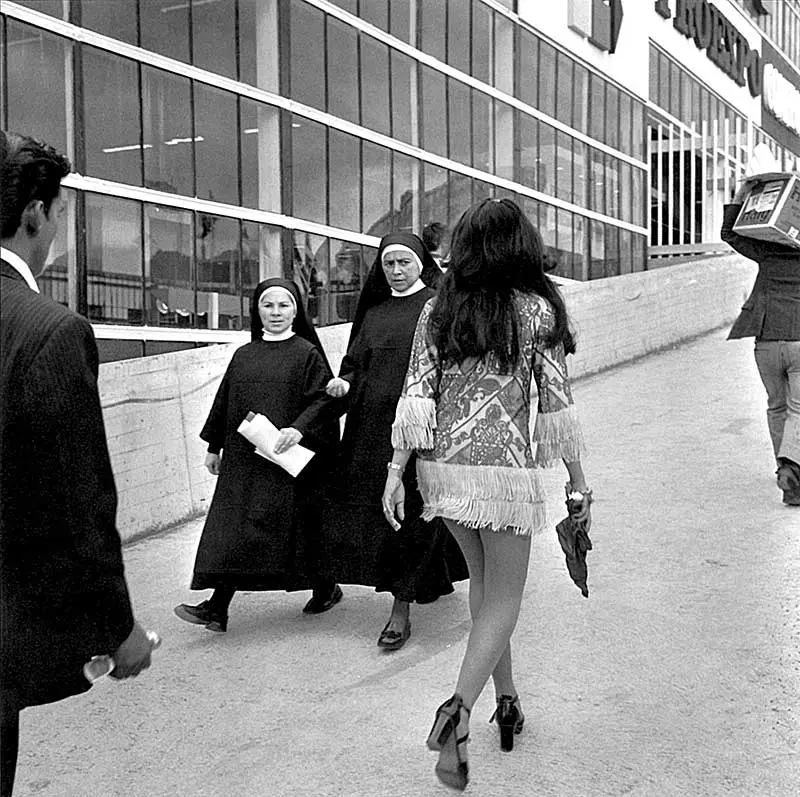
On October 24th, 1973, census day, when citizens were mandated to stay in their homes and the city streets left empty, Caicedo took a series of photographs (as a newspaper reporter, he was allowed to roam and record the day’s events) that documented the invisible people not accounted for in official statistics or in the official version of political reality, those who live in the margins, the disenfranchised, the beggars. This series once again demonstrates that Caicedo belongs to the tradition of street-beat photography. He avoided hideousness, the recording of violence and death, the exhibitions of human misery. Unlike Cartier-Bresson and others who made their careers traveling around the world incessantly, Caicedo is a photographer who travels into the city, one who for decades courses the streets of a city that is, in the words of Juan Manuel Roca, as ours as it is nobodies.
Three months before that, on July 23rd, 1973, Caicedo was commissioned to cover the burning of the Avianca building, located less than 200 meters from the spot where Jorge Eliécer Gaitán was assassinated on April 9th, 1948 in what is known as the “Bogotazo,” a day when Caicedo was almost lynched by a mob incensed by his photographing of the assault on the city. From a helicopter, Caicedo shot the smoking building, at the time the tallest in the city. In his dispassionate style, the tragedy is presented as a mute event, without evident casualties, in what could appear like a ghost town. “My photographs are of details, they are not important photographs, they are not portraits of famous people. A photojournalist is both born and made. Those who are not born one can become one. If he is a discoverer, great; if not, it’s ok, he can become accustomed to seeing. A photojournalist must have a nose for it, eyesight, be immersed in situations, and pay great attention to the details."3
Carlos Caicedo’s photographs were featured on the front page of El Tiempo for almost thirty years with images as surprising as this. His work was a model and a challenge for colleagues like Francisco Carranza or Fernando Cano, who worked for El Espectador, the competitor of El Tiempo, as they attempted to match his skill and to always get, as he did, the front page.
Recognitions of his works, however, are shamefully scarce. In 1976, Bogotá’s Museo de Arte Moderno offered Caicedo the opportunity of presenting a retrospective exhibition covering his by then more than twenty years in the trade. The exhibition, curated by Rafael Moure with Hernán Díaz and Beatriz González acting as advisors, was later presented at the La Oficina Gallery in Medellin. The interest resurfaced twenty-five years later, in 2001 when Foto Museo organized a solo exhibition that briefly surveyed his work and published a catalog. In March, 2014 Foto Museo also supported the filming of two documentaries, Carlos Caicedo, la mirada silenciosa and Francisco Carranza: la pasion por un instante, both directed by Juan Carlos Delgado. These documents, along with a few articles in the press, are all that has been written and said about the photographer to date.
While some of his colleagues from the second half of the Twentieth Century, like Leo Matiz, Manuel H. Rodríguez, Sady González, Nereo López, and Hernán Díaz gained, almost all at an advanced age, a level of national recognition and honors, Caicedo remains in relative anonymity. His discretion, his deeply self-effacing personality, and his guarded privacy have all contributed to making his work barely visible today: like his urban characters, anonymous and barely revealed to us.
NOTES
3. Molina, ibid.
* All images illustrating this article are courtesy of the Caicedo Family holdings, authorized for reproduction by Patricia Caicedo.
SANTIAGO RUEDA