
Last September, Galería D’Museo presented the exhibition Edgar Sánchez. Esencia del paisaje, featuring recent works in which the artist updates his view of the landscape genre. Edgar Sánchez (Aguada Grande, state of Lara, Venezuela, 1940; National Fine Arts Award, 1998) is one of Venezuela’s most renowned painters, due both to his five-decade career and his important contributions as a teacher. Possessed with a solid knowledge base and sensibility, Sánchez has made significant contributions to the arts in Venezuela, in the field of figuration and in the development of a pictorial technique of superimposed planes built through a grid of lines, dots, and small splotches. This has given his entire oeuvre a particular characteristic and has allowed him to carry out aesthetic explorations of the painting’s texture and space, in a variety of themes that include the human figure, faces, and landscapes. In his most recent series, which recreate the urban space, it is interesting to note the way in which color planes create successive transparencies that blur the shapes and form a whole veiled by a gaze that can be called subjective. The city is enveloped, then, in a dream-like atmosphere where passers-by fuse into the buildings, advertisements, and streets.
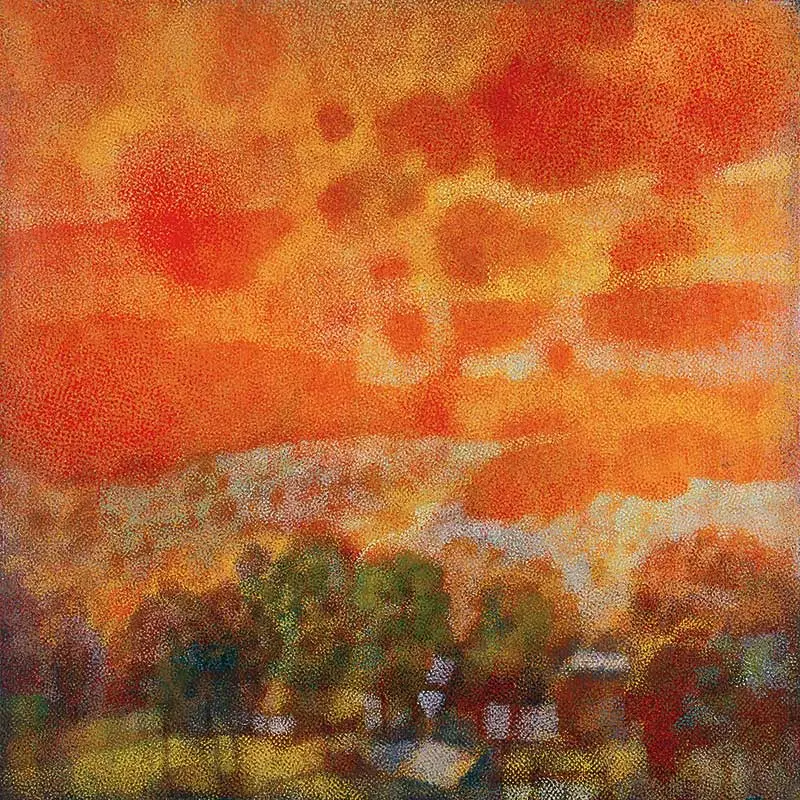
In this exhibition, Sánchez distances himself from the urban theme and moves to the natural landscape, finding inspiration in the settings of his childhood in the fertile land of the state of Lara, in western Venezuela. A certain nostalgia, a poetic gaze, and a memory-laden tone are part of these works, where the artist has recreated the colors of dusks contemplated as he was growing up. In that sense, Sánchez has declared his intention of moving away from the prejudice of remaining in the contemporary moment, assuming instead a turn to the past as an endless source of images and emotions to be transferred onto a painting.
Following one of the broadest and deepest traditions in Venezuelan painting, such as the landscape genre, Sánchez has created a series of works where the natural environment, the flora, the relief, the land, and the sky are the protagonists. His gaze is not, however, portrait-like, but, on the contrary, properly pictorial. By means of an audacious use of color and light, and, in general, the blurred and veiled quality of his planes, the artist is able to imbue the landscape with a very personal tone. The landscape thus becomes a pretext for an attempt to hold on to the matter of memory in its sensorial intensity, and in its radical distance from the concrete and the palpable.
The works featured in the show all present important changes with respect to his prior landscape series. First, the frank assumption of the theme of the natural environment, as opposed to the reiteration of urban topics in his immediately previous work. From this derives a suppression of the human figure, intended to focus the representation on the flora and the terrain. On the other hand, the formats have become smaller, and the palette tends toward pastel colors.
The exhibition curator, María Luz Cárdenas, focuses on the importance of the technical element of Sánchez’s art in the achievement of atmospheric, subtle space. For her, “the artist redefines the technique of pointillism, working layer upon layer. He fragments. He superimposes. He overlaps the planes in his paintings and proposes an expanded notion of space as a pictorial text. In the totality of the painting, the splotches and mists behave as units in themselves, full of associations activated by memory. These are not decorative works; they are links of nature in remembrance.”
In works like La Arboleda, Sánchez brings into full display his knowledge of painting as a realm of color. The gaze is distant, allowing for the unfolding of an orange-tinged sky that encompasses almost half of the plane, and which appears loaded with nuances and plays of light. In En el valle del río we encounter a similar treatment, but the intensity of the colors has given way to a subtle contrast of greens and browns, dark orange hues, and blues. In En la montaña, Sánchez is able to create a landscape using only shades of green.
Esencia del paisaje was, in a way, an expected exhibition. This poetic approach to the landscape has been long in preparation in plenty of the artist’s previous works, such as the beautiful series Piel y paisaje, or the urban landscapes of recent years. Here, Sánchez was finally able to give shape to those impulses.
KATHERINE CHACÓN