
Painting reinvents itself at every moment. This is what Flavia Metzler’s works revealed in a recent exhibition titled Espaço exterior, curated by Marcelo Campos at Artur Fidalgo Gallery. Against the grain of the so-called crisis of contemporary art and the myth of the end of painting, her work reasserts the power of figurative art, or narrative, of spatial composition and chromatic creativity, making clear the great degree to which painting remains a language of many possibilities.
In these works, the recurring characteristics of Metzler’s work—always focused on surrealistic, fantasy-laden themes and formal compositions—are once again in full view. Strange scenes are abundant, punctuated by significant doses of irony in disconcerting situations that include elegant personages, hybrid animals, and unusual objects. Sometimes, the small format forces viewers to come close to the works, enhancing their enigmatic and enchanting tone.
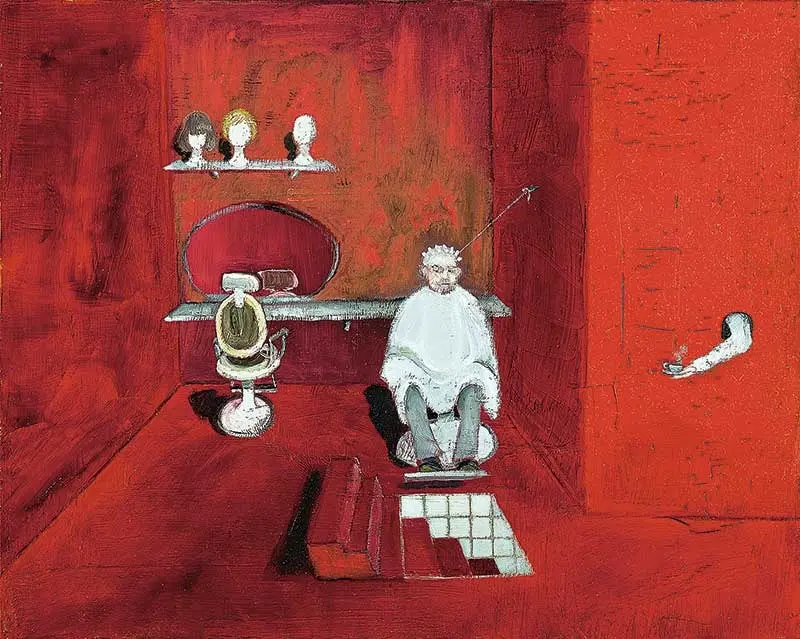
Plenty can be made to fit in a small space. Narrative systems and detailed information populate small canvases, as in The physicist, the hypephysicist, and the transphysicist (2014), an entirely red environment simulating the workspace of a barber or a haircutter. In it, we find a seated character who seems to be waiting for his turn, yet his head is tied to the wall. Meanwhile, next to him, an arm emerges from a hole in the wall, serving a cup of smoking-hot tea. Across from this character is a hollow on the ground, with a staircase that ends just over the floor level, in empty space, thus reinforcing the scene’s illogical element.
Metzler’s canvas Monstrorum Historia (2014) reveals a different pictorial system in the arsenal of an artist who often accumulates three-dimensional details on the plane, composing works that are almost objects. This painting’s circular format and pompous molding compose a kind of locket holding the image of the encounter between two hybrid beings, a woman-fish, and an ox-dragon. This style brings Metzler close to a long iconographic tradition in Western culture, outlined by the production of illuminated manuscripts, portraits, carvings, hymnals, maps, navigation charts, cameos, etc. The core of the work is connected to the idea of photographic reminiscences. In turn, La Joven (2012) refers directly to cameos: at its center is the portrait of a young woman in an oval space with a small padded red door. The same resource is found in Anotaciones en azul, dorado y blanco (2014), which among other elements features the portrait of a woman in profile, formatted inside an oval area and permeated by a variety of organic motifs, in a style that follows the decorative patterns of Art Nouveau.
Architectural elements, such as friezes and Baroque volutes, are always present in Metzler’s work. Many of her canvases feature no linear compositions and propose no perspective. They create several areas of recondite spaces where figurative references, beings, signs, icons emerge as if the painting were a box, a case for keeping small secret objects. Such resources can perhaps be traced back to the philosopher Gaston Bachelard’s thought; in The Poetics of Space, Bachelard speaks of primordial images that awaken life’s primitive hideaway. Flavia’s images simulate an intimate immensity, flirting with Bachelard.
Symbolic, complex, imaginative, caricaturesque figures compose her bestiary, like one of those Medieval anthologies of fantastical animals in allegorical narratives. These paintings seem to suggest spaces within spaces, narratives within narratives. The sensation is that the artist makes an extensive collection of imagetic icons, in a catalographic sense, as an “art naturalist” who seeks out and records the vestiges of a civilization erected under the sign of the image. In this meta-pictorial game, the artist suggests a philosophical meaning for her work. She seems to play with the viewer in a rhetorical divertimento of fake truths.
Born in 1974 in Rio de Janeiro, where she still lives and works, Flavia entered the painting course at Universidad Federal de Rio de Janeiro in 2004 and began producing works the following year. In 2006 she began participating in national collective exhibitions, and from that point forward her career has been marked by solo and international exhibitions.
The quality of Metzler’s work justifies the rapid recognition she achieved. Unwavering commitment with aesthetic investigations and the construction of a vigorous and coherent body of work, against the grain of contemporary languages that are, to a large degree, attached to new technologies and differentiated supports, this artist is contrasting a unique body of work, devoted almost exclusively to the meticulous craft of painting. Flavia creates a universe that is simultaneously serene and enigmatic.
With no pretense to originality but with extreme cohesiveness in terms of language and repertoire, her work reveals, above all, the authenticity of the painting.
ALESSANDRA SIMÕES