
Gabriel de la Mora is an artist obsessed with detail. The collection of objects and the particular arrangement of his pieces develop into projects that are of the purest conceptual art style. His ideas always contain a morbid motivation that stems from the importance given to obsolete, abandoned, old, and even possibly unpleasant elements. His work is based on great powers of observation and imagination that the artist uses to arrange the objects in specific sequences, positions, or scenarios that favor a certain reading and reflects what he is trying to convey. Pushing the boundaries of drawing, sculpture, painting, and installation, de la Mora’s proposals are images charged with symbolism and cryptic meanings. But they also stand out for their conceptually complex paradoxes combined with highly clean and simple design execution.
What We Do Not See Looks Back at Us is the latest solo exhibition by Gabriel de la Mora. It opened on October 18, 2014, at the Museo Amparo in Puebla and remained open to the public until March 2, 2015. Curated by Willy Kautz, the exhibition proposed an approach to de la Mora’s aesthetic inquiries centered on the monochrome tradition based on the temporality of the image. The selection of works was based on the temporary nature implicit in each of the objects that in themselves constitute the work or are part of the elements that constitute it. This temporal aspect subjects the images—either through time, exposure to weather, neglect, or carelessness—to a “breakdown” or conversion toward monochrome.
The premise established by de la Mora with his proposal, understood in terms of conceptual and post-conceptual practices, is to approach the idea of the specific object raised by Donald Judd and to reference projects that were no longer relevant as drawings, paintings, or sculptures. And he achieves this in a very interesting and well-structured way of using his powers of observation, obsessive attention to detail, and delicacy to collect imperceptible objects in everyday life.
The title of the exhibition references the title of the book Ce que nous voyons, ce qui nous regarde (What We See Looks Back At Us, 1992) by French theorist Georges Didi-Huberman, By adding the adverb “no,” de la Mora and Kautz formulate a specific action by proposing a question that leads us to think about all the things that we have missed during the journey of our lives— for considering them mundane or inconsequential—but that nonetheless have possibly been, and continue to be, central to our lives and appreciating them only requires that we look back to them or at the right place.
Viewers can observe the monochrome from the moment they enter the first exhibition room. It is right there where de la Mora begins his bombardment of stimuli and the cryptic messages he presents for deciphering. The first work that we encounter when entering the exhibition is Lo que no Vemos, Lo que nos Mira (What We Do Not See Looks Back to Us, 2014). It is a 14 x 333 cm text—the title of the exhibition—created with obsidian and reversed like a mirror image. The nuances produced by the reflections of shiny material reveal certain attempts in the tones that reflect but that are also trapped in the blackness of the mineral.
The works that follow are full of not so evident but fundamental information within the process. Such is the case of 92 Días/Granizada 22.05.2013 (92 Days/Hailstorm 05.22.2013, eroded enamel on canvas. 60 x 60 cm, 2013] The foundation of this piece is formed by a series of old photographs that cannot be seen and that are under a very slow disappearing process. The object was exposed to the weather for 92 days in a cycle that culminated with hail on the last day that left sinuous and very specific traces in the final result presented in the acrylic.
Throughout the exhibition, besides the monochrome, there is a precise and constant element: the arrangement of works associated with the vintage concept, with the notion of the old and destroyed. This somewhat dark projection of objects, allows us to observe torn photographs, detached acrylics, eroded materials, and poorly finished objects that do not let us forget the deterioration process that all have been subjected to during their existence. It gives us the opportunity to give inanimate objects a process of “life” that makes us aware of his birth, usefulness, and decay.
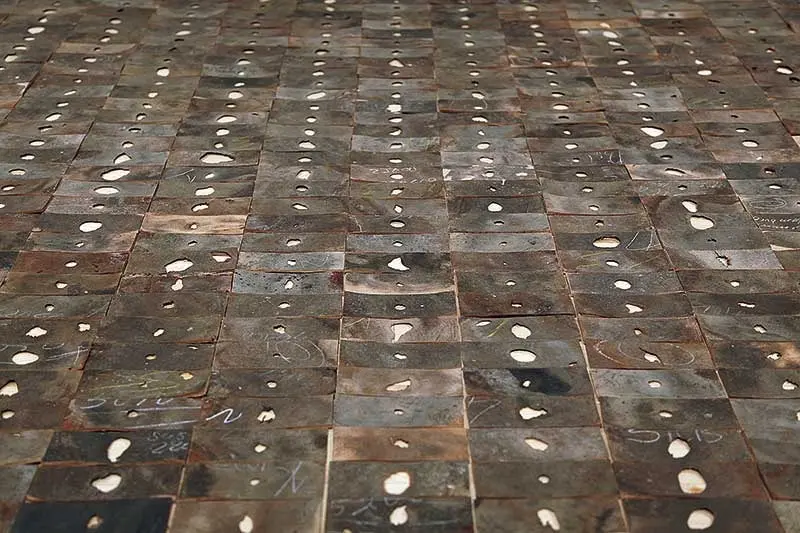
This feeling is confirmed in the installation titled 441 (discarded shoe soles. 175 x 462 cms. 2014).
Enclosed in a cluster of unknown stories, of subjects with the same amount of experience as each of the soles, these pieces recognize all of those anonymous individuals and their specific journeys. It is one of the most enigmatic works because of all the meanings that can be embedded in it. And not even Gabriel de la Mora can possibly know all of them.
HECTOR TAPIA