
Daros’ interest in generating debates and prompting new readings of the artistic event is once again in the foreground.
Is art an illusion? Is art real? Is art more real than reality? What is reality, an illusion? These questions, written in different spaces of Casa Daros1, provide a context for the unsettling exhibition it presents under the title of Ilusiones, intended to explore the widely debated and complex relationship between art and illusion. Is there a good perception of reality? This question gives shape to a deep-reaching investigation not only of a good section of artistic activity, but the sciences as well as explorations of history, philosophy, linguistics, and psychoanalysis, to cite some of the disciplines that engage the issue.
What is interesting about the curatorial proposal developed by Hans-Michael Herzog and Karin Steffen is that their selection is not after specific answers, but after opening up the space to visualize the impossibility of holding a single, uncomplicated position regarding the problem they confront.
The selection, comprising almost fifty works, is an invitation to problematize the concept of perception, to think about it in a more conscious way, and from that scenario to delve into what it is that we call reality, and what illusion. Throughout its course, the exhibition interrogates what it is that we really see, asking us to formulate a new question: Are we confronted with a crisis of our codes of representation?
The works on the exhibition show us that it is possible to explore the issue from manifold perspectives and with varied resources, using means such as photography, video, installations, objects. The use of everyday objects, stripped of their habitual function, disarticulates and disconcerts the observer’s gaze, habituated as we often are to relate form and function.
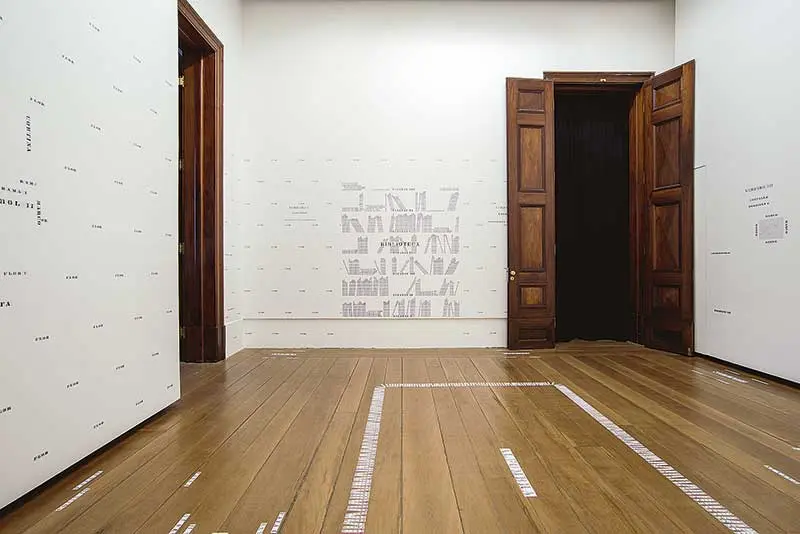
Luis Camnitzer (1947, Born in Germany, emigrated to Uruguay) opens the show with an important selection of works that wonder (and ask us) about the problem at hand. The works, dating from the 1960s and ‘70s, trace back to aspects touching on semiotic concerns and, in instilling doubt, unsettle our assumed certainties. Words take the place of the objects they designate; Camnitzer’s Cajas2 is an example of ambiguity and displaced meanings that impact the viewer’s observational experience, confronted with images and text that generate a new narrative. The two versions of Esto es un espejo. Usted es una frase escrita (1966-68) incorporates the work of imageless texts, while the reconstruction of Living Room (1960-2010), comprised of words that allude to objects usually found in such a space, prompts the observer to imagine the place on the basis of linguistic designations that replace things.
The thirty-one works by Camnitzer selected for the exhibition operate as a well-deserved homage to an artist who transforms a resource such as suspicion into a creative method, mistrusting the certainties that reality presents us with.
In his essay “The Artist, the Scientist, and the Magician,” Camnitzer tells us that “In a forgotten reality, the field of art is not there to produce objects. Art is a field of knowledge where problems are posited and solved, the site where it is possible to speculate about issues and relationships that are not possible in other realms of knowledge.” In his view, both the artist and the scientist must be responsible, serve the common good, and be rigorous. Which takes him to a third character: the magician. “The magician, not the artist, is at the opposite of the spectrum with regards to the scientist (…) the essence of the magical act resides in its ability to conceal the process and retain its secret. The magician’s relationship with the task of cognition is not to expand knowledge, as a good scientist and a good artist do, but to challenge what is known with the purpose of creating a spectacle.” For Camnitzer, the three characters operate in different ways with regard to the surrounding reality: the scientist attempts to explain the uncanny; the magician attempts to simulate the uncanny; the artist presents us with the uncanny in order to expand the realm of what is believable."3
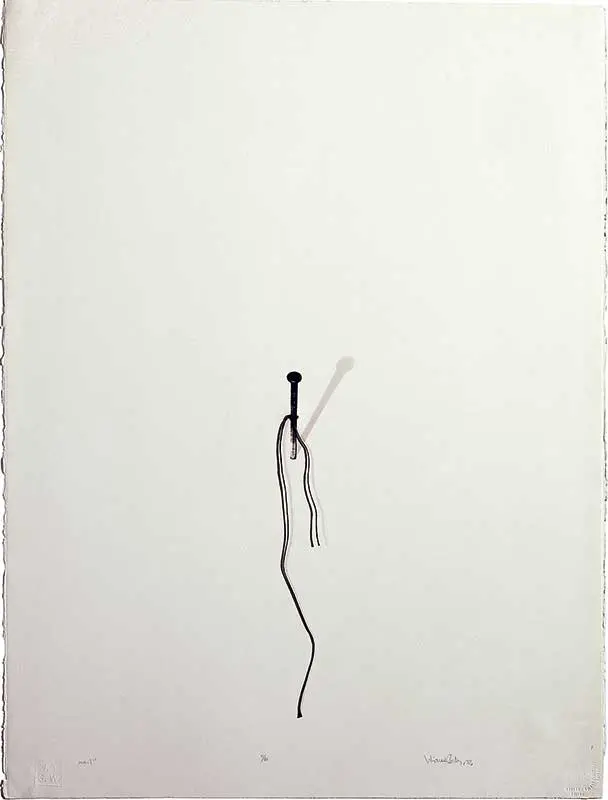
The work of Liliana Porter (Argentina, 1941) makes use of a reduced set of simple elements, such as nails and rope, to confront us with the relationship that exists between the real and the virtual. What interests her from that visual confusion is the possibility of questioning the substance of reality and time,4 involving the issue of the relationship between representation and reality, between words and things. Porter’s objects, located in a “non-site,” hold for her the potential of helping to keep us undistracted from the main reflection, which in these works of the 1970s focuses on reality and representation within an a-temporal framework. Using elements with a lesser load of meaning, she seeks to have her works pose questions rather than formulate answers.
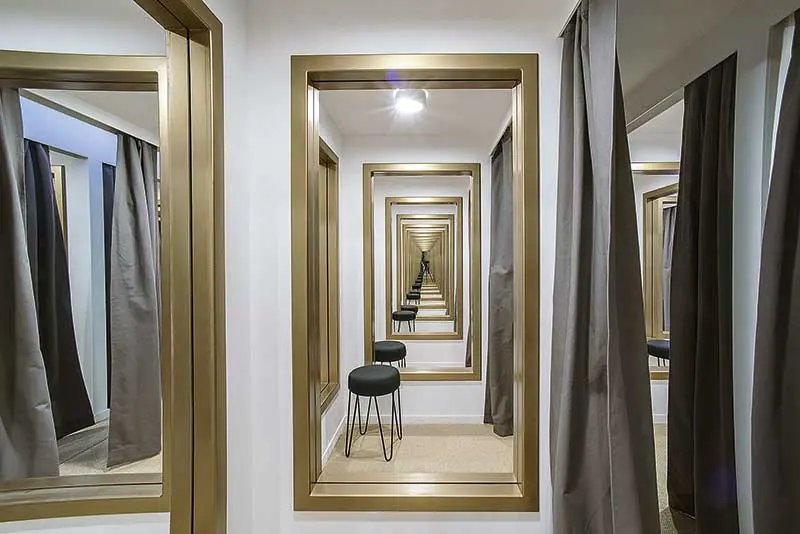
For Leandro Erlich (Argentina, 1973), visual “trickery” is a way of interrogating the real, unsettling our assumptions, inviting us to review convictions, and valuing the possibility of new discoveries. His three works on exhibit here are a disquieting prompt for us to question notions of our perception of reality. In Piedras (2002), the traces of human steps move rhythmically in a constant circle; in Las puertas (2004), a light source filters through the bottom of doors to suggest an occupied space, but as we open them both the light and the initial presumption of habitation vanish; Cambiadores (2008) features dressing rooms that capture our image and repeat it in a game between real and virtual openings, mirrors and reflections.
The use of optical effects and various simulations make it possible for Erlich to manipulate spaces and create situations to create a reality of his own. A reality that leaves no room for everyday routine, as the viewer—supposedly well familiarized with what is depicted, as they are regular situations—must discover where the illusion is. Thus the dynamic agency that Erlich reserves for the viewer, who, for him, plays “a role as an actor, but, interestingly, without abandoning their position as observers."5
According to Erlich, what is important is not to hide the trick as a magician would, but to do the opposite: “To reveal the trick is a way of lessening the importance of phenomenology and inviting a conceptual interpretation of the work.”
Mauricio Alejo (Mexico, 1969) plays with sensory deception through a series of brief videos located in everyday spaces and centered on optical illusions. In Línea (2002), a line is transformed into a water jet, and a plate breaks to let us see a play of lines in motion. It is as though the artist were intent on revealing for us a world that is real but hidden to our perception, demanding its unveiling. “I don’t mean to open a door to the unconscious, but to a more evident and factual world that continues to surprise us but exists in reality, hidden in plain sight."6
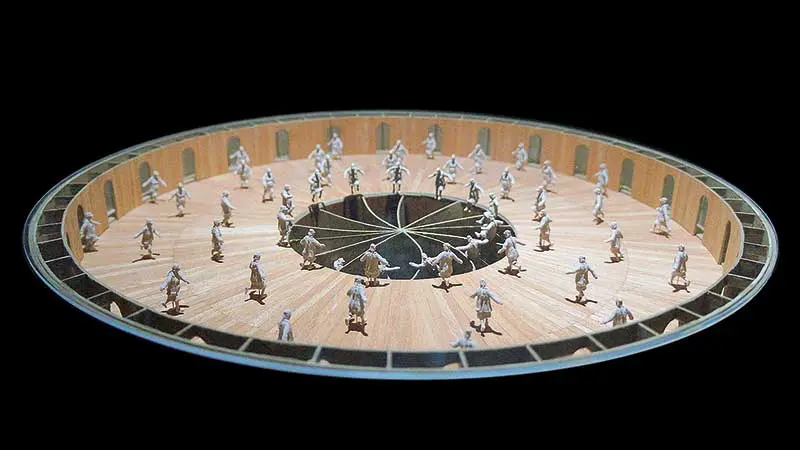
Three artists opt to engage illusion from a perspective in which social and political phenomena are salient and central. The violence that plagues the Cauca region in Colombia is the starting point for Fernando Pareja (Popayán, 1979) and Leidy Chávez (Popayán, 1984) to set up their proposal. In Sin título (2012), gyrating discs with stroboscopic lighting and sound are a stage for tiny wax figures to fall into a hole that absorbs them. And the cycle does not stop: some figures fall and are replaced by others, in a sequence where female figures emerge from a circular gallery to fall into empty space.
Although they use visual devices that had a great impact during the Nineteenth Century, their objective is not to nostalgically revisit such historical mechanisms, but to confront us with the way in which images are produced today, what we are capable of seeing, what we are willing to see. The fascination produced by this mode of animation seeks to present the reality of the everyday dramas lived by people subjected to the crossfire of Colombia’s armed conflict.
Teresa Serrano (Mexico, 1936) is present with four works, focused on a reflection about visual language and the impact of representation. In the four works, the violence symbolized by objects or situations is not explicit, but operates through metaphors, in images that prompt thoughts about gender representations, debates about power relationships, and reconsiderations of the roles played by the female figure.
The video Boca de Tabla (2007) portrays a woman at her own home, engaged in everyday chores inside a labyrinthine space where actions are repeated, loneliness is foregrounded, and the question emerges: is this space she so tirelessly traverses a home or a prison?
5 Rolling Stones (1999) are spherical shapes wrapped in wigs, like severed female heads, that roll on the floor inviting viewers to kick them around. How do I look at them? With the drama of the severed head, or as balls for playing?
Religious themes are present with two works: Molde soplado (2012) and Del mismo diámetro (2012). In the former, using the fragility of blown crystal, the artist creates four highly symbolic pieces of headgear: the skullcap, the miter, the biretta, and the hat used by Catholic church dignitaries. Despite their transparency and fragility, it is possible to see in them the suggestion of such urgent issues as violence against minors or the impossibility of creating spaces for the inclusion of women in domains that are markedly male-dominated.
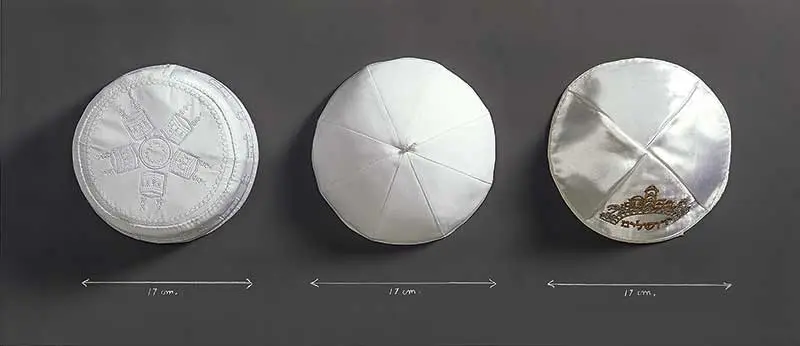
Del mismo diámetro deals with the complex situation of religion in the contemporary era. The most common diameter of the human head is 17 centimeters, and this is the measurement of the head covering used by three of humankind’s great religious groups: Christians, Jews, and Muslims. Again, the illusion of the divine through symbols of every earthly power.
José Toraic (Cuba, 1966) engages the issue of our perception of political power from an ironic point of view. His video Opus (2005) features figures and numbers that are pronounced in the voice of Fidel Castro: a tireless numerical discourse that repeats only figures used and manipulated in our informational every day. The rhetoric of power transcends the Cuban space and, verbalized through the recourse to statistics, creates a seemingly unquestionable reality, information that is intelligible to a majority of the population who receives it as true on the basis of the “objectivity” of the exploration they are presented with.
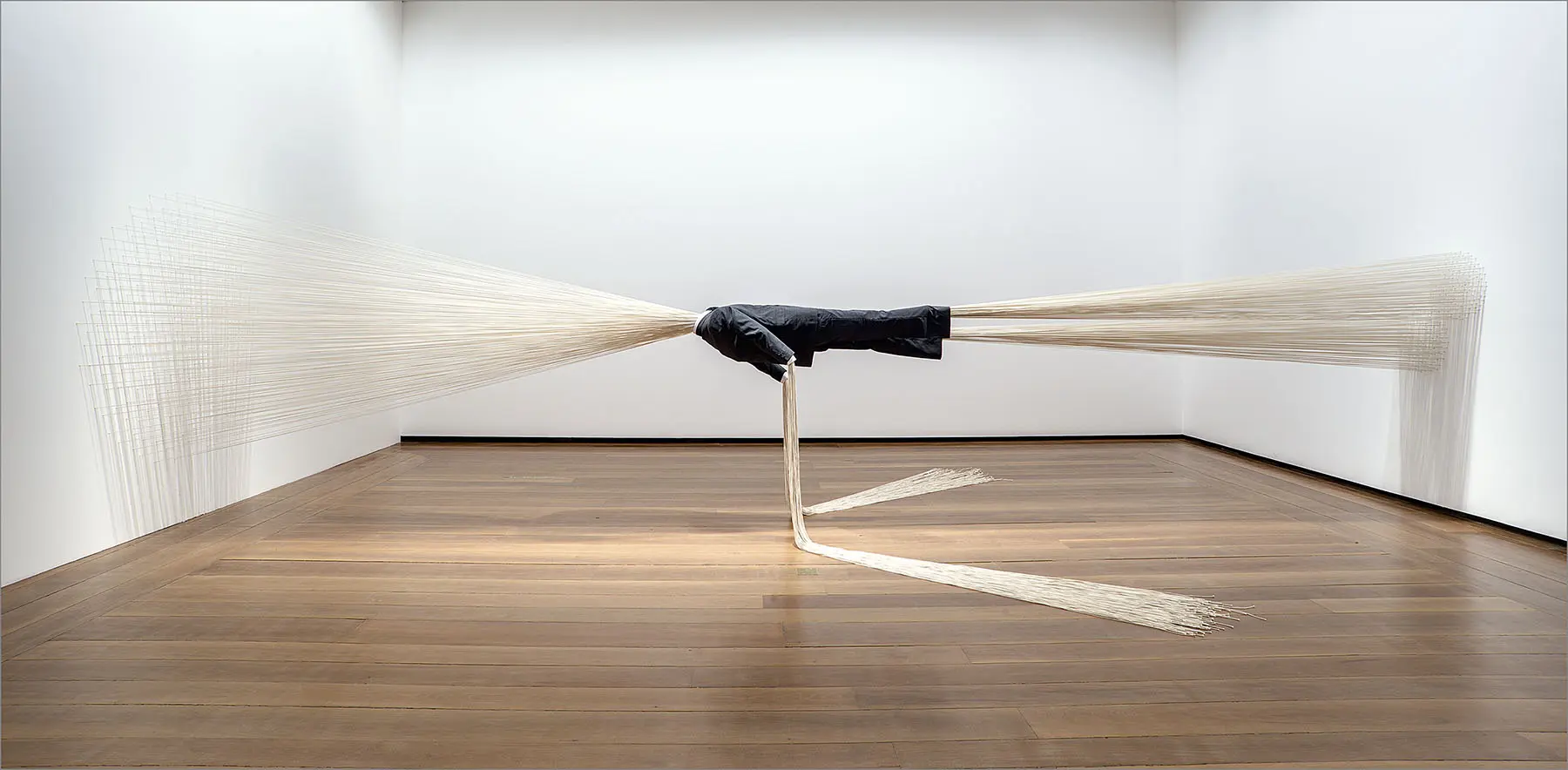
José Damasceno (Brazil, 1968) presents El presagio siguiente (experience sobre la visibilidad de una substancia dinámica) (1997). A male suit floats in space, traversed by ropes that emerge from its limbs and head, to anchor itself on the walls. The image brings to mind the question of how we perceive in space, not only ourselves but also the objects around us. For this artist, perception is a possibility of exploring matter, form, and idea in locations built to generate estrangement due to the way in which the objects are presented. Damasceno says: “Reality, or what is commonly called real, has innumerable strata, layers, dimensions, densities, states, porousnesses, channels, an unimaginable structural complexity that moves, grows, and changes second by second in another universe, immersed in different points of view."7
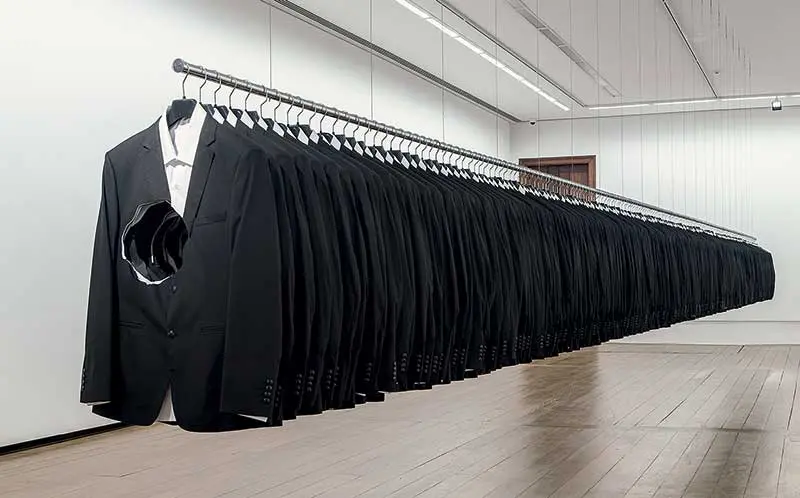
Playing with ambiguity is also the intention of Los Carpinteros, with their work 16M. Marco Antonio Castillo (Cuba, 1971) and Dagoberto Rodríguez (Cuba, 1969) are the authors of this 16-meter installation composed of 200 black jackets placed around white shirts, all with an irregular hole cut on their right side. From either end of the work, we visualize a kind of tunnel, at the end of which there is light. An evident example of the relationship between reality and illusion, since the supposed tunnel exists only for as long as the 200 jackets remain hanging in the same order. The work follows a line that characterizes their work: the functionality of the object is questioned, which allows Los Carpinteros to transform it and outstrip its usual meaning. The shifting codes, the possibility of rewriting functions, and readapting them to a new symbolic meaning makes it possible to understand why they define their work as “an allergic reaction to reality.”
NOTES
1. This 1866 building, located in the Botafogo neighborhood in Rio de Janeiro, was reopened after a careful restoration driven by Zurich’s Daros Latin America collection.
2. His Cajas date from the 1970s, when he was interested in the construction of objects related to texts.
3. Luis Camnitzer. “El artista, el científico y el mago,” in Revista Humboldt, Mediación mediatica 156, December 2011.
4. An interview with Liliana Porter by Katrin Steffen, July 2014, in the catalog for Ilusiones, Casa Daros, 2014.
5. An interview with Leandro Erlich by Katrin Steffen, Ibid.
6. An interview with Mauricio Alejo by Katrin Steffen, Ibid.
7. José Damasceno, “Un altro attimo”, Ibid.
*Daros Latinamerica Collection, Zurich.
IVONNE PINI