
The individual trajectories of Jaime Gili (Caracas, 1972) and Ricardo Alcaide (Caracas, 1967) are similar in more than one respect. Both belong to a generation of Venezuelan artists who have faced the challenge of voluntary emigration—as an experience of estrangement and incorporation into globalization processes and phenomena—with implications that, far from confronting the break with their origins, have turned into stronger continuous explorations of their local entities to provide critical and formal support for their respective proposals. Thus, the essential foundation of their inquiries shares a reformulation of the principles of modernity and the renowned consequences of its utopian agenda in Latin America, especially from the practice of architecture. Both artists exhibited duly differentiated solo exhibitions at the Alejandra von Hartz Gallery in Miami.
Jaime Gili’s exhibition was titled Ornament and Barricade, an installation that consists of 8 recent pieces of various dimensions inscribed in the tradition of geometric abstraction. In his drive to develop renewed approaches to painting, Gili has used a unique methodology that speculates on the improbable dialogue between significant players in the art and design of the twentieth century who, through fictional accounts, are brought to the tropical coasts of Venezuela. For his exhibition at the Kunsthalle Winterthur in 2009, he had Max Bill meet with botanist Henry Pittier—also of Swiss origin—to whom we owe the name of a Venezuelan national park. Then in 2012, he paired architect Gio Ponti—who actually did go to Venezuela to design Villa Planchart—with painter Armando Reverón on the warm beaches of Macuto. From that encounter, he produced a series of paintings that would reveal the play on contrasts between two opposing physical and psychic geographies. The subjective examination that drives Gili’s proposal also favors the challenge to move forward on the premises raised by the European vanguards. For this exhibition, the artist chose Carlo Scarpa, the Italian architect that designed the Venezuela Pavillion in the Venice Biennale. However, the artist points out, painting requires a slow and deliberate development that is not easily limited to closing progressive series. In this sense, the works displayed are the result of the accumulation of a series of projects and voices that come together in Gili’s London studio to draw new guidelines for representation.
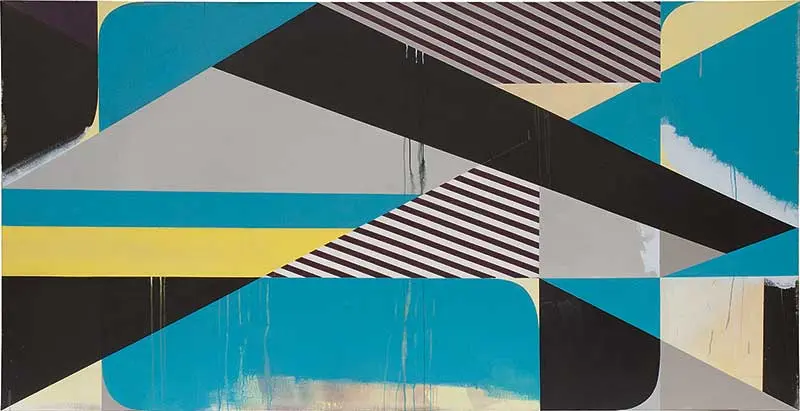
Painter par excellence with a solid academic education in Caracas that eventually continued in Barcelona and London, from the beginning he was interested in exploring modern currents and the geometric abstract tradition, discovering in Cruz-Diez, Soto, and Otero the clues of a legacy that have led him to experiment with and problematize unprecedented possibilities. His pictorial projects are conceived through intricate geometries underpinned by energetic planes, angles, and vertices, evoking prisms and starry figures—some rendered in black and white—to finally develop a boundless chromaticism that denotes the scope of his skill not only in two-dimensional representations but also in architectural interventions designed for public and private spaces.
In the exhibition, before us, the work has evolved towards a more analytical abstraction that incorporates the totality of its constitutive elements on the canvas. The different planes and parallel lines intersect through diagonal, orthogonal, and even curved lines on the pictorial surface, now transgressed by a controlled dripping and rubbing that, along with a tonal scale of greater complexity, it has reached a new level of maturity and austere sophistication. While the assembly is classic over previous installations seeking to energize the previous space to create a new one, the two-dimensionality of the picture is slightly disrupted by a small angle separating wall paintings and creating a virtual background. Crossing the paths and access to the works of his beloved referents has undoubtedly allowed him to advance in his own search but also in relation to the politics and ethics of the creation. For this reason, Gili alludes in the show title to the guarimbas or homemade barricades that last year played the lead in violent protests in Venezuela, making an analogy with what passes or is not beyond the limits of his own studio.
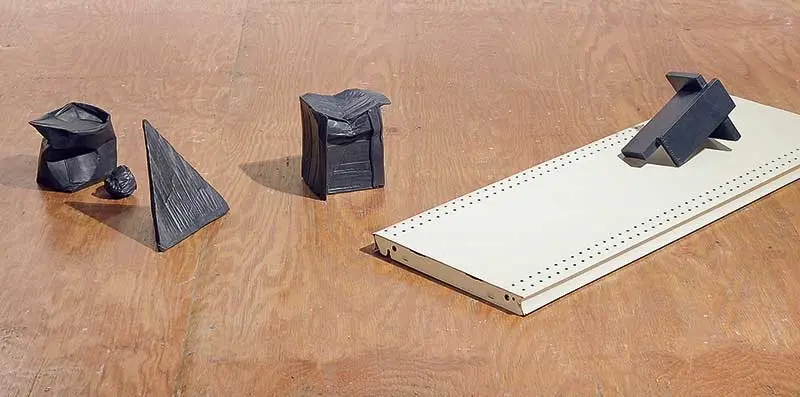
Displacement, an installation featuring Ricardo Alcaide, brings together a diverse repertoire of altered photographs, sculptures, and paintings that coexist in a space thoroughly articulated to speculate about modern utopia and architectural reconstruction. Living and working in São Paulo reinforces his artistic practice based on the language of architecture, particularly that of Lina Bo Bardi and his contemporaries Gio Ponti and Carlos Raul Villanueva.
Earlier this decade, Alcaide starts a new body of work based on the selection of objects and residues found in construction sites, which he rearranges, moves and depicts in the foreground of black and white photographs. The reticulated structures of this compilation of models and prototypes eventually refer us to the matrices of new constructions. From waste, Alcaide generates another constructive possibility that, within its precariousness, maintains in its proportions a certain nostalgia for the organizing systems of lost modernism and also manifests a reaction to the excessive real estate development of the new metropolis where the construction boom and an overflowing economy are in stark contrast to informal housing; thus perpetuating the huge inequalities in society and showing the failed promises of popular housing. His compositional strategies move towards the development of simple MDF mockups constructed from simple modules, transiting from the photographic representation to the presentation of these structural models that, despite their fragility, demand a profound reflection on the tensions that exist between economics and architecture. They propose construction methods that refer to the inconsistency of modern utopia and that refer us to the deep contradictions of our realities; structures that could very well be visions of a society’s rehabilitation.
His current proposal matches these production strategies in order to somehow transcend modern memory by “trying to rebuild ruins and debris through fictitious constructions and new compositions with architectural references.” In this installation, the artist poses a dialogic relationship between the formal aesthetic of modernism and its utopian impossibility. He combines found platforms and furniture with the vestiges of their abstraction, creating correspondences with a group of small bronze and intense blue patina sculptures, cast from crushed cardboard boxes, now deployed on the ground. The installation also includes two photographs, Land of Order I and Untitled with Plastic Bag, iconic images of modernism in Brasilia and Caracas; the former intervened with geometric elements and the latter with a compressed garbage bag. The group is completed with his most recent production: two MDF boards painted with industrial lacquer that could very well be formally perceived as an abstract and geometric recreation but that, as we take a closer look, reveal the imperfect traces of background division of what could have been shelving. In a deconstructive action, Alcaide insists and metaphors that support his proposal: the failure of the notion of progress in relation to modern aesthetics.
RUTH AUERBACH