
This exhibition titled Signs by Johanna Calle impressed me because of the manner in which this artist pushed the boundaries of drawing. It is a visual but also a manual exercise that relies on materials like metal mesh, thumbtacks, cotton, texts written in a typewriter, intervened photographs, cardboard, wood, and pencil. It’s like the drawing version of a tsunami that reconstructs and reinvents the medium. But while Calle does push the boundaries of the medium, the proposals never stop being drawings, perhaps because of her insistence on only intervening the two-dimensional surface—with piercings, sewing, cuts, scratches, etc. Perhaps the use of the gray color on each piece, a gray with many nuances—which communicated in the exhibition space the feeling of being in front of an ad, before a particular publication with an ominous message—also contributed to seeing the work as a drawing.
Thus, drawing in this exhibition was a “mental thing,” a visual and manual proposal that was also matter-based. Each drawing was a body with a presence in its support and in the room. And it’s important to stop here for a moment to reflect on art as a body. Art is presented to the viewer as a body that has no apparent justification and that is often uncomfortable in the same way that a black butterfly on the wall that we had not previously noticed would. Therein lies one of the peculiarities of art: its presence. And unlike psychoanalysis, for instance, in this process the patient—or in this case the art object—participates in the therapy by projecting its world from within the boundaries that define it and cannot build objects outside the parameters that define it—as it can occur in therapy. Because it is a body, the images it produces are bound to the materials needed to appropriate a wall or a piece of paper and unlike another art form, literature, its construction cannot occur away from it through mental images.
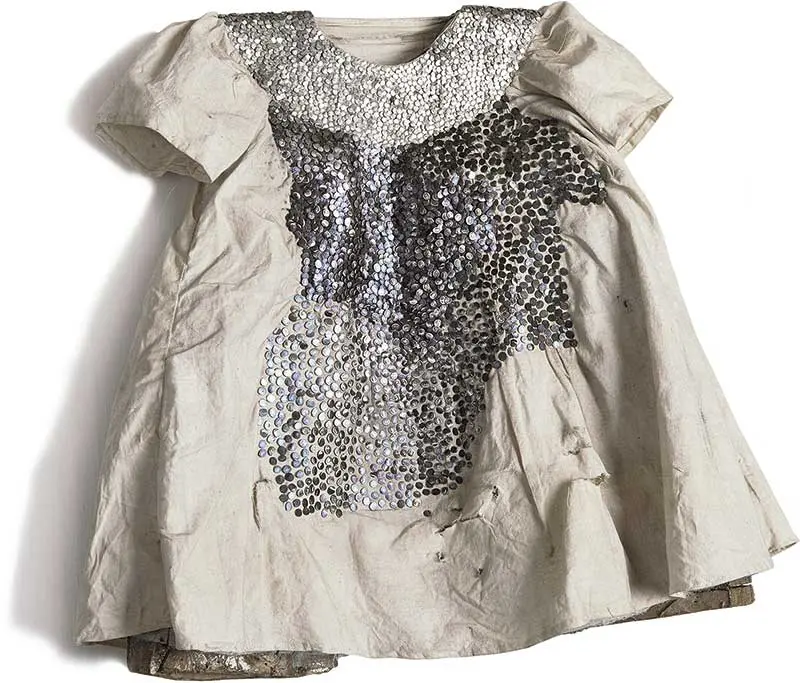
And the exhibition was full of bodies that demanded attention. I remember, for instance, a metal mesh with a “No” embroidered on it as if it were a tablecloth or handkerchief. It is a “No” that becomes matter and makes itself heard in a domestic setting. Or a figure that becomes undone as the mesh that shapes it breaks apart. Or faces made with wire of young women who exhausted “sleep” or rest on the plaster that supports them. And there are the stains, scratches, black butterflies, letters, and bugs that also demanded their place as bodies. And it was also because of this that the title of the exhibition impressed me. It was indeed an exhibition of signs. According to the dictionary, a sign is an indication of something that signifies something else. Signs are matter that does not exactly represent what it intends to convey, but it is rather the remnant of an experience or act.
Signs are also details that contain the key to a universe outside the realm of consciousness. Thus the drawings created for this show made those signs even more unsettling.
The exhibition was also an exploration of ways to display these signs: vertical boxes and all kinds of shelves were assigned to become supports for these traces. Giving a place to the fragility of signs could be a theme to meditate about art.
But this exhibition also presented drawings that conveyed obsessions. And this could actually be read in some of the works that had words like mania, maniacal, insane asylum, mental illness, and madness inscribed in them. Obsession as mania—a suffix that means an excessive preoccupation about something—as a ridiculous extravagance, infatuation, craziness, weirdness; hysteria, hysterics, a complex neurosis of varying degrees of intensity that is mainly observed in women, characterized by a multitude of symptoms. A phenomenon provoked exclusively through suggestion; a hallucinatory form of mania, self-induced hallucination that is generally hysteria-based and characterized by answers that make no sense and absurd acts. Mania, maniacal, weird, crazy extravagant, capricious lunacy; Mania, maniacal, asylum, mania, craziness, psychosis, or a psychotic stage. The exhibition transformed drawing into mantra.
A few years ago, Johanna Calle wrote the following in Errata No. 1 magazine: “One of the tools I’ve used to create my work can be defined as a documented record of the process. Despite having some similarities with an archive, I prefer to call these records something else. Like with an archive, I attempt to document and organize information around certain themes, but the subjective nature of my work is very different from the precise and methodical order found in archival material. The “thematic records” that I gather for each work gradually develop and expand as the research progresses. I incorporate notebooks, notes about the process and its pitfalls, photographs and sketches, texts and reference works; direct quotes, studies that examine the themes from different perspectives, as well as the exploration of materials to define formal aspects and even failed attempts.” And then Calle concludes: “The sum of the thematic records that I have created in recent years could be considered part of a small personal, heterogeneous and incomplete archive.”
Thus the exhibition could also be considered a careful record of presences, things, and visual gestures. And it is there that drawing becomes really useful for bringing details into focus. By recording them they become public—although they do maintain their desire to remain hidden, to be only insinuated. They are evidence of intimate details of individuality. The artist’s individuality but mainly the viewers who the exhibition space unsettled and willing to follow the detectives’ suggestions: to place one’s trust in the details rather than in general impressions; to trust the meaningful singular fragments full of meaning; to trust drawing.
NATALIA GUTIÉRREZ