
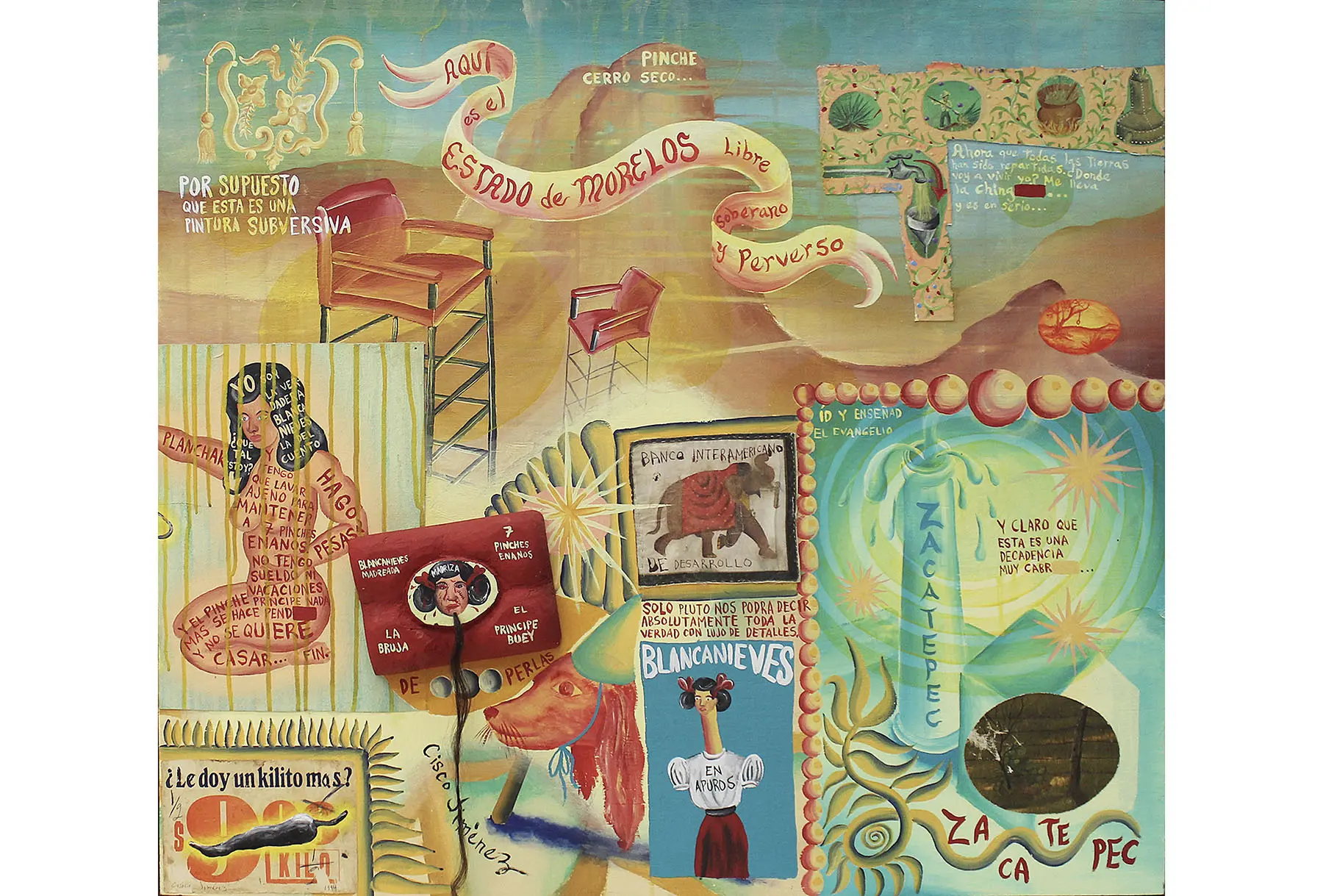
Mexico City’s Museo de Arte Moderno turns 50, and to celebrate the occasion it has programmed a series of curatorships that reflect on the role played by this space (such as the exhibition expressly devoted to commemorate the anniversary, curated by Silvia Navarrete, which describes the museum’s evolution in a clear, succinct, and effective way) and the processes it has used—and still does—as an exceptional showcase. Under this premise, it has initiated a series of dialogs between the works of representative artists of the 1980s. In the first of these dialogs, curator Octavio Avendaño Trujillo has sought out the points of correspondence and equivalences between Helio Montiel (1955), whom we can identify as one of the practitioners of Neo-Mexicanism (although an exhibition in this very museum, held in 2011 and curated by Josefa Ortega, starts with the question that puts in the same box a roster of artists from Enrique Guzmán to Graciela Iturbide), with Patricia Soriano (1964) and Cisco Jiménez (1969), two artists who appeared on the local scene ten years later, somewhat on the margins of the furor caused by other Mexican artists in the international arena, thanks to globalization.
As Avendaño explains in the exhibition card, the starting point (in his words, derives from) Kurt Vonnegut’s 1969 novel Slaughterhouse 5, which makes use of the resources of science fiction to tell the story of the firebombing of Dresden by the Allies in 1945. Avendaño writes: “The fictional plot uses spatial and temporal displacements to activate the critical device in the face of the violence and madness of the human species.” What Avendaño deploys here is not Vonnegut’s novel as such, but his narrative strategy in the service of a political point; the painters set to dialog also appeal to the resources of this science fiction (“the visual vocabulary in a fantastic register and the appropriation of the mass-media iconosphere,” as the curator points out) to shed light on a state of affairs and a political and social situation.
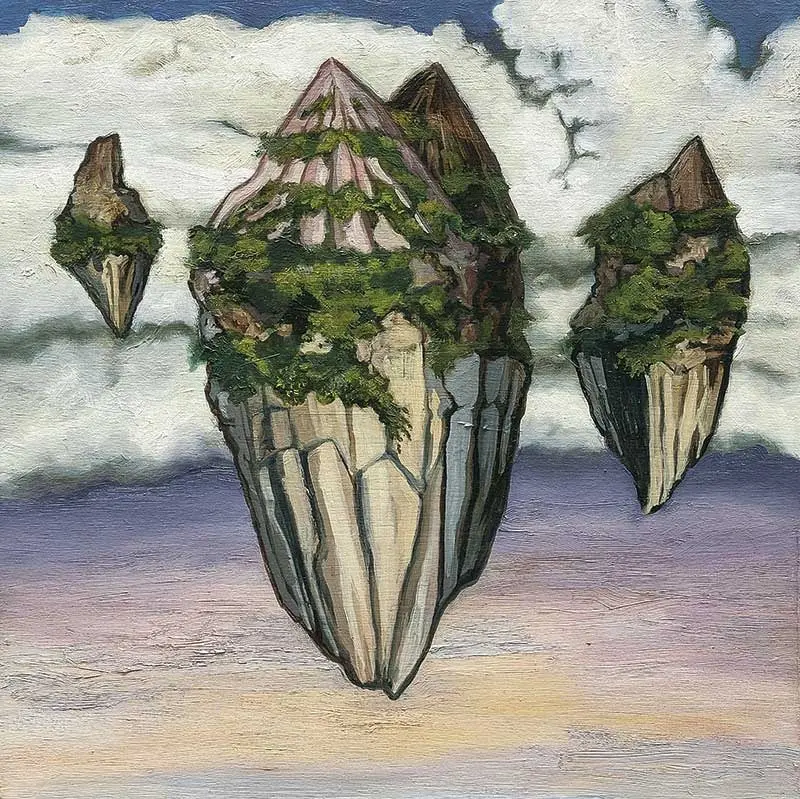
In the composition of her landscapes, Patricia Soriano uses organic patterns and geometric grids on which she superimposes—as thematic resources—anthropomorphic monsters and a Lovecraftian cosmic terror of bound human heads. In her canvases, Soriano depicts her own demons—figures and motifs of an inner landscape—along with those of everyday social reality. The thematic and formal tension of her compositions emerges from successive contaminations: the clichés of traditional landscape painting layered with expressionist resources, on top of geometric grids which, in turn, are superimposed—window-like—on other landscapes, characters, and details, with other resources that appeal to collage but also to the panel-based narrative structure that serves as an expansive resource for illustrators of trading cards and comics. A landscape of mountains like islands floating in the sky evokes the work of illustrators like Moebius or Roger Dean. I could continue listing references that connect to a dual game of nostalgia and violence of lost worlds, but what stands out is not as much the catalog of images as their dissolution—fused in the apocalyptic crucible of the artist’s imagination and her exercise—not as an appropriation but a review of the damage, which takes us, time and time again, from the vices and excesses of figurativism to geometric abstraction.
Meanwhile, Cisco Jiménez gained recognition at a young age thanks to an aesthetic formula that can be described as voracious. The racing of his—vertiginous—lines gives no quarter to the viewer’s eye, and it becomes a narrative path that is repeated and invades surfaces in an unflagging way, like the circuit of an organic machine always on the verge of overflowing its own boundaries. In fact, the compulsive drawing of figures, plots, and diagrams exceeds the two-dimensional format and projects itself—like a mechanical collage—into the three-dimensional, or contaminates the lost white space of the body of a sculpture whose shape I can as well describe as a boot and as a severed leg, and the graphic resources of advertising coincide in the amalgam that contains or defines his aesthetics. That boot (or leg) is encased inside a glass tube that mimics those seen in science fiction from the 1950s; behind it we can recognize a somewhat cubist cephalopod, the sketch or caricature of a nude bullfighter against a lilac ground, below it a dog on a mauve ground, further down a flower (or star) screaming (superimposed to it is a mug with a face), and even lower two round bodies with tentacle-like limbs, one with six eyes and jaws and the other, covered in green and purple circles, looking like a planet. Despite my detailed description, some things have been left out; these give a unique tone to a narrative always ready to jump outside its container to overspill on the gallery’s parquet flooring. This narrative gobbles up reality to represent it through an imagination halfway between political caricature and alternative comics, and also tends, in its excess, towards the text. Cisco Jiménez paints a system of hoses connecting stomachs, on which he has written different names of Mexican street-food specialties. The painting is an intricate organic diagram showing (and not) a food culture and transforming it into a monstrous digestive mechanism. Behind the paintings' intricate system of organic plumbing, Jiménez has drawn a network of lines incidentally resembling the geometric grid in Patricia Soriano’s space landscapes. Beyond the formal and thematic concepts shared by these three artists, In the exhibition’s museographic design (the work of David Osnaya and Arely Flores), which becomes an unending line where viewers can lose themselves for hours, Avendaño was able to exploit other connections.
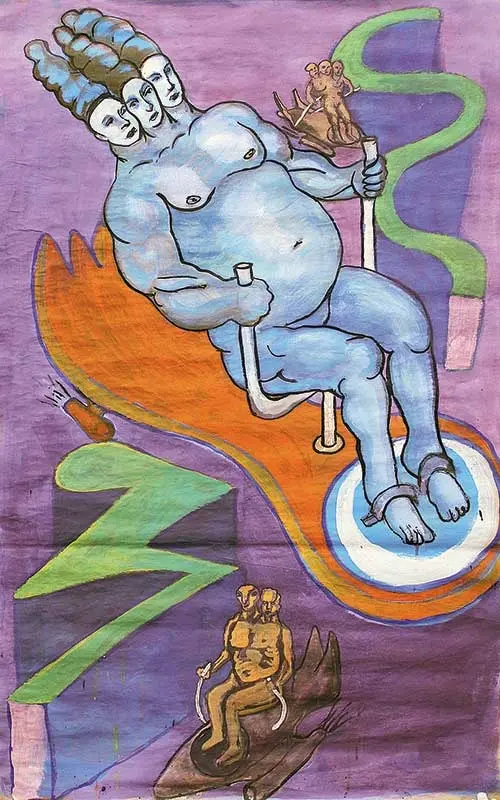
By the time Patricia Soriano and Cisco Jiménez began to make their name as artists, Helio Montiel was already a point of reference. Raquel Tibol described him as a “cultivator of transavantgarde Mexicanisms,” and by 1993 he had already had a retrospective at Zona. In 2012, Boris Viskin launched a virulent attack against the exclusion of artists who exhibited in that space in Antes de la Resaca, an exhibition curated by Sol Henaro for MUAC, which followed the guidelines established by Cuauhtémoc Medina for what he defined (or, rather, encompassed) in his exhibition La Era de la Discrepancia. All these precedents could help us define Los espías del Cosmos as an act of sedition—a critical position—that serves as a point of reference for the near future. Helio Montiel belongs to a generation of Mexican artists who have been displaced and redeemed, turned into modern monuments beyond the debates of the contemporary. In that sense, museums as spaces of exhibition seem to define nominal territories. It is in this context that Avendaño rescues Helio Montiel from the oblivion to which he has been condemned and brings him into this curatorial dialog. In Helio Montiel’s painting, there is a syncretic sum (or an amalgam) of spatial baroquism, traditional colors, and street art, the precedents of which are found in Surrealism and its psychedelic successors. The theme of his multicolor tableaux is change—the currency of the ephemeral—represented in the constant mutation of organs and bodies, which multiply like the metaphor of various tropes that end up being the same thing: the liberation of the senses, the alienation of modern life, the alternative reality of videogames, etc.
Although Helio Montiel’s work can be seen as a forerunner to the visual imaginaries of Patricia Soriano and Cisco Jiménez, it actually functions as a catalyst for the communicating vessels defining an imagination that revises and updates the mannerisms that defined the Twentieth Century’s visual culture (from the arts, through the arts, and beyond the arts). I don’t mean that it contains all those styles (the ambition, for example, of the vertiginous succession of images of what has come to define the Twentieth Century’s visual culture in information-selling advertising); I am referring to the simultaneity that opposes and synthesizes the spirit of such practice, like the synecdoche of a mass culture that overlays contradictory scenarios that lose their original meaning to form that other large-scale general meaning where reality is spatial melodrama. This is why the title of the exhibition is so pertinent: it connects these artists and turns them into a product. They are a decoy and an advance party, they serve as a reminder of the critical nature of painting, in an effort to open a dialog that updates them beyond the reference. The work of these artists is recent. We must heed, however, Avendaño’s final warning in the exhibition’s card: “Their images don’t dictate, they guide.”
RICARDO POHLENZ