
In Colombia, there is a deferred debate: painting is not dead. Perhaps as an echo of Charles Saatchi’s decision around that time to stop collecting painting, a questioning of the discipline started inexplicably in our country in the 1990s. This, which in one way or another contributed to the loss of painting’s prestige in Colombia, differed from what happened in Europe and North America, where painting did have a place in contemporary art. Artists like Mario Vélez, better known abroad than in Colombia, continue to work in the genre, but questioning it in intelligent ways in terms of space, theme, or technique, and emphasizing a conceptual aspect that saves it from banal virtuosity.
Vélez is exhibiting his most recent work in Canto rodado, at Christopher Paschall gallery in Bogotá. Large formats with a palette of earthen tones, siennas, golds, grays, and greens represent the individual’s relationship with nature and the cosmos. A topic that is, in principle, very hard to represent. For example, in the triptych Fragmentos de tiempo (2013-14) we see a series of shapes resembling embryos or red, yellow, and violet eggs, against a sienna, almost orange background that accentuates the natural and organic character of Vélez’s works, situated well beyond abstraction. There is here a strong reminiscence of Francis Bacon's work, albeit without any human or animal figures. The only figures are those “eggs”.
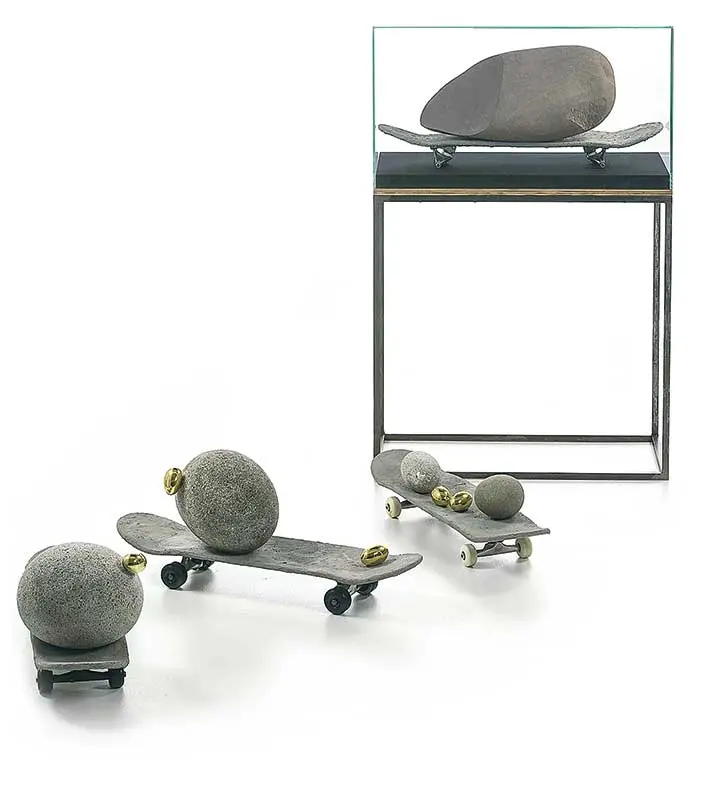
But looking at the exhibition as a whole we realize that these are not eggs but shapes alluding to rocks and stones. The exhibition starts with a video showing a hand-rolling some riverbank rocks. The sound produced by the rocks clashing is amplified in the entire space where the video is located, in the company of a group of sculptures. One of them, an urn containing an enormous rock, has the shape of the ones Velez paints. The rock can be touched through two holes in the glass urn that encases it. A strange sensation is aroused as we touch the rock, watch the video, and hear the rocks clash. Now we can begin to understand paintings like Silencios estelares (2013-14), where we find references to those same rocks as they establish a harmonious dialog, insisting that silence is, in reality, a way to tie down the depuration or decanting of sounds, rather than the absence of sound.
In other spaces of the gallery, we find a set of sculptural objects titled postcolombinos (2014), truly masterful works that play with the idea of a post-Columbian cultural era. Artist Oscar Murillo would be very happy if he saw this: stone-like, gray-colored skateboards are the support for a few river stones and golden eggs. It is as if those shapes that Vélez paints came out of the canvas and materialized into those objects on the floor or inside a glass urn, carefully displayed as objects in dialog with the pre-Columbians. A subtle sense of humor is evident in these works.
Entering the gallery’s main space we encounter a good amount of large-format works: Péndulos, Universo oscilante en paralelo, Vibraciones angulares, among many others reminding us that the universe has a weight, but that its weight can be lightened. In fact, the viewer will feel lighter in that experience. Even more when that lightness is augmented with a number of rocks arranged on the floor, which forces our path into a zigzag; our perception is different and the aesthetic experience becomes even more enriching. Rolling becomes an extension of matter, and it gives shape to those rocks. The passage of time polishes them. It is time, indeed, that intervenes in that constant carving.
Mario Vélez’s works, which interrogate and exalt painting, and go beyond the frame without tearing it to pieces, without erasing it from space, prompt us into thinking and feeling beyond a simple or banal act of contemplation. Quarry, decantation, rolling stone: we discover an entire universe thanks to this artist.
RICARDO ARCOS-PALMA