
It is a clear and meaningful coincidence that Marta Chilindron, a New York-based Argentine artist who avoids being labeled part of any specific artistic movement, has attained a degree of constructivist-deconstructive dematerialization since she began her works on clear vinyl and then on acrylic (2000) and other synthetic materials, with an emphasis on transparency. “Glass would work if it were not so dangerous,” said the artist in a recent telephone interview. The coincidence consists of not imposing precise boundaries, of not enclosing, and offering an open perception across time and space. Having placed the reader in the context of the author and her production, let us consider the experience of Chilindron’s exhibition titled Sculptures Expand//Fold//Collapse presented at the Great Hall of NYU’s Institute of Fine Arts (IFA). This elegant French-style building, once owned by the Duke family, stands in stark contrast to Marta Chilindron’s Plexiglas sculptures in an exhibition that is emblematic of temporal interaction in the arts. Displaying works from very different historical moments is a risk that even today not everyone dares to take. This exhibition demonstrates that the stable element (the period building) does not suffer when compared with one that is current. Through transparencies, physical geometric shapes, variable dimensions, and color palettes that are very different stylistically from the ornate characteristics of the Great Hall, Sculptures Expand//Fold//Collapse established a relationship that is valuable to both those who experience this educational space every day and to the casual audience.
It should be noted that some of Chilindron’s smaller works partially lost their flexible identity as a result of their placement in the space. A case in point was the piece Convertible Circle, which was placed on a heavily veined marble table. But we recognized that this location was as temporary as it was semiotic. A foldable piece the size of a large open book can be relocated to different spaces. At the same time, their degree of visibility or invisibility is a choice at the service of the artist’s aesthetic language.
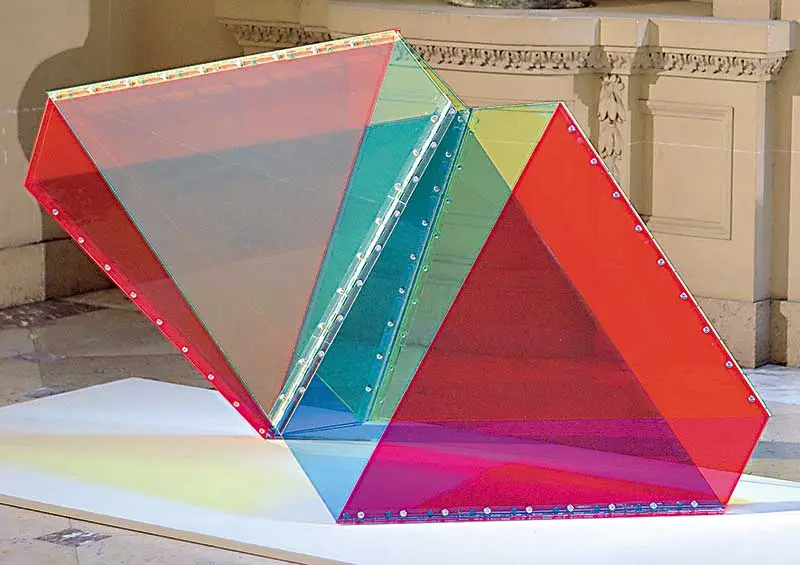
The term “articulated” is also important to be able to properly perceive Chilindron’s work. All of her planes and volumes exist in thin sheets fastened together by hinges that the author handled as aesthetic and functional elements. Her works with industrial and synthetic materials are not new but her approach and the direction it takes is. The use of synthetic elements refers back to Naum Gabo, with whom Chilindron shares the view that more than matter and the material, time, space and movement are the meaningful elements in the work of art. Other prominent artists that have worked with polymers since early in their careers—as far back as the Seventies—but with aesthetics that are very different from that of Marta Chilindron, are Argentines Gyula Kosice and Rogelio Polesello, and Mexican Feliciano Bejar.
Curated by Susanna V. Temkin and Katherine J. Wright, also authors of a well-documented catalog, the exhibition includes works created between 2006 and 2014. There were two sculptures impeccably curated in the lobby of the building: Ring (2013), presented flat against the wall, would greatly change its appearance as the natural light received from the street and the occasional light inside changed. The placement of Ring is an example to follow for collectors and interior architects. In the same entrance space—in a wall recess that would fit an elevator—there is the work titled Wall Cube (2014). Like all works by Marta Chilindrón, this yellow acrylic work is of variable dimensions. Conceived by the artist to hold the cube in place and give it considerable volume, Wall Cube is overtly a finished work that also reveals its structure. These two works are emblematic of the entire exhibition and even of her early works on wood. The following small and medium size pieces on acrylic are displayed in the exhibition hall: Sphere (2008), Convertible Circle (2009-2014), Helix (2011), and Mobius (2013). Across from them, two large pieces created with twin wall polycarbonate unfolded folded, and collapsed: Green Pyramid (2006) and Orange Cube 48 (2014). While the boundaries of the works are physical, viewers are left with the feeling that the sculptures’ movement could continue forever given the unpredictable manner in which it manifests itself in each sculpture.
During her two early periods of works on wood, Marta Chilindron would do everything herself. A decade and a half since then, she no longer does everything herself but “the steps of preparation are intense, are divided into several stages that must be very precise. Although I would love doing everything myself, these kinds of cuts require the involvement of other people and I do enjoy the collaborative aspect of the process.” The objects by Marta Chilindron create an expandable, foldable, and collapsible ritual with corresponding transparencies, concealments, and exposures. Viewers decide when to stop playing.
GRACIELA KARTOFEL