
Sanatorium is a hybrid and interactive artistic practice conceived by
Pedro Reyes (Mexico, 1972) as an intimate and moving journey of “meaningful surroundings.” Everyone goes through that thread of knowledge
willing to experiment with experiences proposed as healing therapies that
induce both a personal and ludic state; namely, to a threshold for change.
With infinite potential as a traveling space that generates different lectures in each viewer, the great reception of this proposal—already presented in multiple venues like the Guggenheim Museum in New York and dOCUMENTA 13 in Kassel, among others—does not solely reveal the need for our contemporary world for playfulness, intimate rituality, closeness, and connection, but it also stands out from the dominant art scene where the society of entertainment and cult to Baal limit the potential for artistic imagination.
This group of equally simple and playful therapeutic exercises diverts from the norm of the usual and reformulates essential questions—who are we, how would we like to live, what legacy would we like to leave behind, etc.—as we walk through each of the rooms that serve as containers of interior places.
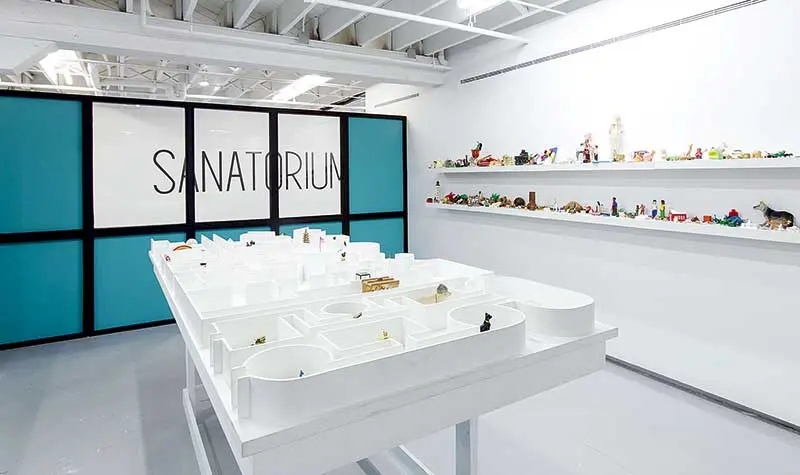
Sanatorium promotes a sensitizing intersection between art and life by encouraging modes of social exchange that, while sometimes anonymous, make us feel as if we were part of the same vital current of extraordinary and vulnerable transient beings. The honesty with which this proposal was conceived is evident in the work Manual de Operaciones (Operations Manual), a piece that any person of the public can acquire and that includes, on the one hand, a number of references to thinkers—like Ivan Illich or Jacob Levy Moreno, one of the pioneers of sociodrama—who are capable of challenging the paradigms of Reyes’ time and, on the other, conversations with colleagues and researchers that shaped the work’s conception, among these: the artist and educator Raphael Montañez-Ortíz, who transferred the performance from the artist’s body to the collective stage in his Physio-psycho-alchemy events; Antanas Mockus, mayor of Bogota, Colombia, who incorporated playful elements into the urban landscape to change the dynamics of human interaction and as a “vaccine against violence”; and the irreducible Alejandro Jodorowsky, inventor of Psychomagic, a technique to achieve healing experiences through catharsis—a term that in Greek means “to cure.” In short, leaving behind the idea of the artist as creator of art objects, Reyes proposes a practice that incorporates and expands a path taken by minds capable of challenging paradigms, which—with the support of medical researchers—provokes in participants experiences connected to their personal stories and that uses art as a ludic way for social healing. It is an attempt that also revives the legacy of Brazilian artist Lygia Clark.
Also creator of the exercise Palas por Pistolas (Shovels for Guns)—an intervention that marked the beginning of his approach for transforming objects and attitudes—Reyes includes in Sanatorium a series of instructions based on the central question: “Can a new social reality be modeled from the experience of interaction?” and, in that same vein, from the notion of health understood as “the way people maintain a sense of coherence believing that life is manageable and has meaning,” a concept developed by Aaron Antonovsky. The practice proposal is a place to reconnect with the being perceived in relation to others. But the experience has to be lived. I can only evoke how spectators turned actors-patients are received by an artist-therapist student who is part of the volunteer group. Upon entering the Museum of Hypothetical Lifetimes participants find a white mockup with spaces that will eventually contain their stories—from birth to their imaginary deaths— reconstructed from a selection of small objects. Reyes designed each space for a narrative experience inspired by the emotional architecture of Goeritz and Barragán.
In Citileaks colored bottles tied with yarns containing the unspeakable secrets of the inhabitants of the city who, in exchange for writing and depositing a secret, can read one from a stranger, in an exchange that is both unusual and liberating. In Epitaphs, everyone plays at experiencing death and chooses an epitaph that is carved on paper with a punch. In Goodoo, the magic proposed consists of participating with a doll that represents a loved one and exercising the power of intentionality. In Philosophical Casino, each participant writes a question and selects a giant dice from among options that contain quotes by several thinkers. The phrase now turned prophetic, triggers a personal reflection process.
ADRIANA HERRERA