
The Smithsonian Institution has been working hard lately to compensate for the many years it neglected the work of U.S. Latino artists. Last year the Smithsonian American Art Museum presented Our America: The Latino Presence in American Art, which, curated by E. Carmen Ramos, the museum’s new curator of Latino art, displayed over 90 works of art made by Latino artists, many of them recent purchases. And now, on display at the National Portrait Gallery (NPG) is Staging the Self, an exhibition featuring the work of six contemporary Latino artists: David Antonio Cruz, Carlee Fernandez, María Martínez-Cañas, Rachelle Mozman, Karen Miranda Rivadeneira, and Michael Vasquez. The exhibition, co-curated by Taína Caragol, the NPG’s new curator of Latino art and history, Rebecca Kasemeyer, Dorothy Moss, and David Ward, is part of the museum’s vibrant Portraiture Now series, a program designed to bring contemporary work that often challenges traditional notions of portraiture, identity and subject formation into an otherwise fairly traditional museum space. If the NPG’s broader mission is to display works of art that depict figures who have made important contributions to American history, then the Portraiture Now series allows the museum’s curators to think about portraiture more conceptually, to imagine how different media (photography, painting, video, and so on) affect the way artists and viewers understand images of themselves and others, and also to question how portraits of individuals might relate to and inform ideas of community.
Such an expansive view of what portraiture is and how it functions seems to be exactly what the curators have in mind when they describe the exhibition’s unifying thread in terms of theatricality. All of the artists represented in Staging the Self “present identities theatrically,” write the curators. “Like actors searching for a character, they explore the boundaries of individuality. In the process, portraiture loses its aura of certainty and instead becomes an evolving map for finding oneself and others.” But the idea of portraiture as “an evolving map for finding oneself and others” is not the same as thinking of portraiture theatrically—as a staged identity. To say, individuals, like actors, stage their identities seems a truism at this point. Really what person isn’t aware that we all, in important ways, stage our identities, from moment to moment and from context to context? And more, that such presentation affects both the way we understand ourselves, as well as how others understand us?
More interesting, I think, is how portraiture might dislodge individuals from their fixed identities, and, as the curators describe, function like a map for finding oneself and others. It is specifically the relational component in this statement—that is, the connection drawn between oneself and another entity—that I find compelling, for it suggests that no individual exists independent of her or his environment. Pushed to its limit, this position suggests that there is no inner unitary self, only relation. The idea that a portrait could help find oneself and others might thus be understood as provocatively undoing itself: There is no “finding of oneself” because there is no ultimate self to be found, there is only other. Or rather, we all exist in a constant state of becoming, in, and through a process of exchange. Although this idea has been around for a while, in the context of the NPG, an institution designed to valorize the accomplishments of unique and “great” individuals, its emphasis could provide a fresh perspective on the meaning and conception of portraiture in the contemporary moment.
Regrettably, Staging the Self—despite the inclusion of much excellent work—fails to take on this challenge. The emphasis on some vague idea of “theatricality,” combined with a curatorial statement that conflates staging and relationality (as well as staging and memory) leads to frustrating inconsistencies in the show’s conceptual framework that takes away from the exhibition’s unity and makes much of the work less interesting than it might otherwise be. The generalized description “theatrical” fits some works better than others, and likewise, phrases like relationality and intersubjective exchange (or in the case of Carlee Fernandez, even inter-species exchange) applies to some work more than other work; these are differences that should be elaborated, explored, drawn into comparison with one another, and considered in the context of Latino portraiture specifically. Acknowledging and investigating differences this way could have—should have—added texture and complexity to the exhibition instead of confusion and simplicity.
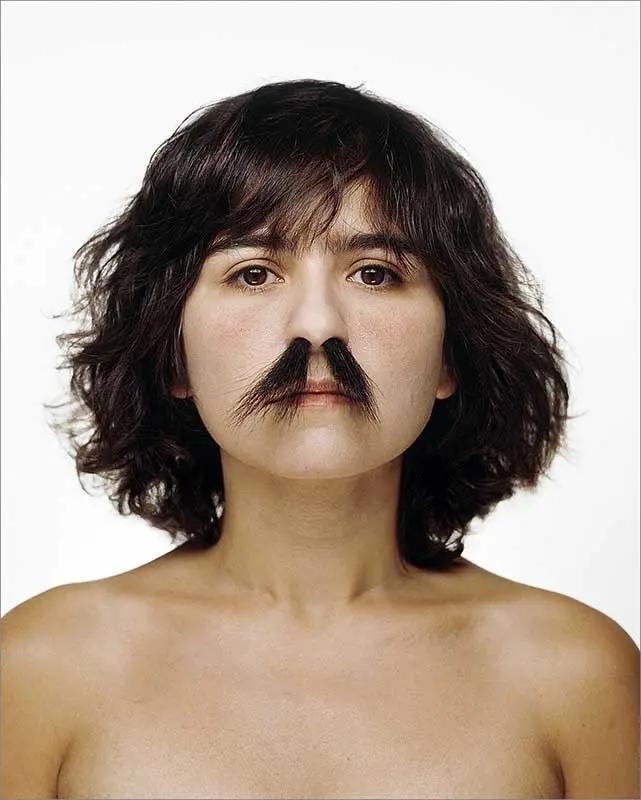
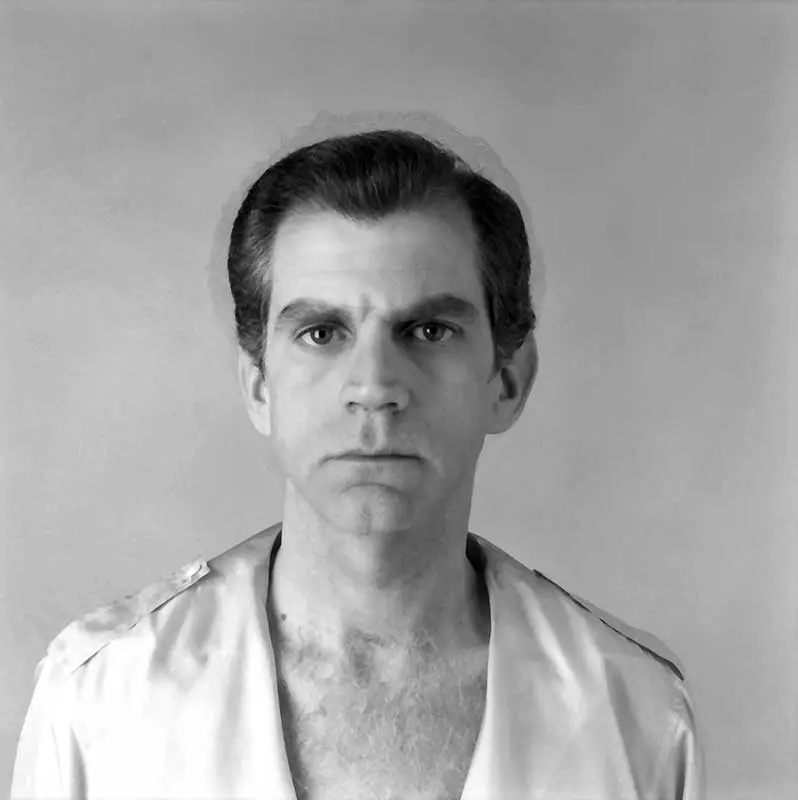
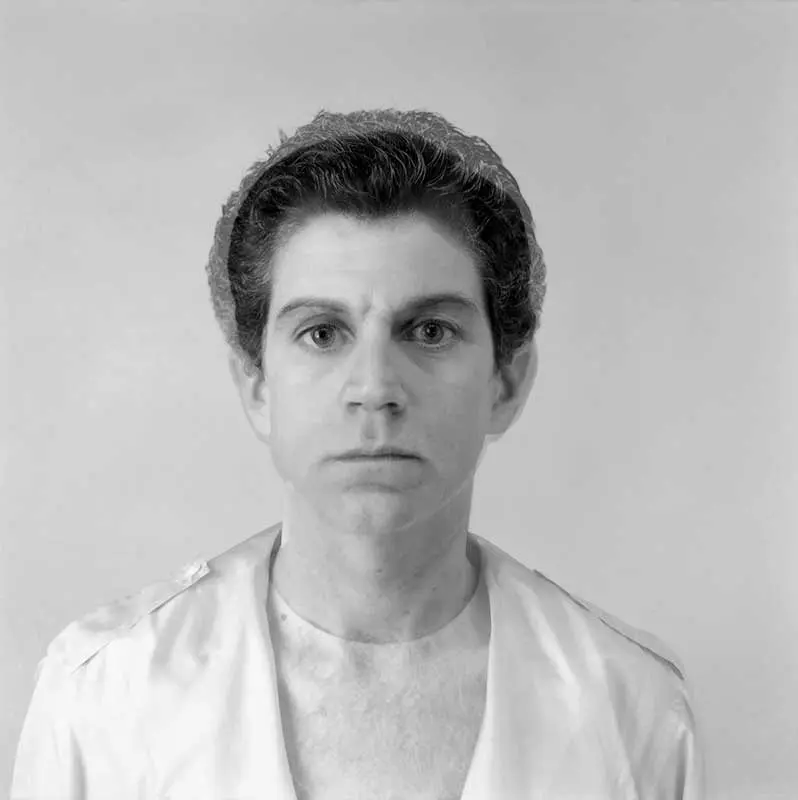
Carlee Fernandez and Maria Martinez-Cañas are two artists whose projects feel especially under-served by the exhibition’s organization. It’s not that their work doesn’t leave a strong impression, in both cases, it does. The problem is more that the concept of staging or “theatricality” negates some of the intellectual rigor of both women’s production. Fernandez’s striking photographs of herself wearing a bear suit in which she combines her body, hair, and weight, with that of the animal becomes a playful performance more than any kind of investigation into the relationship between human and animal bodies, or between antagonistic and passive identities. And the same can be said of her diptych, Man (2006). Two photographs hang side by side: one of her father at age 19; the other of herself. Fernandez, in the image of herself, imitates her father’s posture, wears his identical clothes, and stands in seemingly the same spot. There is warmth in this piece; it is a loving tribute to a father, an expression of admiration, and an acknowledgment of how similar she looks to him. But as Fernandez juxtaposes her body to her father’s, as she filters her identity through his, both beings change. Fernandez and her father become one another, yet neither ever disappears. Similarly, Martinez-Cañas’s series, Duplicity as Identity (2008-9) overlays photographic images of herself on ones of her father—sometimes her father’s image is more visible than hers, sometimes hers more than her father’s. On the one hand, the series raises fairly traditional, if still interesting, questions about the dependence of younger generations on older ones, and about the similarities in appearance and facial structure between a male parent and a female child (with all of the images appearing androgynous to some extent). But the work, I think, says something more than this too: as Martinez-Cañas creates her images such that father can only be seen through daughter, and daughter through father—the images emerge only as each subject is exposed, as a philosopher like Jean-Luc Nancy might say, to the other. For Nancy, it is exposure to others that designates “being insofar as it is relation, identical to existence itself.”
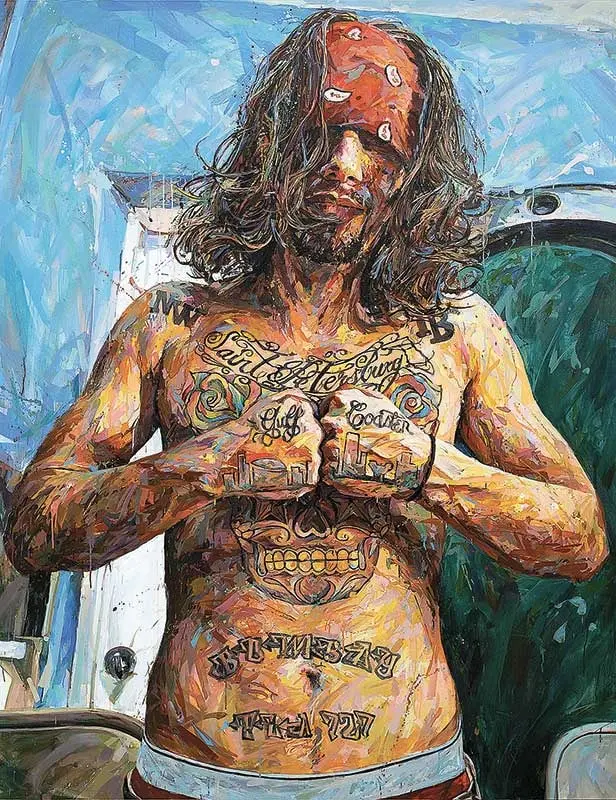
But if the work of Fernandez and Martinez-Cañas suffers some under the banner of theatricality, the artist who benefits most is Michael Vasquez. His large-scale paintings based on photographs of the friends and gang members that he looked up to and was surrounded by as a young child being raised by a single mother are bold, confrontational, and nothing if not dramatic. The young men in Vasquez’s paintings do in fact stage identities: they pose, display tattoos, and perform for each other and the viewer in gestures of defiance that appear both intimidating and pathetic—a performance reinforced by Vasquez’s brushstroke, which is also somehow “stagey.” In This is Ours—AJ (2011), a nearly eight-foot-tall canvas, Vasquez’s animated brushstroke fights for attention, and nearly overshadows the depicted figure. In fact, though the bare-chested, tattooed figure stands with his fists bumped together, it is Vasquez’s brushstrokes—colorful, lively, angry—that feel confrontational, not the young man portrayed. The virtuosity in these painted strokes seems designed to function like proof or evidence. Evidence of Vasquez’s skill, evidence that he survived a childhood full of gangs, and guns, and drugs—evidence that he survived childhood without a father. These paintings demand respect. But there is something aggressive and unforgiving about the work that makes it difficult to digest. For me, there is too much theatricality here, (and too much play with stereotype), yet within the context of Staging the Self, this is precisely what gives the work its sense.
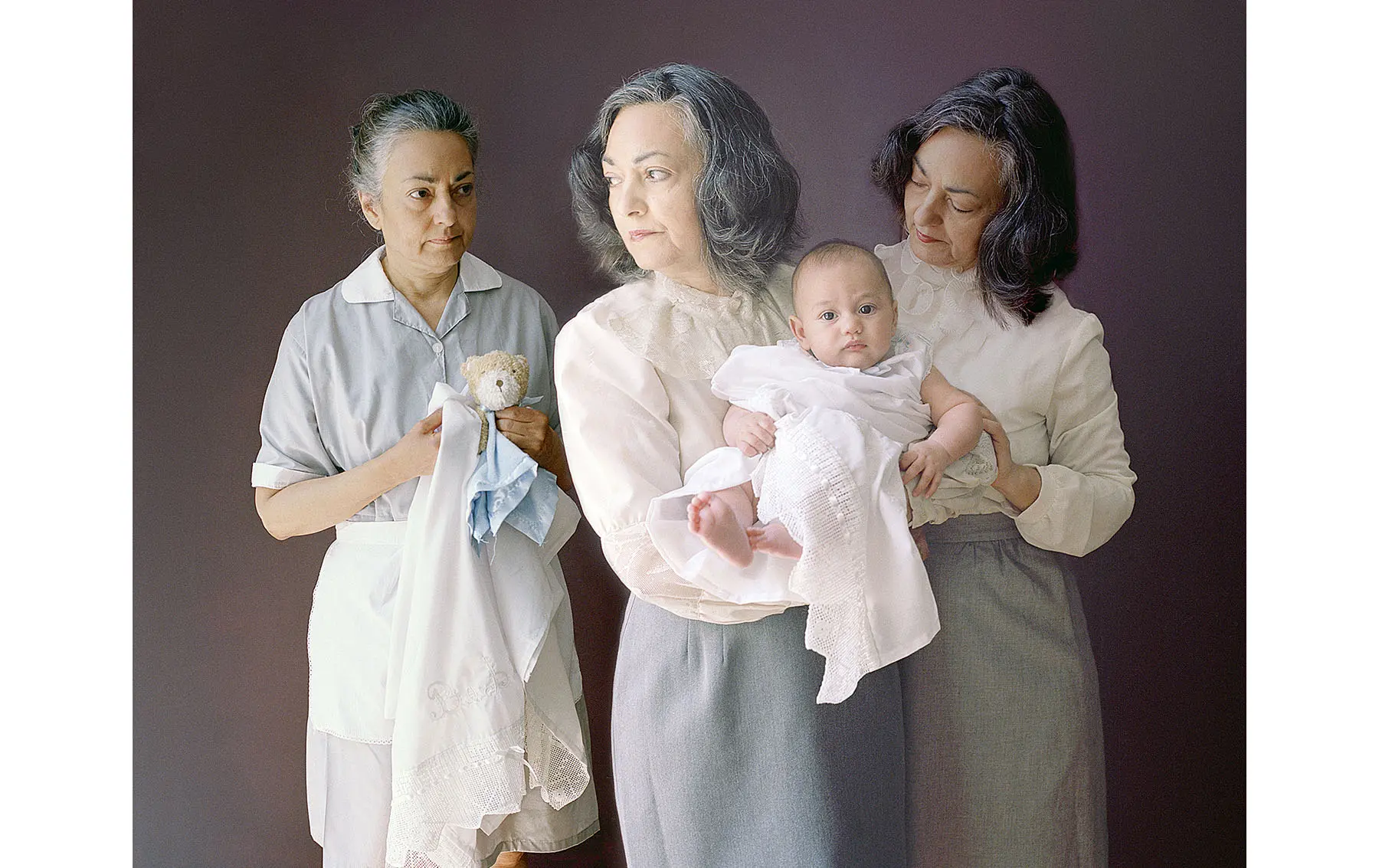
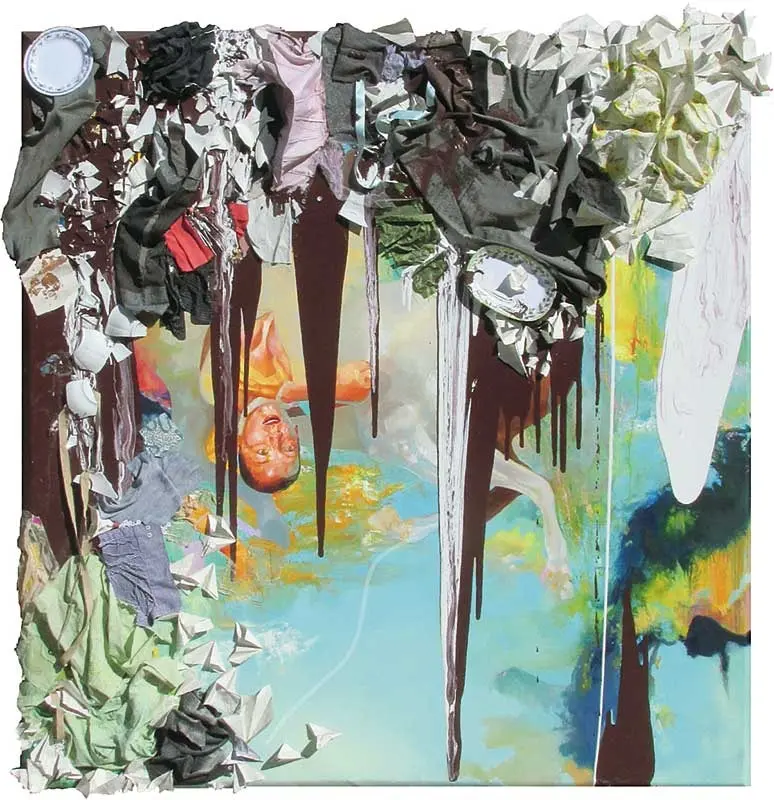
So if projects by Fernandez and Martinez-Cañas lose some of their power in Staging the Self while Vasquez’s paintings gain meaning and even help organize the exhibition’s content, then works by the other three included artists—David Antonio Cruz, Rachelle Mozman, and Karen Miranda Rivadeneira—operate, within the exhibition’s framework, at varying degrees of success. Cruz’s thick assemblages, which combine a wide range of materials (including rags, china, costumes, gold-leaf, and enamel paint) that address queer identities, invisible histories, and the impact of migration on one’s sense of self and belonging. His canvases have a material presence—weighted down by fabric and thick with opaque enamel paint, they obscure as much as they reveal, performing the tension between being seen and not being seen, between exposure to others and withdrawal into one’s self. By the same token, Mozman and Rivadeneira address the impact of family history, real and imagined, on one’s sense of self. Both of these artists “stage” their photographs (both also use their mothers as models), but for neither is the staged element the work’s most interesting aspect: for instance, Mozman’s excellent photographic series, Casa de Mujeres (2011), illustrates a complicated and imagined family history that situates, among other things, a light-skinned sister against a darker-skinned sister. The stiff, awkward encounters between the characters, all played by Mozman’s mother, however, results not so much in a staging of identity, but in its mysterious multiplication and ultimate un-knowability.
If I’ve been hard (perhaps unfairly?) on the curators of Staging the Self, it’s because I find so much of the included work strong, and wish it had been addressed with more conceptual rigor. I also wish more had been asked of me as a viewer. The exhibition seemed to want to create the sense that something significant about identity—identity generally, and Latino identity specifically—was being presented, but the desire is not enough. Without adequate visual or textual guidance, no clear curatorial message can be communicated. The NPG is currently planning a performance art series, which is an exciting development for a museum with a history of displaying traditional media and conservative content. Perhaps this will be the place for curators to engage in a more theoretically rich discussion about the future of portraiture and for that matter their own institutional relation to historically excluded communities. (In this regard, it will also be interesting to see how the gallery frames One Life: Dolores Huerta, which, organized by Taína Caragol, is scheduled to open this July.) In this case, Staging the Self would have benefited from a more honest concentration on the relationships that seem most relevant to the formation of the identities of the artists included in the show: those with their families and immediate communities. A focus on these relationships would have made it clear that we are all in constant states of becoming, endlessly negotiating the outside world, never to find completion.
TERRI WEISMAN