
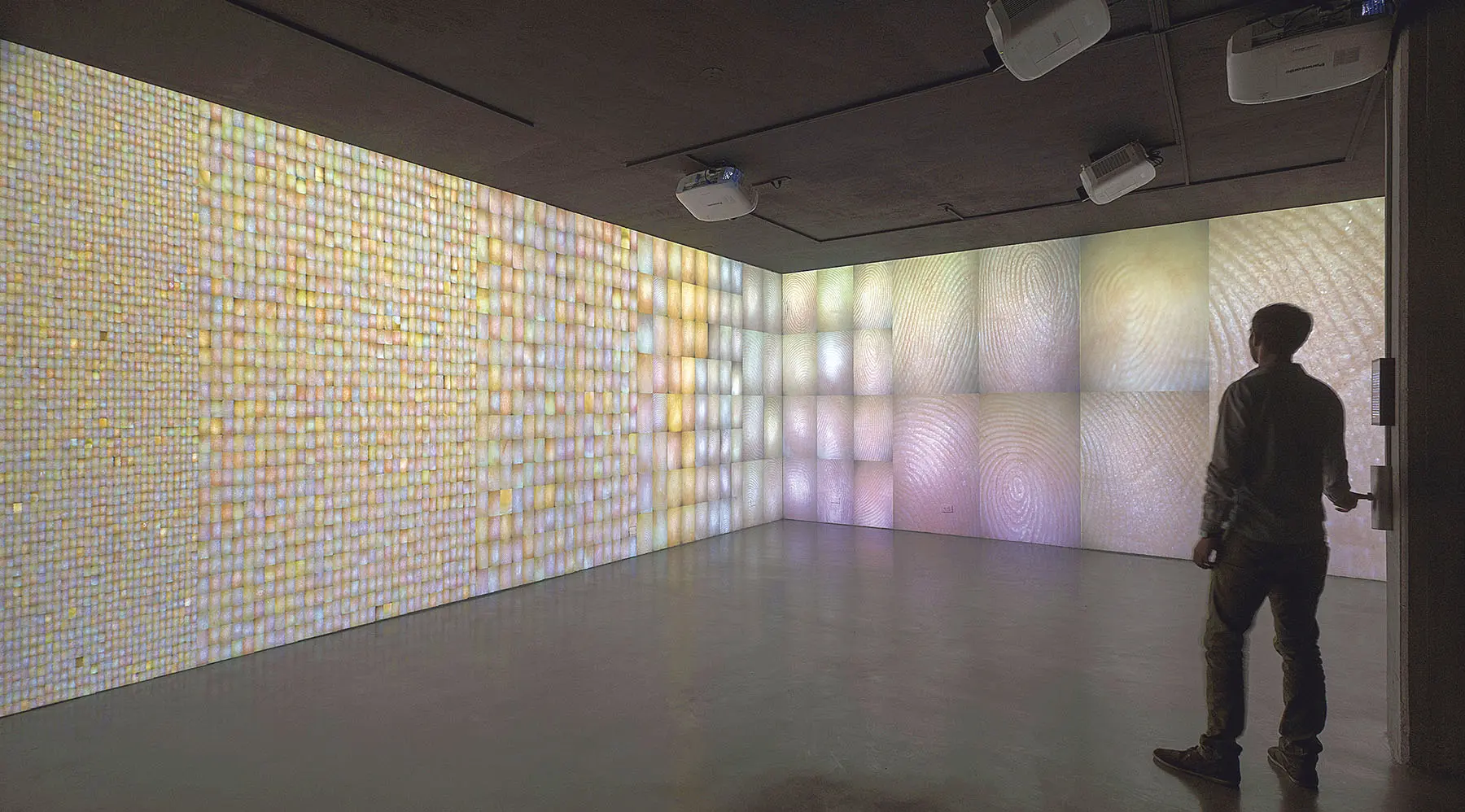
There is something distinctive about the works that establish a relationship between art and science: the interactive participation of viewers, who are no longer contemplative and passive spectators but true activators that make the work a full-body experience in which image and body create new perceptive relationships involving all the senses. Such is the case of the exhibition Signs and Indicators by artist Rafael Lozano-Hemmer presented at the Fundación NC-arte in Bogota, where our body as an activator is confronted with a series of works that question and expand our perceptual field, which is sometimes exclusively limited to visuality.
The exhibition consists of four works: Basado en Hechos Reales (Based on Real Events), La Media Noche del Año (The Midnight of the Year), Almacén de Corazonadas (Storage of Hunches) and Índice de Corazonadas (Indicator of Hunches). Basado en Hechos Reales shows a game that reverses the role of surveillance cameras in that the person observed becomes a handler of the recording device as he/she is photographed by it. The terror and the feeling of being watched that Paul Virilio so vehemently spoke about three decades ago here totally disappears when the camera is transgressed by those who are aware of its visibility and are empowered to turn the device on or off. The resulting “self-portraits” show us that radical reversal of that which I call “the unfolding of the point of view, "1 where the predominant role of the surveillant is disrupted.
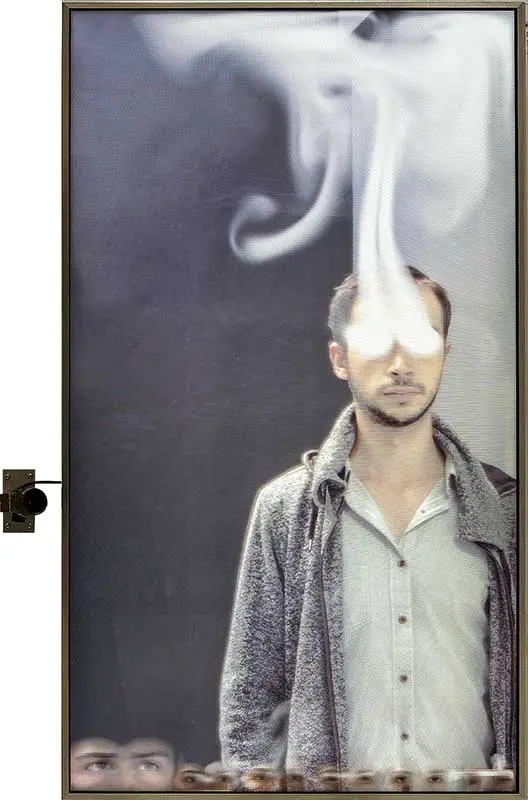
In La Media Noche del Año a “mirror” reproduces the torso and face of the person being observed as if it were an image of identity. Suddenly the eyes disappear from the reflection of the activator, leaving a cloud of smoke in their place, which underscores the old idea that the soul escapes from the eyes or that the eyes are the reflection of the soul. The activating device of the camera behind the mirror (Alicia would be happy about this), makes us smile from the excitement of seeing the reflection of our eyes vanish in a cloud of smoke above our heads. Andrés García-Larrota wrote in the exhibition’s introductory text that it is almost a mystical image reminiscent of Saint Lucy. Like the sight of that Saint, our eyes have been torn from their sockets and become part of the hundreds of pairs of eyes contained in a database. But all of this of course is only an illusion.
The third work, emphasizes the indicial device as a digitized identity mark. Each activator places his/her finger on a fingerprint scanner similar to those found in airports, banks, and other sensitive sites where digital identity is irrefutable proof that we are who we are. At that moment, the recorded fingerprint becomes part of a large database that generates a mosaic on a screen. This work exposes the devices for control that exist in our time, where we are “booked” in a large luminous identity file. It is a fantastic image-print that fuses the tactile, with the epidermal and sweat in a single luminous moment.
The fourth and last work, Índice de Corazonadas, in my opinion, the most ambitious piece for its size and what it represents, is a complex lighting device that captures the heartbeat. As activators, we get on a small stage and place our hands on a pair of bars. These are heartbeat receptors that illuminate a light bulb that in turn reproduces our heart rate. Our pulse is thus incorporated into the “storage” which is nothing more than a ceiling covered with light bulbs turning on and off intermittently. These light pulses thrilled me. One thing is to hear one’s heartbeat, but being able to see it is something else altogether, especially when it illuminates the darkness. In fact, I had never seen my heart beat so fast. “Is it possible that I am in love?”—I asked myself, still smiling.
It is not difficult to smile when experiencing an installation like this one. It suffices just observing the people looking at the roof full of light bulbs, trying to locate their heartbeats already in tune with hundreds of others. About this, Lozano-Hemmer has said: “the idea of repetitive rhythms, of minimalist music (...) is music that repeats certain patterns, but that, because it is out of phase, creates different resonances and sounds in the same manner in which we observe the installation: not only do we see our heart flashing but we also observe a landscape of vital hearts surrounding it."2
Undoubtedly, this is one of the best exhibitions I have seen in Bogota during the end of 2014.
NOTES
1. ARCOS-PALMA, Ricardo. From the View to the Glympse. The Unfolding of the Point of View. Trial & Error, Revista del Pensamiento Contemporáneo. Bogota, No.7, 2000.
2. LOZANO-HEMMER, Rafael. The intent according to the artist, was taken from the NC-arte video about the exhibition. https://www.youtube.com/watch?v=clXSUkB_Cxo#t=74
RICARDO ARCOS PALMA