
The Centro Cultural Plaza Castelli in Buenos Aires presented the exhibition titled Roberto Frangella: 40 Years Painting (1974-2014), a thorough retrospective that included ink drawings, paintings, ceramics, and sculptures.
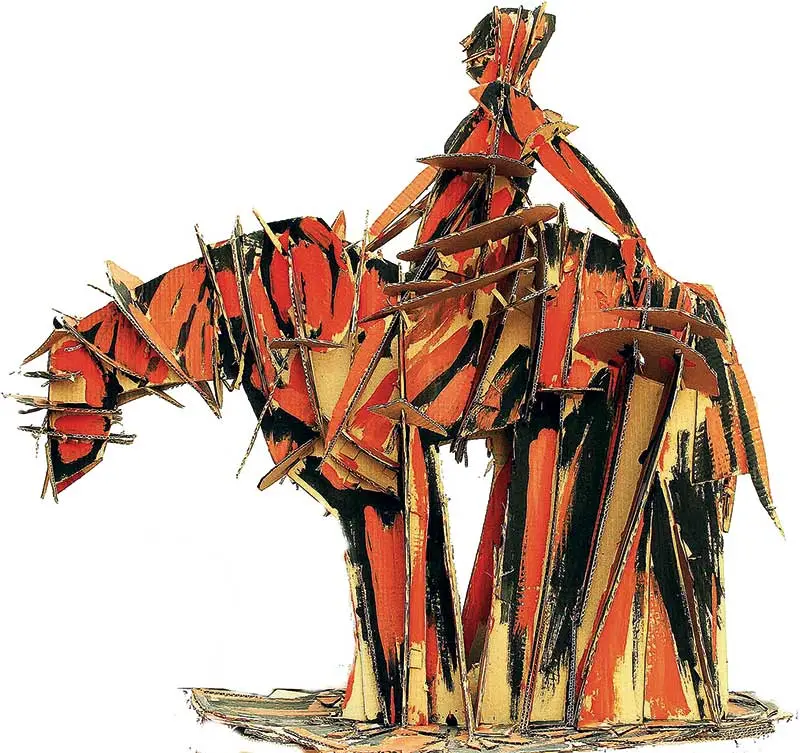
A prominent architect, sculptor, and painter, Frangella (Buenos Aires, 1942) have had a long and prominent artistic trajectory. In 2013, he was granted the Expovivienda BATIMAT Trajectory Award, one of Argentina’s most prestigious recognitions in architecture. He is the author of several prominent architectural projects won by competition in Argentina and abroad, including the Escuela Normal Superior en Lenguas Vivas (Buenos Aires), the Central Bank of Paraguay (Asunción), and the Zaharia house in Bariloche, among many others. Earlier in 2012, Frangella inaugurated the exhibition halls of the Centro Cultural Plaza Castelli, after being selected by that institution’s director, Sandra Juárez. In addition to his remarkable career, he was chosen because his work reflected the core values of that cultural center: fostering community participation and advocating cooperation and solidarity. Beyond his achievements at the institutional level, throughout his career, Frangella has incorporated a commitment to social issues as a central aspect of his work, including initiatives associated with assisted self-construction and housing plans through cooperatives. This has allowed him, in his own words, to “learn a lot from others, from their souls and warmth.” Beyond the professional context, he has carried out solidarity actions of an even more direct nature, such as the organization of a weekly dinner in support of the so-called cartoneros (waste pickers), men and women that, as a result of the deep economic crisis that hit in Argentina in 2001, make a living walking the streets of the city in search of paper and cardboard to sell. According to Frangella, who admires and respects the cartoneros: “I wanted to be an artist like them.” And he is. A great part of the work presented in this retrospective reflects the spirit of their approach, in pieces made entirely with waste material found in the streets of Buenos Aires. His small and large sculptures were created out of cardboard packaging, recycled containers, and empty paint cans. A colorful map of the city is assembled from a variety of colorful boxes of toothpaste, tea, medicine, and soups. According to Frangella, “I am passionate about the almost casual creation of assemblages and glued constructions. My approach to composing with elements and parts is informed by my training as an architect. Likewise, my works present concepts through figurative imagery that, nonetheless, always point to a message of equality, justice, and the well-being of the entire planet. I actually use art as a vehicle to express my convictions as a human being that aspires to a better world.” Intertwining art and life is a vanguardist ideal that is fully accomplished in Frangella’s artistic endeavor. He successfully alternates work in the studio with his explorations on the streets of the city. An activity that involves the close observation of others and their needs, while always being open to modify, always willing to intervene to offer a hand and share his knowledge with others.
Words are also present in his works. Some recent proposals like Informe Maciel (Maciel Report) and Cosmos, oil paintings on canvas full of color, include words that harmoniously blend and flow into that which is represented. Words even shape a small picture book created with small single sheets of paper: Cuentos de la Isla Maciel (Tales of Maciel Island). It contains ink drawings of characters from the neighborhood of La Boca: the immigrant, the boatman, the seamstress, children playing soccer. They are small and beautiful sketches in which the vitality of the line extracts the essence of the neighborhood, immersing viewers in a living, breathing, architecture: the bridge over the creek, the moving boat, the patio with geraniums, the soccer ball kicked across a makeshift field. The images are again blended with the words in small stories in which the characters describe themselves, even the great Benito Quinquela-Martín is rescued as the artist who knew how to “grow up understanding his surroundings and transform knowledge into a complete and happy proposition that makes life more bearable.”
Frangela’s singular wanderings have also led him to explore and incorporate other techniques. During his stay in Paraguay, for instance, ceramics became another discipline that he approached with respect through observation and his admiration toward those who practice it in that country.
Frangella defines his retrospective as “many years of drawing feelings and illusions,” and with one sentence summarizes his entire life as an artist “To create is to give oneself as a fruit.”
VIVIANA SAAVEDRA