
Defining contemporary art in her book The Meanings of Contemporary Art (Contexto), Brazilian art critic Katia Canton asserts that artistic practice became “a project of ceaseless negotiation with life’s events and perceptions.” This is, precisely, the core of the work of young artist Rodrigo Matheus, as can be seen in his recent exhibition Do Rio e Para to Rio and from.
This is Matheus’ third solo exhibition at the gallery. And here he presents a new series of sculptures, installations, and collages, produced during a stay in Rio after almost four years abroad. The works were built on the basis of postcards sent from Rio to Europe throughout the Twentieth Century. These are postcards the artist found in second-hand fairs in Europe; he brought them back to their point of origin and combined them with postcards sent from Europe, which he found in Rio already in the Twenty-First Century.
The idea of a micro-narrative was the background for those sculptures and installations that reproduced, inside the gallery, what the artist observed as recurrent in different cities: the relationship between vegetation and architecture. One of the thematic examples explored by Matheus was the Modernist vocabulary of buildings from the “Golden Age” and the iron fences later annexed to them.
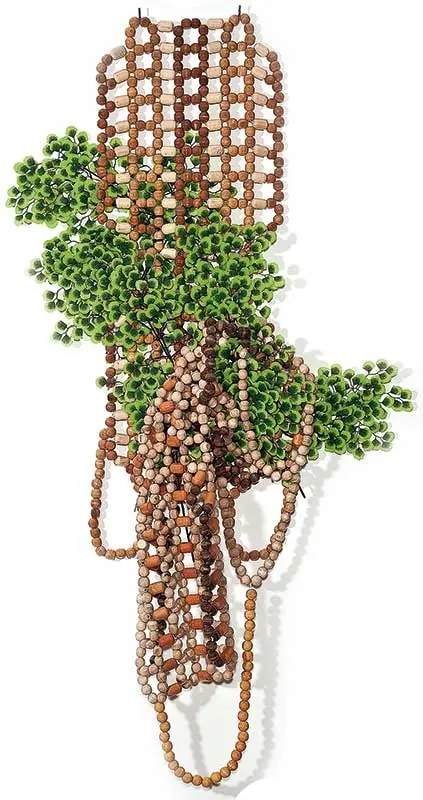
The selection of works featured in this exhibition used the city’s own visual repertoire to develop sculptures that appropriate both what is planned and what is spontaneous and improvised in the urban grid. “The materials used in these works come out of that context. Metal grills in varied designs, artificial plants, sand, protective fabric for building remodeling, display windows, and construction materials, all question the glamour image of the postcard and confront them with the city’s real problems,” the artist comments.
According to Matheus, the exhibition also discusses the ambiguity of the process of modernization in Brazil on the basis of the imaginary projected by Rio de Janeiro, “entry door to the country and natural monument, the old capital of the Portuguese empire, the former capital of Brazil, tourist destination, and the current focus of an urban retrofit seeking to establish in its historic center a globalized island surrounded by a tropical landscape that resists domestication.”
Born in São Paulo in 1974, Matheus lives and works between London and his hometown. He graduated with a degree in MultiMedia and InterMedia from the Communications and Arts School of the USP (ECA-USP) and has a Master’s Degree in sculpture from the Royal College of Art, in London. Galleries in London, Rio, São Paulo, and Los Angeles represent him, and his works are included in many public and private collections, such as the Imhotim Institute, MAM-São Paulo’s Museum of Modern Art, Pinacoteca do Estado de São Paulo, Rio’s Museum of Modern Art, and Itaú Cultural Institute. Some highlights among his solo exhibitions are Coquiero Chorão, Ibid Projects (London, 2014), Colisão de Sonhos Reais em Universos Paralelos, Manuel Antonio da Mota Foundation (Oporto, 2013), and Handle with Care, Galpón Fortes Vilaça (São Paulo, 2010). Among his group shows, the Astrup Fearnley Museum (Oslo 2013) and Itinerarios – Itinerancias, 32° Panorama at the Museu de Arte Moderna in São Paulo (2011).
In a large part of his oeuvre, Matheus presents situations that question the power structures behind visual identities that regulate our subjectivity in the name of civilized progress. His works articulate diverse media—video, installation, sculpture—to discuss the nature of representation in the arts and their relationship to industrial design.
In this show, Matheus brought together, in an even more significant manner, industrial and natural elements in a single body, sending a critical gaze in the direction of collective notions of the representation of nature forged within a public and urban environment. In this way, the artist modified the mechanism of everyday life and propose new combinations for it. He built, on the basis of objects that circulate in the world, new meaning possibilities, outside of those programmed by their function.
It is here that Katia Canton’s vision fits when she defines the project of contemporary art as not having as its driving force the “tradition of the new” proposed by the avant-garde and the post-avant-garde, but a search for meanings, an operation that starts with the constant negotiation between art and life, life and art. As in Matheus’ works, the contours of these are fluid: the quest is for identities, alterities, bodies, relationships between ethics and aesthetics, evocations of personal memories, demarcations of zones of resistance, all in the pursuit of a sense of belonging in a world where the virtual is a constant.
ALESSANDRA SIMÕES