
Last September, Rubén D’hers, a young Venezuelan musician based in Berlin, presented the exhibition titled Quebrada Escondida at the Oficina No.1 gallery located at Centro de Arte Los Galpones. D’hers’s first solo show in Venezuela, the exhibition also represented an opportunity for the public from Caracas to be exposed to another facet of the musician’s creative endeavor, this time as a visual and sound artist. D’Hers has presented sound exhibitions before at various cultural venues in Europe with similar characteristics and qualities.
Like in earlier exhibitions, Quebrada Escondida is an installation that consists of 18 string instruments that D’hers uses to create a unique sound-based environment. Besides guitars—his instrument of choice when playing in concerts with his rock and free jazz band—he also used other instruments from the Latin American region like the four-string instrument known as cuatro and a regional version of the mandolin.
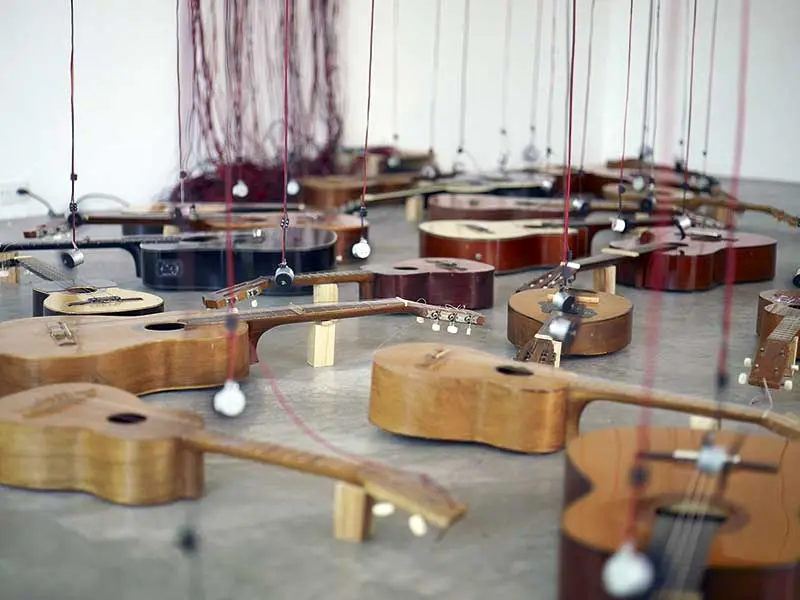
Placed on the floor of the gallery, the instruments constituted the visual element of the installation. An impeccable computer-generated work of sound engineering was programmed by the artist to follow a certain order and to modulate the timing of the sound emitted by each of the instruments. In turn, these sounds were enabled by the actions of motorized guitar picks hanging from nylon strings above each instrument. At first, it appeared as if the sound were the result of random action as if the initial sway of the picks were part of chance. But although this may be possible, it was not entirely so.
A specialist in electroacoustic composition and sound design and a graduate of the Bauhaus Universität Weimar, in Germany, Ruben D’hers does not surrender his work to chance. The instruments are pre-tuned at the time of the installation and are placed in specific locations so that each sound has a distinctive density and a different emphasis according to its place in the space. While it is possible that air could affect the undulating movement of the nylon and picks, the sound set is part of an impeccable structure streamlined through technology. While viewers are actually able to distinguish isolated and autonomous sounds—and even the sound effects of instruments not present like the violin—they can also hear a cohesive and absolutely harmonious sound set. It is precisely the concept of harmony, so important in music, that prevails in this sound proposal. D’Hers achieves this by performing music without directly playing the instruments. His process is purely conceptual in nature; it is an exercise designed to prevent the supposed “tactile playing” of the instrument through the use of programming tools.
The result is the attainment of a delicately harmonious sound environment. The exhibition room becomes a “suspended” space for sensory enjoyment, an experience that is completely removed from the chaos and anarchy ensuing from any detuning or any dissonant arrangement. Quite the contrary. As the musician that he is, D’Hers cares that the simultaneous combination of several sounds yields a harmonious result. According to the artist “Each one [of the instruments] is programmed with a different chord. By activating the mechanical system all of them sound in unison and let listeners judge whether a harmonious melody reaches their ears!”
On the other hand, listeners can also simultaneously distinguish isolated sounds. But this depends on the listener’s location in the space, the direction that he or she is facing, and the distance between him or her and any given instrument. These can also be defined by the temporal patterns previously programmed by the artist. There are instruments that are activated before or after others, and there are times when all sounds occur simultaneously. This confers a very unique polyphonic quality to the work precisely because of the perceived “orchestral” moments that in actuality do not exist. This is one of the beautiful virtues of a sound installation like Quebrada Escondida.
Ruben D’Hers studied art in Caracas and then electroacoustic composition in Berlin. He was co-founder and guitarist of the jazz-rock band kRé until 2007. Since then he develops solo projects in which he experiments with sounds generated from stringed instruments. He currently explores the creation of sounds in specific areas, something that Canadian composer Robin Minard, author of the exhibition’s presentation text, calls “sound spaces.”
SUSANA BENKO