
Despite a childhood in Colombia and many years spent in Europe, Ruven Afanador did not attend a flamenco performance until he was an adult living in New York City. Prior to this experience, flamenco existed for him only as something mythic and imagined. After attending his first performance Afanador created a major photographic exploration of this theme, resulting in his book Mil Besos (2009), which largely explored the phenomenon of flamenco from a female perspective. Five years later Afanador has revisited this territory, this time engaging male dances, in a new collection and book titled Angel Gitano: The Men of Flamenco, on view at Throckmorton Fine Art from November 6, 2014, to February 28, 2015.
Flamenco is a rich subject for a photographer such as Afanador, one that is rife with complexities and contradictions. It is a form of cultural expression that suggests passion, emotion, and the earthy spontaneity of a peasant-born folk tradition. However, it is also a time-honored form of dance with its own vocabulary and traditions that can be as exacting and hidebound as to compare with any other more “academic” type of dance, and in the wrong hands can appear to be almost formulaic. Flamenco is a dance form that seems to reinforce the hard boundaries of conventional male and female roles, yet it is also replete with androgynous elements: the women who are often big and strong with powerful and commanding voices, the men who exude a sensuality aided by their tight, high-waisted pants that flair at the bottoms and their shoes with (moderately) high heels, and the use of melodrama, glamour, and excessive makeup that can so easily be parodied by drag performers.
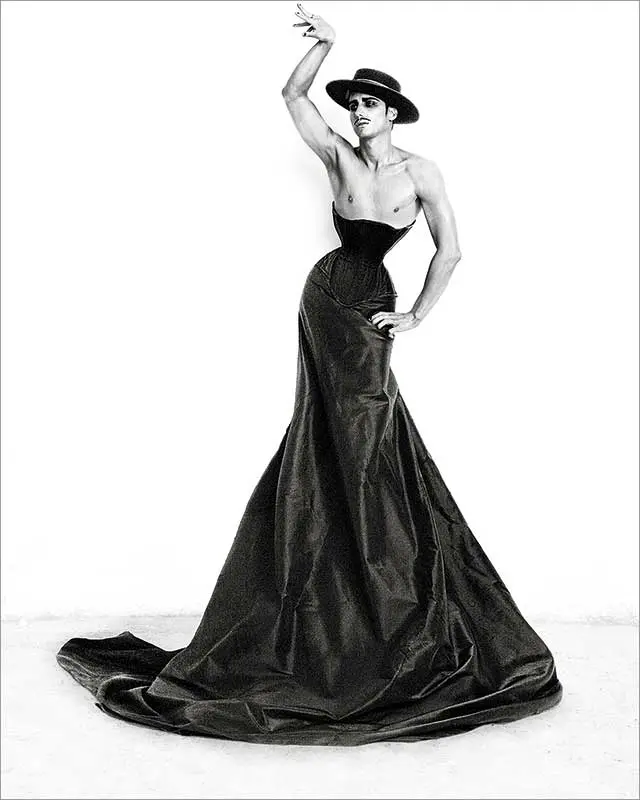
Afanador expresses these variations in his photographs. Shot in the desert in a black and white so severe in its high contrast that one could almost forget what an exuberant colorist the artist can be. The stark matter-of-factness of these works is belied not only by the choreographed poses and artful compositions, but also by the deployment of wigs, false mustaches, and other theatrical effects that evoke Fellini in their neo-realist grounding that gives way to a flamboyant surreality. One sees such qualities in images such as the portrait of Juanma Zurano Palacios, with its giant grotesque head offsetting the lithe body underneath, or the image of Mariano Bernal Montero and Jose Manuel Alvarez Conde, which actually reads like a film still from some neorealist treasure.
Angel Gitano has been described as a companion work or bookend to Mil Besos, and of course, the pairing is obvious. However, another of Afanador’s collections should also be considered, his 2004 book Sombras. This book is a highly stylized exploration of the male body in a very fanciful and homoerotic manner, and Angel Gitano seems in many ways to be an amalgamation of these two prior books. This is apparent when one regards two different images of Daniel Rodriguez, “Alma”. In one, the dancer is clothed in a long black ruffled skirt, a black lace face mask that extends upwards, and ornate nipple covers. In the other, he is garbed in a beaded white bikini thong, heeled dance shoes, nipple covers, and nothing else. In both pictures his face is obscured, leaving a dramatically posed body in a frozen suggestion of potential movement, undeniably male and yet willing to play with affectations of masculinity and femininity.
Such dualities appear in other ways. In various works, Afanador sets up contrasts between youth and old age, corpulence and physical perfection, direct immediacy, and contrived theatricality. Angel Gitano is therefore far more than a collection of portraits of men dancers; Afanador has assembled a rich and generous body of work that borrows from one world and transforms itself into another entirely of the artist’s making, reminding us that some traditions are rich enough for reconsideration and all traditions are occasionally in need of renewal.
RICHARD LESLIE