
The exhibition A Chronicle of Interventions was open for visits in the period between October 9, 2014, and February 22, 2015, in San Jose, Costa Rica, in the already traditional TEOR/éTica space, curated by Inti Guerrero (formerly TEOR/éTica’s artistic director) and Shoair Mavlian, assistant curator at Tate Modern. It was the Costa Rican stop of an exhibition previously presented at Tate Modern’s “Project Space,” devoted to exchanges between the British institution, young curators, and artists coming from geographical areas underrepresented in the museum’s collection and exhibitions. Not only Costa Rica (or, given the selection of artists for the show, “Central America”) took part in this project, but also other places such as Serbia, India, Nigeria, Mexico, and Jordan.
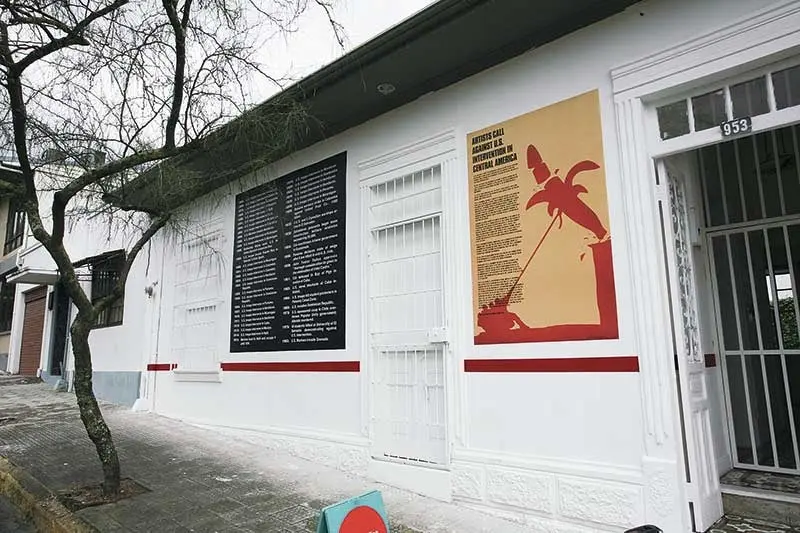
And, where does the exhibition title come from? It is a reference to a work presented in 1984—in other words, thirty years before the opening of the current exhibition—by the New York-based Group Material. Organized in 1979 and intent on creating art with collectively wrought social content, the group presented, as part of a proposal by a different collective (the Artist’s Call Against US Intervention in Central America), artwork focused on US intervention in Central and Latin America as a whole. Titled Timeline: A Chronicle of US Intervention in Central and Latin America, and brought back for this curatorship on the basis of contacts with members of the two groups (Artist’s Call and Group Material), part of it was shared with visitors on the façade of one of TEOR/éTica’s buildings. Next to the image of what appeared to be a monumental banana against a yellow background, interrupted by a group via the strength of a rope, a reference to military interventions in the tropics, there was a chronological of US interventions in different Latin American territories, a story that began with colonization, in 1823, up to events much closer to its first publication, in 1983.
As the curatorial text asserts, this exhibition starts with the selection of images provided by the two artists’ groups, latent in New York in the 1980s, and generates a bridge with younger generations in their reflections about continued political and symbolic interventions by Central America’s northern neighbors. With this perspective in mind, it is important to remember the long history of the TEOR/éTica space, the creation of critic and curator Virginia Pérez-Ratton, which opened to the public as an independent space in 1999, also with regards to the artistic and intellectual production of the “Central American” geographical space. I believe that this exhibition will prompt thinking about the relationship between art, image, and geography, as in the title of one of Pérez-Ratton’s articles: “What region? Pointing Towards a Doubtful Strait.”1
This avenue of interpretation appears even more clearly when we look at the geographic origins of the artists selected for Una crónica de intervenciones, José Castrellón and Humberto Vélez are from Panama, while Regina Galindo and Naufus Ramírez-Figueroa come from Guatemala. Also representing “Central America” is an artist from Costa Rica, Óscar Figueroa. Contributing to the “doubtful” character of the Central American region, artists like New Zealand’s Michael Stevenson and Germany’s Andreas Siekmann are important in helping us think about a local identity on the basis of a geographically broad point of view. To what degree is it necessary for the artist to belong geographically and in terms of identity in order to reflect and create images about cultures that are not his or her own? Just like Group Material demonstrated a concern for Central American political issues not only of Latin American artists living in the United States but of figures such as Keith Haring, does it still make sense to make claims centered on “local artists” at a point in history that is so interconnected, by virtual means and long-distance communications?
Already at the entrance of the exhibition space, audiences encountered a series of newspaper clippings, pamphlets, and graphic materials from another Group Material project: Luchar! An Exhibition for the People of Central America, from 1982 and also held in New York. As the press release for the TEOR/éTica exhibition puts it: “The purpose of the show is two-fold: 1. To form a broad cultural statement concerning the current situation in Central American countries, and 2. To support and substantiate the culture of Central America and its artists in exile.” Thirty years later and at a time when guerillas are no longer an issue in Central American countries, other armed conflicts take place every day in those territories, so that the struggle continues but from a different political and artistic standpoint.
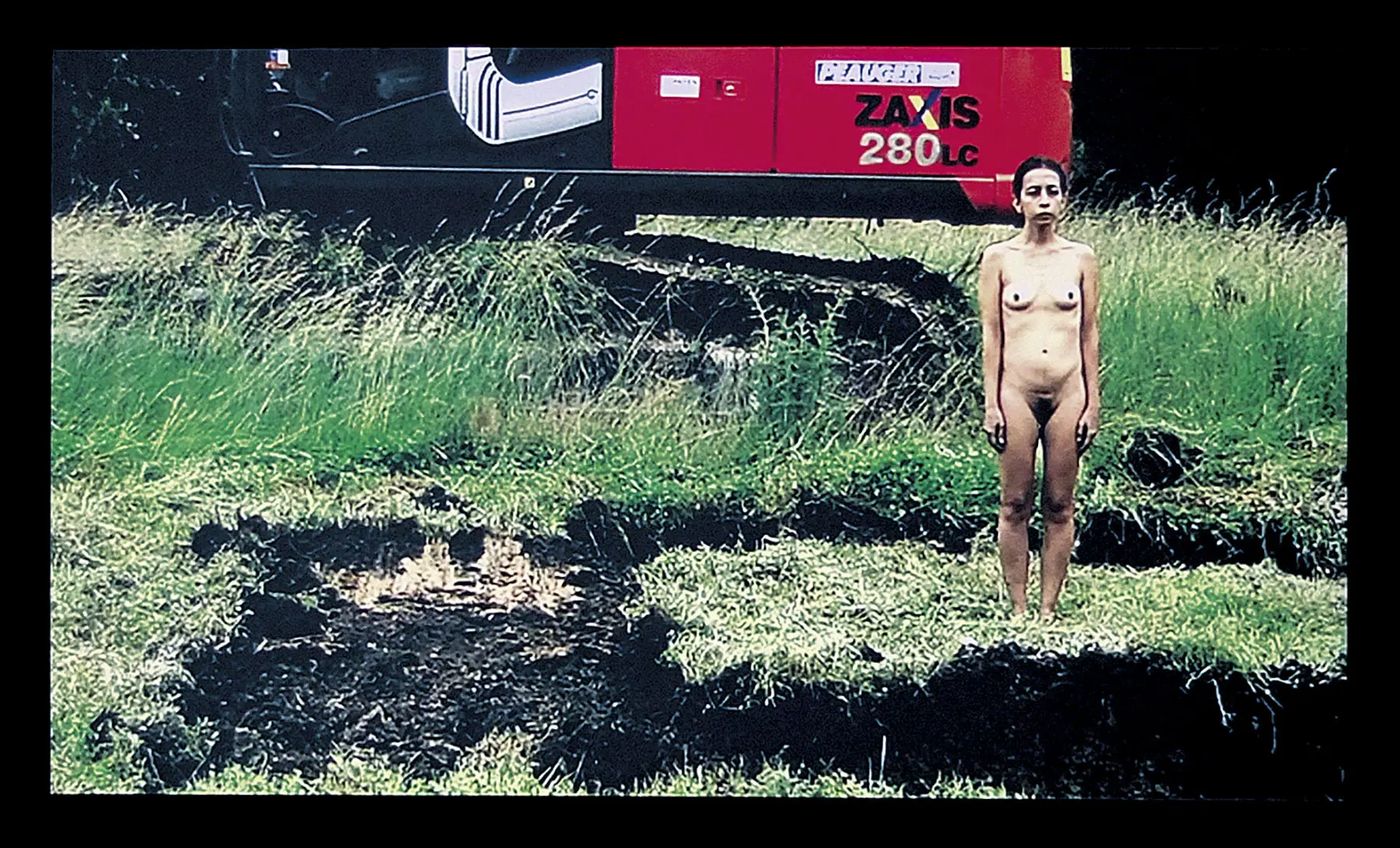
In that sense, it is interesting to have in this exhibition works that involve video and the presence of the body of artists coming from the same place, Guatemala, but who approach political issues in very different ways: In Tierra, from 2013, Regina José Galindo remains static and nude at the center of video composition. Moving around her is a backhoe, which digs a series of holes in the surroundings and gradually transforms the ground on which the artist lays with her eyes closed, in a kind of altarpiece. As the artist says on her website, this is a critique of genocide and the way in which the Guatemalan army built mass graves for its victims during the war.
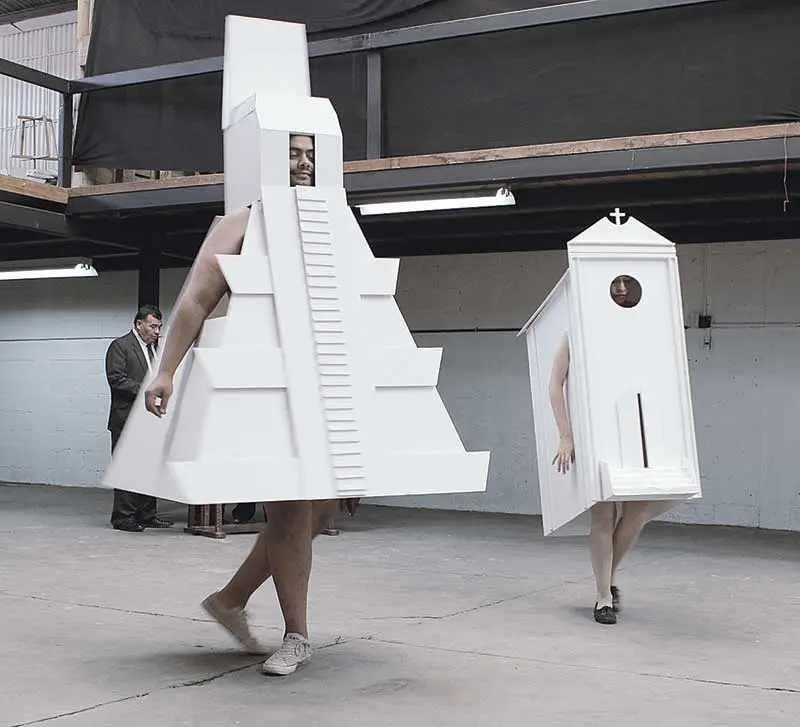
Close to Galindo’s monumental visual register was another video, by Naufus Ramírez Figueroa: Una breve historia de la arquitectura, un espectáculo dadaísta, from 2010. The body of the artist appears clad in a suit resembling a Maya pyramid, while the other two youths in the video are dressed like Christian colonial architecture and a Modernist building. In this way architecture becomes body, and dances to the rhythm of an instrument commonly seen as iconic of the Guatemalan culture: the marimba. On the basis of this dance, which can cause laughter, the artist reflects acidly on the relationship between power, landscape, architecture, and popular culture in Guatemala. Through the clash between those bodies, the costumes of a Dada carnival become ruins and are abandoned on the ground, just like indigenous cultures were decimated by the Spanish presence in the territory.
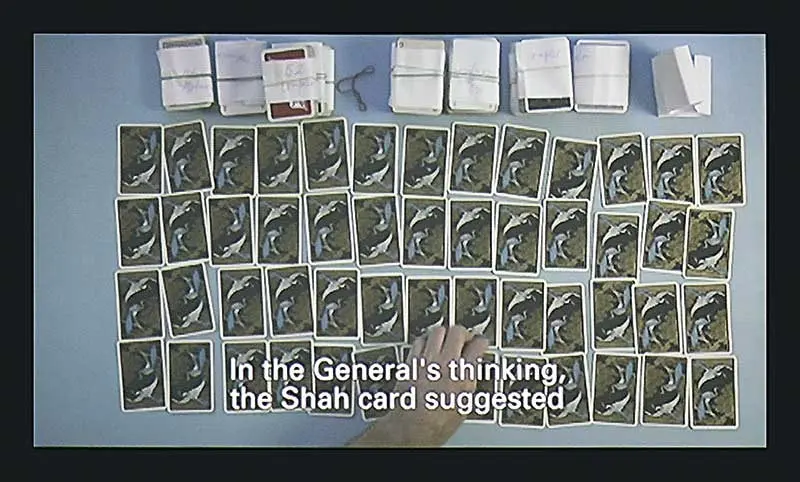
These examples introduce two artists from different generations who create images with reflections about politics and violence, via contrasting literary genres (to return to the idea of a “chronicle” in the exhibition’s title. Starting with this observation, I believe that, more than a curatorship around a chronicle of various interventions, it would be interesting to think of a range of chroniclers with multifaceted languages. However significant the presence of video is (only the works by Andreas Siekmann and Group Material are not audiovisual)—which speaks of a relationship between the moving image and the documentary that observes everyday events (video as a chronicle)—the desires of the artist’s gathered are, luckily, discrepant.
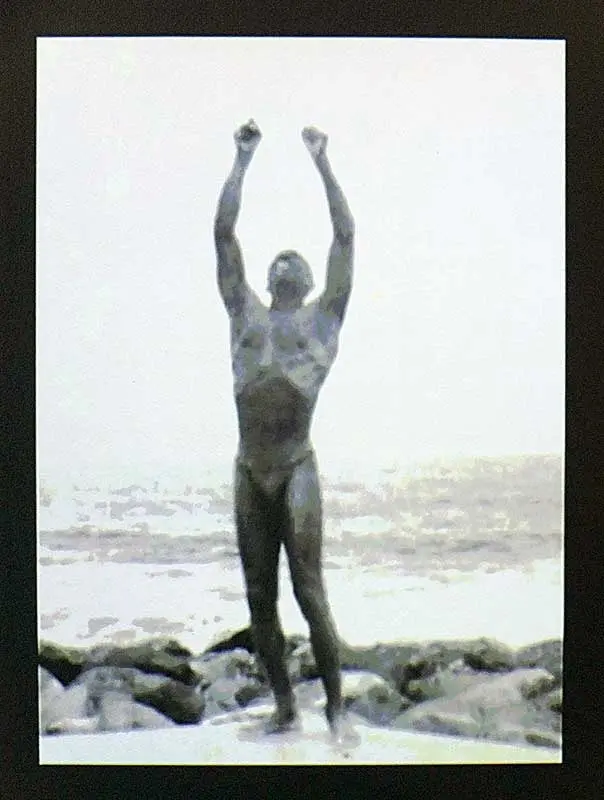
Where Óscar Figueroa uses video to record their action his in the middle of the street, at a fence prohibiting transit to black workers—thus questioning the image of Costa Rica’s “whiteness,” the self-described “Switzerland of the Americas”—an artist like Humberto Vélez carries out a register of negritude but with clearly different narrative intent. Filming a black bodybuilder showing his muscles to the super-8 camera in front of the Panama Canal, Vélez revisits the black and Caribbean immigration that was essential for the construction of the Canal by the US government. Today, what is the place of blacks in a certain hegemonic image of Panama?
José Castrellón is interested in postcards in motion and capturing the tropical beauty of a Panamanian island. The sound, however, is key here, and it diverges from the image—we hear a heavy metal singer. Here, interventions are on the basis of a recording of local traditions; direct political interventions like those of Group Material in the 1980s are dissipated, and a passion for heavy rock music enters the bodies, the homes, the islands, and the photographs of indigenous individuals.
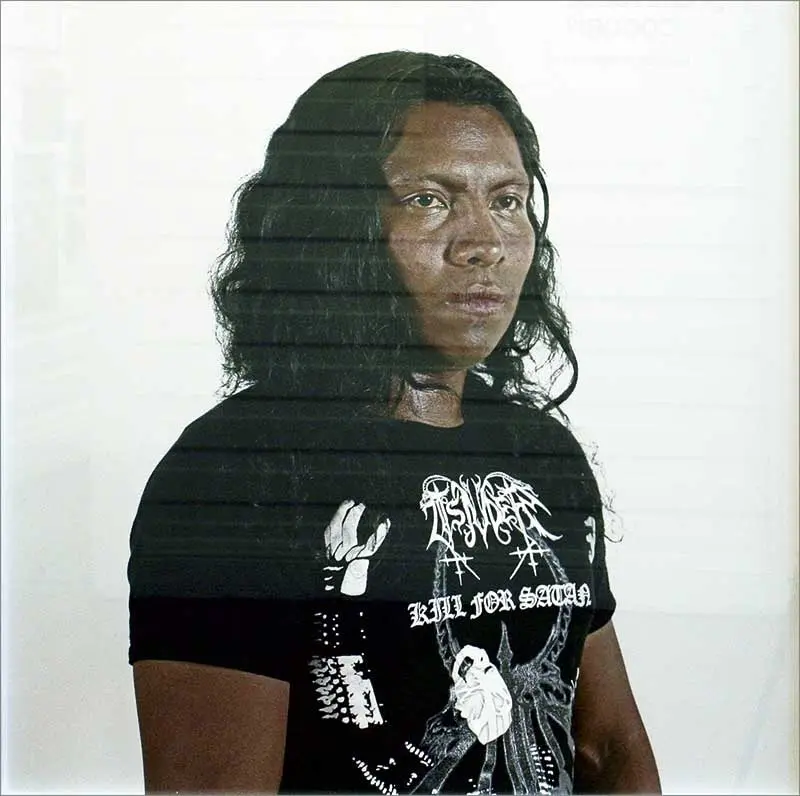
Although this exhibition was held three decades after Group Material’s desires, it seems to make sense to return to the words in the press release for Luchar! And to understand that this curatorship also achieves an interesting cultural affirmation about the artistic and political situation in what is known as Central America. It is up to the audience (specialized or not) to reflect on this selection of works and to wonder: for whom do these vocalists of the “Panamanian heavy metal” scream? To what degree do those geographical predicates contribute to a reading of art objects and visual culture?
As we said before, the struggle continues, but does it make sense to polarize it between the US on the one side and “Central America on the other? These are some of the important questions that the chronicles and interventions in this exhibition pose for the viewer.
NOTE
1. Pérez-Ratton, Virginia. “¿Qué region? Apuntando
hacia un estrecho dudoso, in Del estrecho dudoso a un
Caribe invisible – apuntes sobre arte centroamericano.
Valencia: Universitat de Valencia, 2013, pages 33-62.
RAPHAEL FONSECA